
Intelligent Trademark Analysis: Decoding Legal Vagueness with Large-Scale AI
Experiments in Large-Scale Evaluation of Real-World Legal AI
This paper introduces the Onomatics intelligent trademark analysis system, a large-scale AI platform for evaluating "likelihood of confusion" in trademark law. By combining linguistic analysis, fuzzy logic, and machine learning, the system achieves SOTA performance with 79.9% precision and 94.9% recall across over 55,000 real-world legal cases.
TL;DR
Legal reasoning is often defined by "vagueness"—the grey area where rules alone cannot provide a definitive answer. This paper presents the Onomatics system, a production-ready AI platform that tackles the "likelihood of confusion" in trademark law. By processing over 55,000 actual legal cases from the USPTO and OHIM, the system achieves an impressive 94.9% recall, bridging the gap between abstract legal theory and commercial-scale risk analysis.
Problem & Motivation: The Penumbra of Vagueness
In trademark law, the core question is almost always: Is Mark A similar enough to Mark B to cause consumer confusion?
Traditional AI & Law approaches, such as Begriffsjurisprudenz (jurisprudence of concepts), failed because they tried to model law as rigid production logic. However, real-world law operates in what legal theorist H.L.A. Hart called the "penumbra"—a zone of semantic uncertainty.
The authors identified two major flaws in prior "Intelligent" Trademark systems:
- The Product Blind Spot: Most systems only look at the text of the mark, ignoring the "Goods and Services" description, which is legally half the battle.
- Coarsec Classification: Relying on the 45 "Nice Classes" is too broad. Two products in the same class (e.g., "Chemicals") might be totally unrelated in a legal dispute.
Methodology: The Three-Pillar Architecture
The Onomatics system evolves from the MOSONG prototype, moving from a user-dependent expert system to a standalone SaaS platform. Its architecture follows a sophisticated pipeline:
1. Multi-Stage Retrieval
Processing the entire USPTO database is computationally expensive. The system uses a proprietary data structure to perform a "gross similarity" sweep using Levenshtein edit distance to narrow the field.
2. Deep Linguistic Modeling
For the shortlisted candidates, the AI performs a deep dive across:
- Phonology: Do the marks sound similar?
- Morphosyntax: Are the structures related?
- Semantics: Do they share the same underlying meaning?
3. Granular Product Similarity
This is the system's "secret sauce." Instead of relying on category codes, it uses Machine Learning and DBpedia-enriched structured data to analyze the actual descriptions of goods.
 Figure 1: The transition from legal prototype to the Onomatics commercial engine.
Experiments & Results: Real-World Combat Training
Evaluating Legal AI is notoriously difficult because there is no single "ground truth." However, the authors utilized a massive dataset of 55,435 opposition cases from the USPTO (US) and OHIM (EU).
Performance Metrics
The system's ability to predict whether an opposition would be successful was measured. The results are remarkably stable across decades of legal data:
| Region | Count (n) | Precision | Recall | F-score |
|---|---|---|---|---|
| EU Total | 21,662 | 79.2% | 97.3% | 87.3% |
| US Total | 33,773 | 80.4% | 93.3% | 86.4% |
| Grand Total | 55,435 | 79.9% | 94.9% | 86.7% |
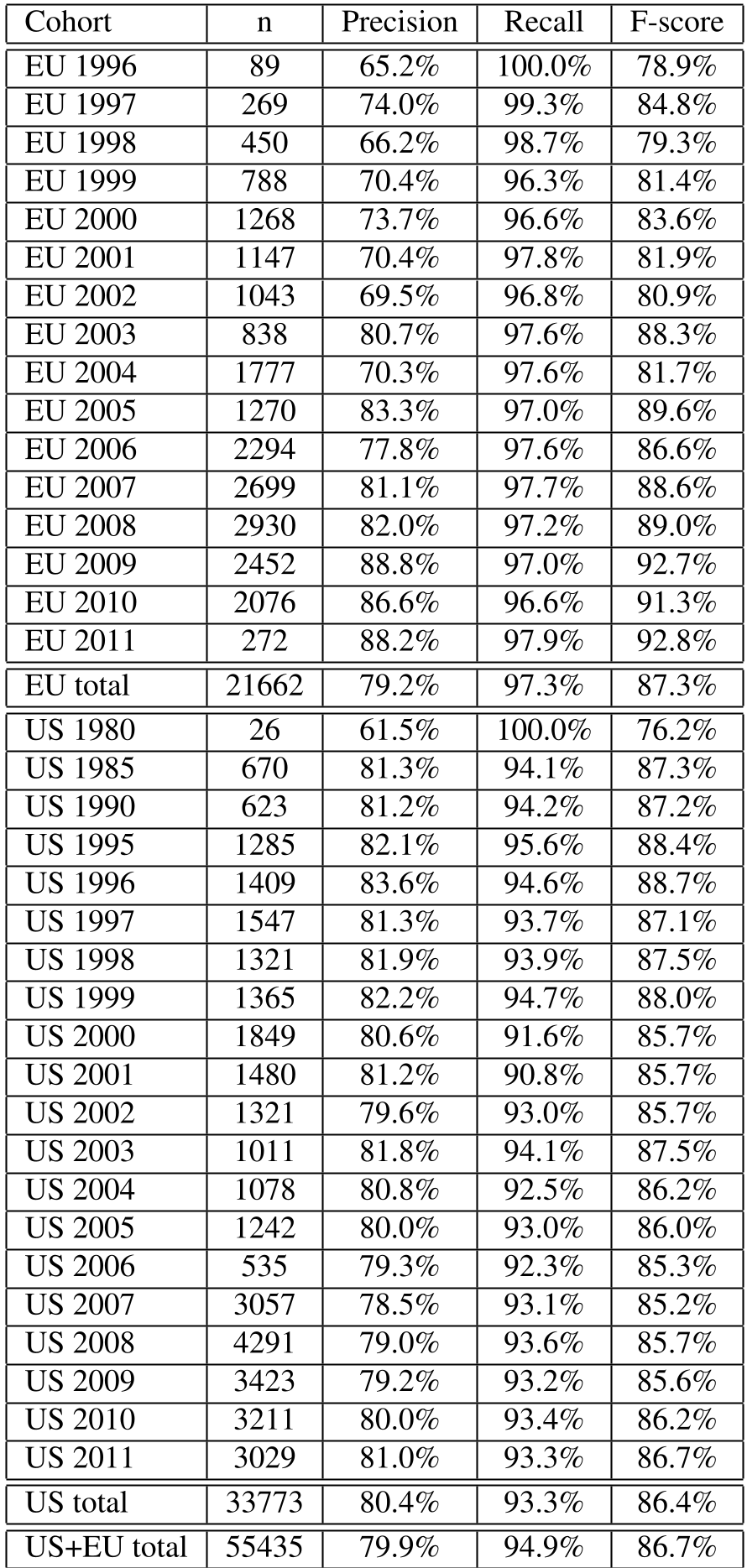 Table 1: Systematic evaluation against historical opposition data.
Key insights from the data:
- Consistency: The system correctly predicted the legal outcome in over 93% of cases (Correct Decision metric).
- Efficiency: Average query times for the EU database are ~0.8s, making it viable for interactive "NameRank" applications where users test multiple candidates in real-time.
Deep Insight: Beyond Just "Search"
What makes this system a "Legal AI" rather than just a "Search Engine"?
The difference lies in the Modeling of Risk. The NameCheck application doesn't just list matches; it calculates an "Aggressivity Score" for trademark owners based on their past litigation behavior and uses dictionary-based checks to avoid foreign-language obscenities or descriptive refusals.
Limitations & Future Work
- Word Marks Only: Built primarily for text, though the modular algorithm allows for future figurative (image) similarity plugins.
- Noise in Data: Legal outcomes are sometimes decided on procedural technicalities (lack of evidence) rather than similarity, which introduces noise into the AI's training set.
Conclusion
The Onomatics system demonstrates that AI can do more than just follow rules—it can simulate the "expert intuition" of a trademark attorney. By tackling the vagueness of language and the complexity of product markets, this work signals a shift where intelligent legal tech moves out of the laboratory and into the global marketplace.