
Unveiling K5YSi4O12: A High-Conductivity, Metally-Stable Electrolyte for Potassium-Ion Batteries
Large-scale simulation unveiled superior potassium-based solid electrolyte with high ionic conductivity and excellent electrochemical stability in <mml:math xmlns:mml="http://www.w3.org/1998/Math/MathML" display="inline"><mml:mi>M</mml:mi></mml:math><mml:math xmlns:mml="http://www.w3.org/1998/Math/MathML" display="inline"><mml:msub><mml:mi/><mml:mn>5</mml:mn></mml:msub></mml:math>YSi<mml:math xmlns:mml="http://www.w3.org/1998/Math/MathML" display="inline"><mml:msub><mml:mi/><mml:mn>4</mml:mn></mml:msub></mml:math>O<mml:math xmlns:mml="http://www.w3.org/1998/Math/MathML" display="inline"><mml:msub><mml:mi/><mml:mn>12</mml:mn></mml:msub></mml:math> (<mml:math xmlns:mml="http://www.w3.org/1998/Math/MathML" display="inline"><mml:mi>M</mml:mi></mml:math> = Li, K)
The study identifies K5YSi4O12 as a superior solid electrolyte for potassium-ion batteries, using first-principles calculations and large-scale Machine-Learning Molecular Dynamics (MLP-MD). It achieves a high room-temperature ionic conductivity of 3.63 mS/cm and demonstrates intrinsic electrochemical stability against potassium metal anodes.
Executive Summary
TL;DR: Researchers have discovered that K5YSi4O12 is a rare "double-threat" in the solid-state battery world—offering both high ionic conductivity (>3 mS/cm) and intrinsic stability against metal anodes. By leveraging machine-learning-accelerated molecular dynamics, the study also reveals a cautionary tale: standard small-scale simulations can drastically overestimate performance due to limited diffusion events.
Background: Within the Na5YSi4O12 (N5-type) family, this research transitions from sodium to lithium and potassium analogs. While Li-substitution fails due to instability, K-substitution creates a high-performance SSE that positions K-ion batteries as a viable, low-cost alternative to Li-ion systems.
Problem & Motivation: The Stability-Conductivity Paradox
The development of All-Solid-State Batteries (ASSBs) is often hindered by a persistent trade-off. Sulfide electrolytes reach liquid-like conductivities but react violently with metal anodes. Oxide electrolytes are robust but "slow," often requiring high temperatures to function.
The authors targeted the N5-type silicate framework because of its unique 3D structure featuring open channels. They asked a fundamental question: Can we substitute the Na+ ions with K+ or Li+ to create a stable, fast-conducting electrolyte? The intuition was that the large void spaces in N5-type structures might accommodate the larger K+ ion, potentially lowering the migration barrier.
Methodology: The Power of Scale
To model these materials, the team moved beyond traditional Ab Initio Molecular Dynamics (AIMD). AIMD is typically restricted to ~100 atoms, which the authors proved is insufficient for potassium conductors. They trained Machine Learning Potentials (MLPs) using an Attention Coupled Neural Network (ACNN).
Architecture and Channels
The framework consists of octahedra and tetrahedra. The units form rings that stack into columns, creating massive longitudinal channels.
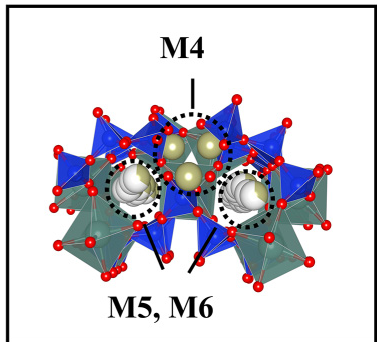 Fig 1. (a) Crystal structure of M5YSi4O12, highlighting the ring stack (b) and the interconnected open channels (c).
The methodology revealed a critical Size Effect: In K5YSi4O12, ionic conductivity dropped from an "illusory" 57 mS/cm in a 132-atom cell to a realistic 3.63 mS/cm in a 132,000-atom cell. This proves that capturing enough "hopping events" requires massive spatial scales.
Experiments & Results: Potassium Wins
The team compared the Li, Na, and K variants across thermodynamics, electronics, and kinetics.
- Phase Stability: K5YSi4O12 is thermodynamically stable (), whereas Li5YSi4O12 is metastable and prone to reduction by the anode.
- Electrochemical Window: K5YSi4O12 remains stable down to 0 V vs K/K+, meaning it can touch a potassium metal anode without forming a resistive interphase.
- Diffusion Patterns:
- Li+: Diffuses in 3D but is hindered by high barriers (1303 meV in channels).
- K+: Exhibits "fast-lane" 1D diffusion along channels with an incredibly low barrier of 157 meV.
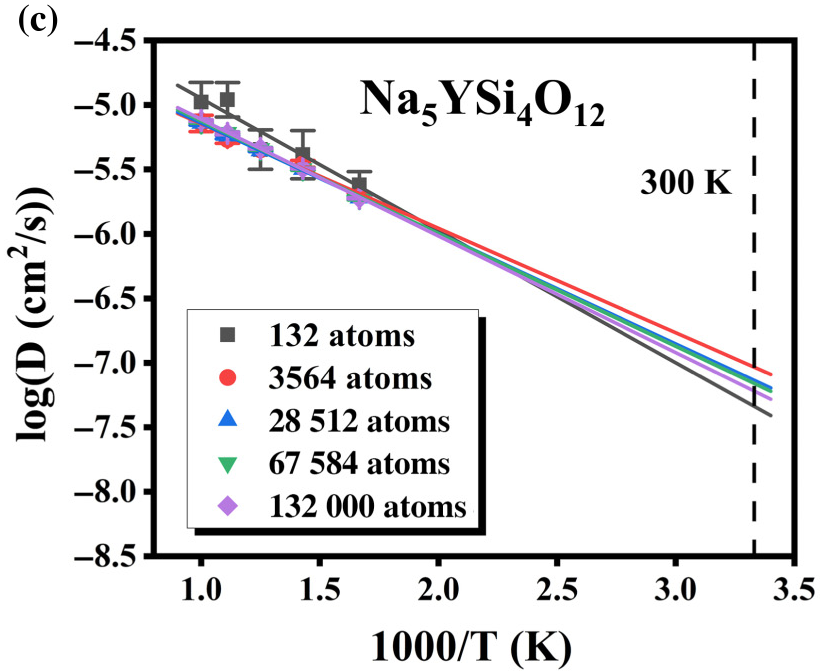 Fig 2. Arrhenius plots showing the convergence of diffusivity as simulation cell size increases.
Why it Works: The "Hopping Length" Insight
A key takeaway from the study is the correlation between hopping distance and conductivity. Even though Li+ can move in more directions (3D), it is "cramped" in the smaller Li-framework. Potassium ions, benefited by the lattice expansion of K-substitution, have a longer hopping distance and lower activation energy, making every "jump" more effective for charge transport.
Critical Analysis & Conclusion
Takeaway
K5YSi4O12 is a premier candidate for potassium-based SSEs, outperforming most known polyanionic K-conductors. Its intrinsic stability against K-metal is its strongest selling point for high-energy-density designs.
Limitations
The study is purely theoretical. While the authors propose a synthesis route via and , experimental validation of the "size effect" remains difficult. Furthermore, 1D diffusion in the K-variant makes the material sensitive to grain boundary alignment and defects which could block channels.
Future Work
The next step is experimental synthesis and testing K5YSi4O12 in a full cell. Additionally, investigating the effect of partial substitution (doping) to potentially turn the 1D potassium diffusion into a more robust 3D network could be a game-changer.