
USED Dataset: Pioneering Large-Scale Deep Learning for Social Event Detection
USED: a large-scale social event detection dataset
The paper introduces USED (University of Trento Social Event Detection), a large-scale benchmarking dataset containing 490,000 images across 14 social event categories. By leveraging Convolutional Neural Networks (CNNs), the authors demonstrate that high-volume, balanced data can significantly overcome the limitations of traditional handcrafted features in image-based event discovery.
TL;DR
Recognizing a "Concert" or a "Wedding" from a single photograph is trivial for humans but notoriously difficult for machines. The USED (University of Trento Social Event Detection) dataset bridges this gap by providing 490,000 annotated images. This paper proves that by moving away from handcrafted SURF features and toward large-scale CNN fine-tuning, we can achieve a 32.7% absolute performance gain in event classification.
Problem & Motivation: The "Data Hunger" of Neural Networks
Before 2016, the multimedia community struggled with a fundamental bottleneck. While Deep Learning was revolutionizing object recognition (e.g., ImageNet), social event detection remained stuck in the era of Support Vector Machines (SVMs) and Bag-of-Words (BoW) models.
The reason? Existing datasets like EiMM (approx. 32k images) and SED were simply too small or too imbalanced to train deep Convolutional Neural Networks (CNNs). Without robust data, models couldn't learn to distinguish between visually similar backgrounds—like the "Stage" at a conference versus a concert. The authors realized that to unlock the power of CNNs, they first had to build a dataset that captured the "infinite variety" of human social gatherings.
Methodology: Building the USED Framework
The researchers curated 14 categories (Concert, Graduation, Wedding, Protests, etc.) with a specific focus on Balance and Diversity.
- Collection: They pulled 35,000 images per class from Flickr, manually removing outliers to ensure high-quality ground truth.
- Architecture: They utilized an 8-layer CNN (based on the AlexNet paradigm) consisting of 5 convolutional layers and 3 fully connected layers.
- Transfer Learning: Recognizing that "low-level" features (edges/textures) are universal, they pre-trained on ImageNet and then fine-tuned the final layers on the USED dataset to capture event-specific semantics.
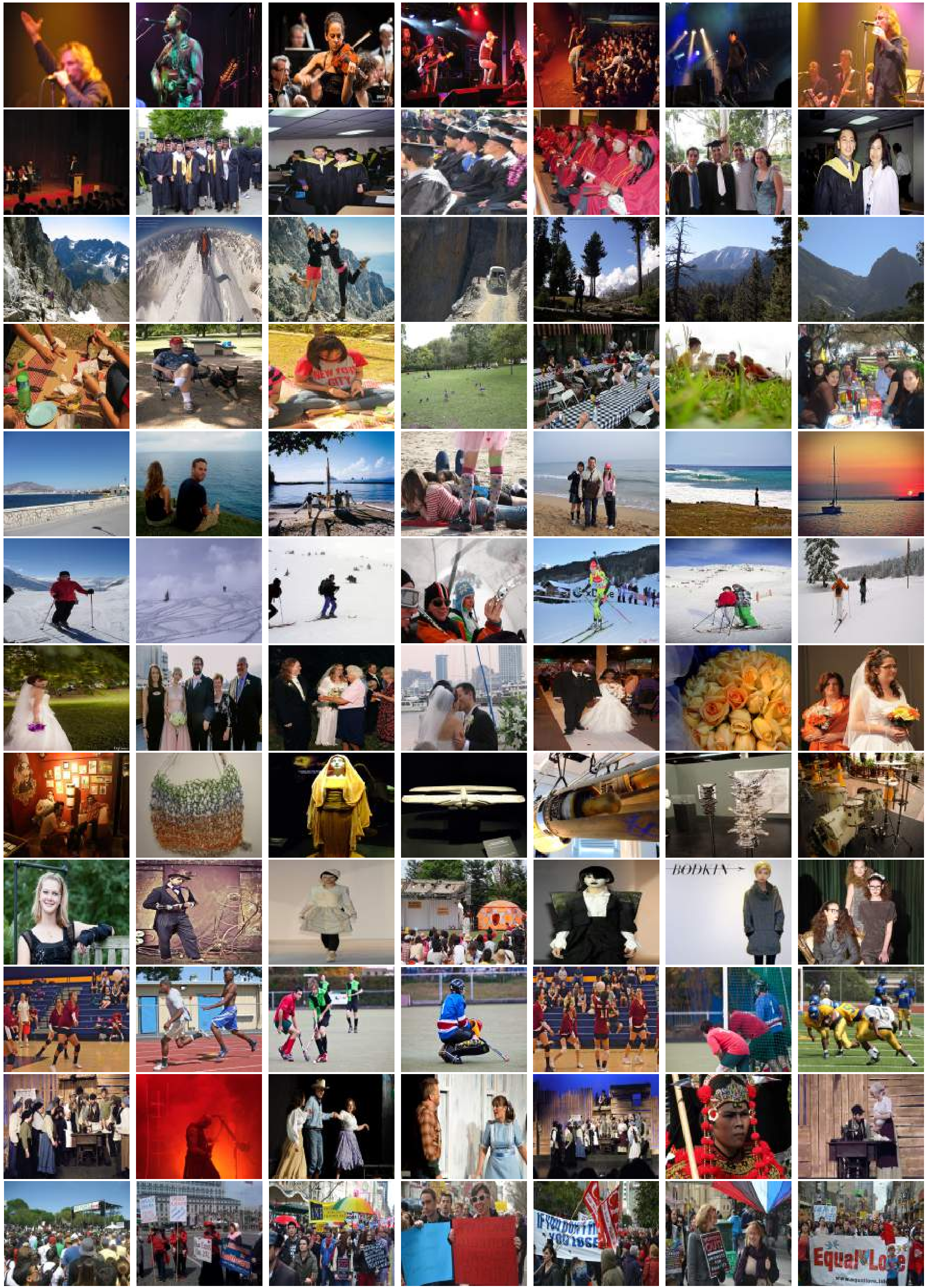 Visual diversity in the USED dataset, showing variations in lighting, subjects, and settings.
Experiments & The Performance Leap
The results were categorical. By training on a balanced, massive-scale dataset, the CNN reached an accuracy that made prior methods look obsolete.
- The SOTA Killer: When tested against a SURF-based baseline, the CNN-trained model achieved 71.54% accuracy compared to the baseline's 38.80%.
- Confusion Analysis: The authors noted that "Ski Holiday" often confuses with "Mountain Trip"—a logical error given the overlapping visual context of snowy peaks. However, for distinct events like "Concerts," the model reached over 90% accuracy in some test subsets.
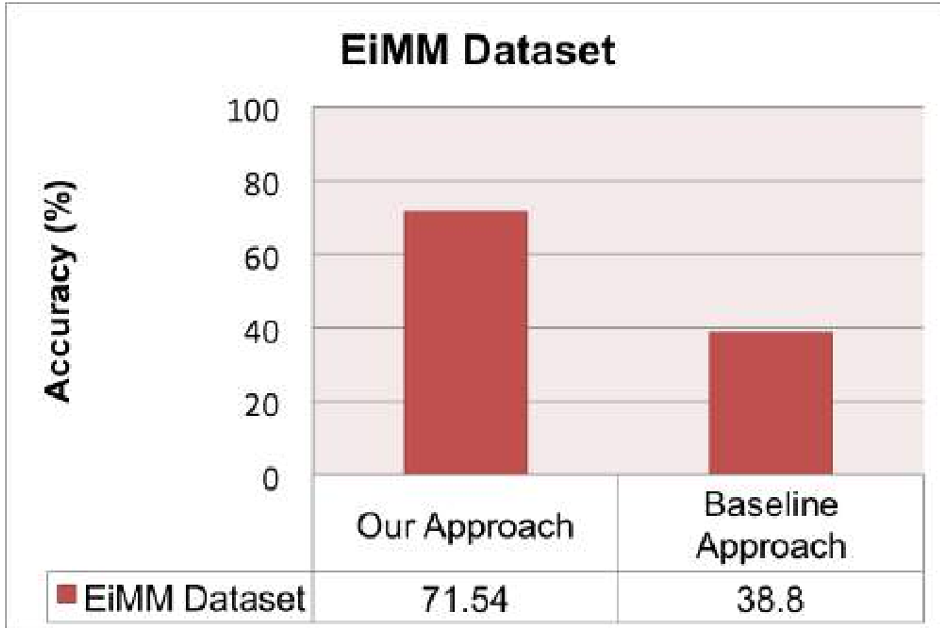 Figure: The dramatic 32.74% improvement in accuracy when switching from traditional features to USED-trained CNNs.
Critical Analysis & Conclusion
Takeaway
The USED dataset was a turning point for multimedia indexing. It shifted the research focus from "What features should we extract?" to "How can we best leverage massive datasets?" The paper effectively demonstrates that the Inductive Bias of a CNN is far superior to handcrafted descriptors when "Social Context" is the target.
Limitations
- Contextual Overlap: The model still struggles with fine-grained distinctions (e.g., Exhibition vs. Conference) where the visual background is nearly identical.
- Static Images: While single-image detection is useful, social events are inherently temporal. Using the USED dataset to initialize video-based models would be a natural next step.
Future Outlook
As we move toward 2026, the USED dataset remains a foundational benchmark for researchers exploring whether modern architectures (like Vision Transformers) can further reduce the "semantic gap" in social activity recognition.