
Scalable Twitmographics: Decoding the Global Zeitgeist through Metadata
Large-scale socio-demographic pattern discovery on microblog metadata
This paper presents a suite of improved hybrid algorithms for large-scale socio-demographic pattern discovery using Twitter metadata. By processing approximately 7.4 million messages, the authors demonstrate a scalable framework for inferring latent user attributes—gender, location, device usage, and activity metrics—achieving high accuracy and processing millions of records where prior works were limited to thousands.
TL;DR
Researchers at Monash University have developed a scalable framework for extracting socio-demographic insights from Twitter's vast metadata. By moving away from restrictive third-party APIs and implementing optimized hybrid algorithms, they successfully analyzed 7.4 million records, revealing patterns in gender distribution, global activity heatmaps, and distinguishing between human and bot behaviors.
Background: Beyond the Message
Twitter is more than a stream of 140-character (at the time of the study) thoughts; it is a rich repository of metadata. However, the academic community faced a "scalability wall." Earlier methods relied on expensive, rate-limited APIs or small, outdated datasets. This paper breaks that wall, proposing a "Twitmographics" approach that integrates user and message metadata at a multi-million-record scale.
The "Scalability Wall" and the Motivation
Why is this difficult?
- Dynamic Data: Usernames and locations are free-form and messy.
- API Bottlenecks: Services like Google Geocoding impose strict quotas and high costs.
- Diversity: The global expansion of users means 1990-era census data no longer suffices for gender or cultural analysis.
The authors' insight was to bring the data "in-house"—using longitudinal historical records and localized geographic shapefiles—to process data in parallel via cloud computing.
Methodology: The Four Pillars of Inference
1. Gender Detection (The Name Game)
Instead of simple 1990 Census data, the authors utilized 130 years of US Social Security Administration (SSA) data. By using hashtables for constant-time lookup, they achieved both high speed and the ability to recognize diverse names (e.g., Arabic, Chinese, Japanese) with nearly 87% accuracy.
2. Hybrid Geolocation
This is perhaps the most significant structural improvement. To avoid API limits, they used a two-pronged strategy:
- Geodict: Parsing free-form text for city/country nouns.
- Coordinate Reverse-Geolocation: Using a "hit test" against Natural Earth polygons using a Quadtree algorithm to quickly determine which country a latitude/longitude pair belongs to.

3. Device & Mobility Stereotyping
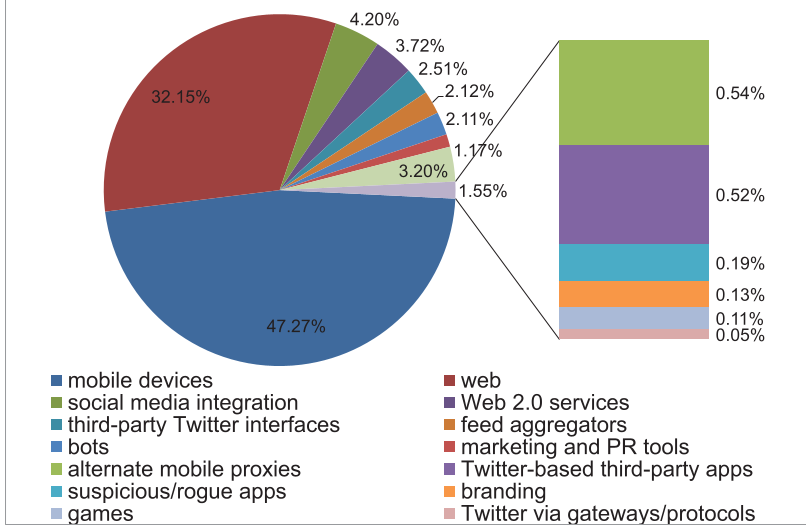
By analyzing "source" metadata (the app used to tweet), the researchers categorized users into 10 classes, such as "Mobile," "Bots," and "Marketing Tools." This provides a proxy for user mobility—showing that nearly 47% of users were mobile during the study period.
Results & The Bot Signature
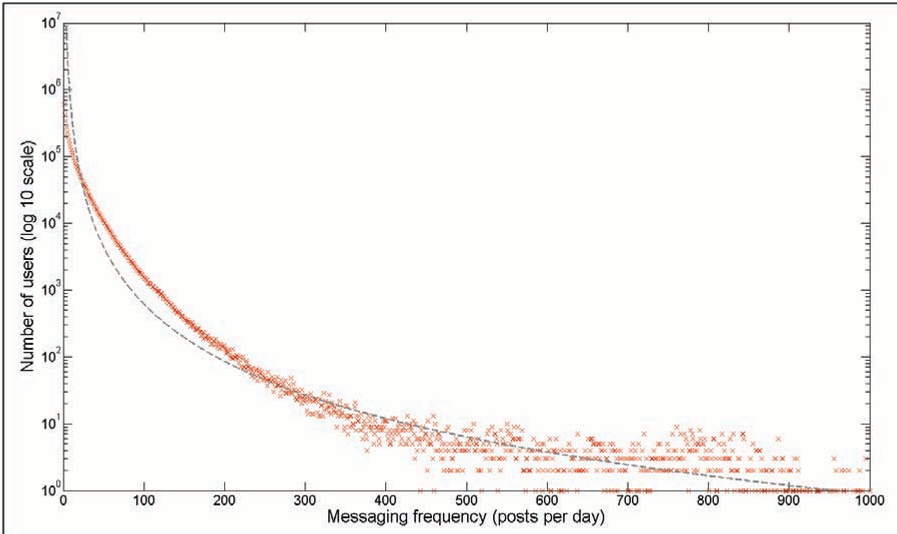
The researchers identified a fascinating divergence in user activity. While human messaging frequency generally follows a power law (most people tweet rarely), the "long tail" of high-frequency posters reveals a different story.
By normalizing messaging frequency (total status count divided by account age), they flagged accounts posting up to 5 times per minute. Manual inspection confirmed these were not human outliers but "Novelty Users" (e.g., automated weather updates) or "Spam Bots."
Critical Insight & Future Directions
The core takeaway is that metadata is a behavioral fingerprint. Even without looking at the text of a tweet, we can infer a user's gender, country, mobility, and whether they are even human.
Limitations: The study relies heavily on the "Name-to-Gender" link, which becomes less reliable as naming conventions evolve and "unassigned" names (the 38% in their study) remain a significant challenge.
The Future: As social media platforms become more restrictive with data access, the "locally hosted" algorithmic approach proposed here—leveraging open-source geographic and historical data—remains a gold standard for researchers seeking independence from corporate API whims.