
LASS: Beyond Common Interests—The Power of Local Activity in Mobile Social Networks
LASS: Local-Activity and Social-Similarity Based Data Forwarding in Mobile Social Networks
The paper proposes LASS (Local-Activity and Social-Similarity), a data forwarding scheme for Mobile Social Networks (MSNs) that integrates community structure with node activity levels. It introduces a self-adaptive weighted dynamic community detection algorithm (SAWD) to refine relay selection, outperforming SOTA protocols like BUBBLE RAP and Nguyen’s Routing.
TL;DR
In the world of Mobile Social Networks (MSNs), simply belonging to the same "club" as your destination isn't enough to make you a good data courier. The LASS (Local-Activity and Social-Similarity) protocol introduces a nuanced way to pick relays: it measures Local Activity—how active a node is within its specific communities. By calculating the inner product of activity vectors, LASS boosts delivery ratios by over 34% compared to traditional community-based methods while significantly cutting network overhead.
Problem & Motivation: The "Inactive Member" Trap
Most social-aware forwarding protocols (like BUBBLE RAP or Nguyen’s Routing) assume that if Node A and Node B share many interests or communities, they are likely to meet.
The Insight: Real-world social groups contain "lurkers" and "power users." As shown in the paper's rugby club example, even if two students are in the same club, one might attend every practice (high local activity) while the other rarely shows up. Traditional protocols treat them as equal relays. If a message is handed to the inactive member, it stagnates, leading to low delivery ratios and high latency. The challenge lies in identifying who is active where it matters.
Methodology: Precision Routing via Local Activity
LASS redefines the routing logic through three core components:
1. Local Activity ()
Instead of a global activity score, LASS calculates activity for node specifically within community . It is the ratio of 's internal encounter weights to the total weights within that community.
2. Forwarding Utility & Social Similarity
Each node maintains a Forwarding Utility vector , where each entry represents its local activity in a specific detected community. The similarity between a potential relay and a destination is the inner product of these vectors: This mathematical choice is brilliant: the inner product naturally rewards nodes that share multiple communities with the destination AND have high activity in those overlapping areas.
3. SAWD: Community Detection on the Fly
To support this, the authors developed SAWD (Self-Adaptive Weighted Dynamic community detection). Unlike static algorithms, SAWD handles "in-pool" (weight changes) and "out-pool" (nodes joining/leaving) dynamics, ensuring the social map is always up-to-date.
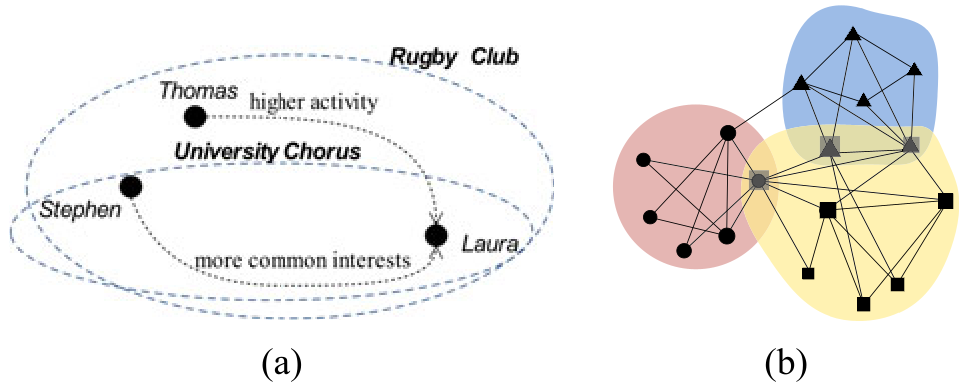 Figure 1: Comparison between interest-only forwarding (a) and LASS which considers activity levels (b).
Experiments & Results: SOTA Performance
Using the MIT Reality Mining dataset, the authors compared LASS against Epidemic, PROPHET, Simbet, BUBBLE RAP, and Nguyen’s Routing.
- Delivery Ratio: LASS reached a peak of ~66.74%. It outperformed the famous BUBBLE RAP by 46.18%. This proves that "Local Activity" is a much stronger predictor of encounter probability than global centrality.
- Overhead Control: Because LASS is highly selective about its relays, it avoids the "broadcast storm" of Epidemic routing. It achieved an overhead ratio of only 26.07%, roughly 41.7% better than Nguyen’s Routing.
- Efficiency: As Time-to-Live (TTL) increases, LASS becomes even more efficient, as its community detection algorithm converges on stable social patterns.
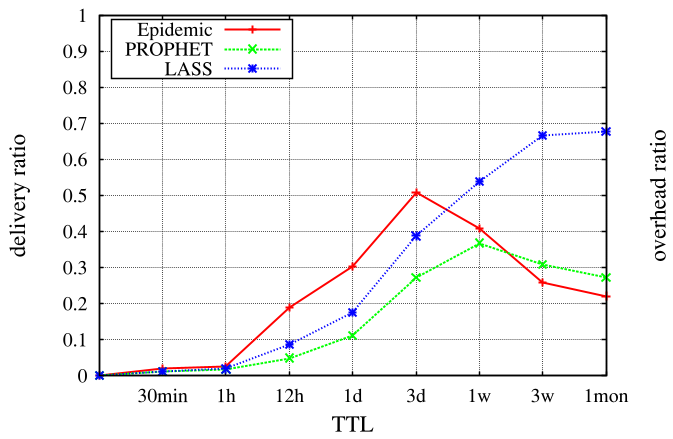 Figure 2: Delivery ratio and overhead ratio comparisons showing LASS (red line) consistently leading the pack.
Critical Analysis & Conclusion
Takeaway
The genius of LASS is shifting from connectivity (does an edge exist?) to intensity (how strong is the activity within a context?). By using vector inner products, it simplifies a complex social selection problem into a standard linear algebra operation that is easy for mobile devices to compute.
Limitations
- Cold Start: Like all history-based protocols, LASS needs an initial observation period (the paper used ~20 days of MIT traces) to build accurate community structures.
- Privacy: Maintaining "Forwarding Utility" vectors implies nodes know about their community memberships, which might raise privacy concerns in decentralized networks.
Future Outlook
LASS provides a framework for "Context-Aware" networking. Future work could extend this by adding "Temporal Activity" (when are you active?) to the vector, potentially solving the problem of periodic social routines in MSNs.