
EM-BIC: Mastering Latent Interest Groups in Decentralized Social Networks
Latent Interest-Group Discovery and Management by Peer-to-Peer Online Social Networks
This paper addresses the discovery and management of latent Interest Groups (IGs) in decentralized Peer-to-Peer (P2P) online social networks. It proposes an unsupervised, dynamic, online clustering framework utilizing a Bayesian Information Criterion (BIC) based Bernoulli mixture model to identify trending IGs and optimize anycast-query forwarding.
TL;DR
Researchers have developed a way to make P2P social networks as "smart" as Facebook without the privacy-invading central server. By using unsupervised clustering (EM-BIC) on local query caches, super-peers can "learn" what people are interested in and route queries to the right users across the network with minimal hops.
The "Small World" Privacy Dilemma
In the era of "Big Brother" social media, decentralized platforms like Diaspora offer a safe haven for privacy-conscious users. However, they suffer from a "discovery problem." In a centralized system, a server knows everyone's interests. In a P2P system, how do you find a group of people interested in Niche Retro Gaming if no central index exists?
Current methods rely on Random Walks (which are slow) or Exhaustive Cache Searching (which is computationally expensive). This paper addresses the gap by asking: Can a pod learn the global landscape of interests just by looking at the queries passing through it?
Methodology: The Intelligence in the Cache
The core innovation lies in treating query forwarding as a State-Space Search problem powered by a Bernoulli Mixture Model.
1. The Statistical Model
Instead of simply storing old queries, each pod (super-peer) treats its cache as a dataset. It uses the Expectation-Maximization (EM) algorithm to group queries into clusters. Each cluster represents a Latent Interest Group (IG).
2. BIC-Based Model Selection
A critical challenge in clustering is knowing how many clusters to create. The authors use a customized Bayesian Information Criterion (BIC):
 This penalty function ensures the pod doesn't overfit (create too many groups) or underfit (miss niche interests), even when the keyword space is sparse.
3. Intelligent Anycast Forwarding
When a new query arrives, the pod follows a hierarchical logic:
- Exact Match: Is this query already in the cache?
- Cluster Assignment: Using a MAP (Maximum A Posteriori) rule, which IG cluster does this belong to?
- Weighted Routing: It uses a centroid-weighted distance to find the best "representative" query in that cluster to determine the next hop.
Experimental Results
The authors tested their system using a network of 1,024 pods and 50 latent IGs.
Superior Efficiency
The EM-BIC approach consistently outperformed both Random Walk and the "Closest Query" heuristic. As shown in the performance charts, the query success probability climbs rapidly as the pods’ caches "mature."
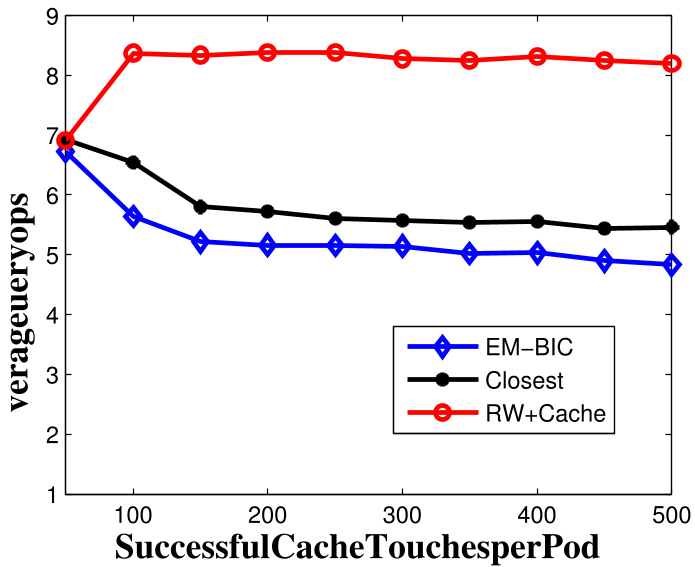 Fig 1 & 2: Evaluation of query hops and success probability for a cache size of 300.
Discovering the "Social Distance"
One of the most impressive findings is shown in Table I and Fig 4. As pods process more queries (SC touches), they don't just find local peers; they successfully discover and route to IGs located multiple hops away.
 Table I: Improvements in IG Number and Name Accuracy as pods learn from more queries.
Critical Insight & Future Outlook
This work demonstrates that Inductive Bias (the assumption that queries follow a clustered interest pattern) can be leveraged to build highly efficient decentralized systems.
Limitations: The current study assumes a fixed keyword lexicon. In the real world, language is messy. Future iterations will need to handle Semantic Ambiguity (polysemy) and Spelling Errors, potentially by integrating modern NLP embeddings (like BERT or LLM-based latent spaces) into the same EM framework.
The Takeaway: Privacy doesn't have to come at the cost of utility. By mining the "latent trail" of successful interactions, P2P networks can become self-organizing knowledge engines.