
Decoding Courage: How LSA Reveals the Hidden Dimensions of Virtue
The Use of Latent Semantic Analysis in the Positive Psychology: A Comparison with Twitter Posts
The paper applies Latent Semantic Analysis (LSA) to investigate the psychological construct of "courage" within the Italian context. It compares definitions provided by a controlled participant group (n=1199) with a corpus of over 12,000 tweets to extract and define the fundamental semantic dimensions of the virtue.
TL;DR
Is courage simply the absence of fear, or something more complex? This research moves beyond theoretical speculation by using Latent Semantic Analysis (LSA) to mathematically map the concept of courage. By comparing 1,199 personal definitions with over 12,000 tweets, the study reveals that while individuals define courage as "overcoming personal fear," the digital public sees it as a "civic necessity" driven by social responsibility.
Background: Moving Beyond Top-Down Definitions
In Positive Psychology, the movement toward Positive Youth Development (PYD) focuses on strengths rather than deficits. Courage is a cornerstone of this movement, yet researchers have struggled to find a universal definition. Some argue fear is required for courage; others say it's just a common feature.
The authors of this study argue that to truly understand courage, we shouldn't just look at what textbooks say—we should look at how people actually use the word.
The Logic of Latent Semantic Analysis (LSA)
The core of this paper is the application of LSA, a statistical natural language processing technique. Unlike simple keyword matching, LSA assumes that words appearing in similar contexts share similar meanings.
The Mathematical Intuition
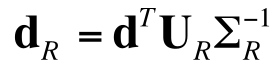
The researchers transformed text into a Term-Document Matrix, which was then decomposed using Truncated Singular Value Decomposition (TSVD):
By reducing the dimensionality of this matrix, "noise" (accidental word choices) is filtered out, leaving behind the "latent" semantic structure—the Conceptual Space. Each dimension in this space represents a "fundamental concept" residing in the data.
Experimental Analysis: Surveys vs. Twitter
The study compared two distinct datasets to see if the medium changes the meaning.
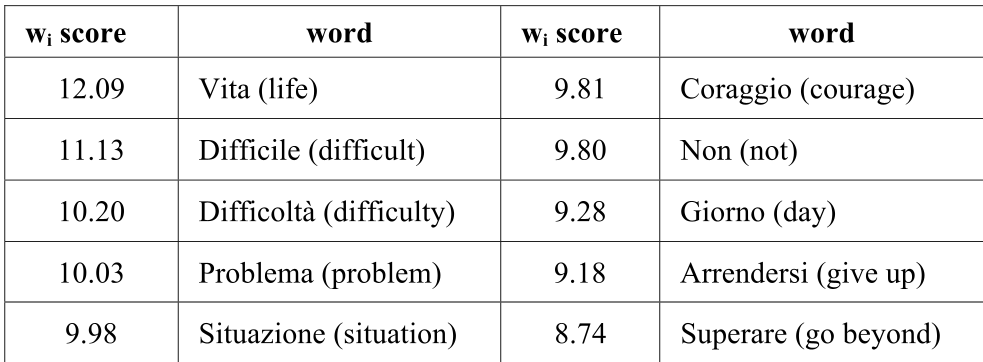
1. The Personal View (Dataset 1: Surveys)
When asked "What is courage?", participants focused on the individual struggle. The top semantic dimensions were dominated by words like paura (fear), affrontare (to face), and difficoltà (difficulty).
- Insight: In personal life, courage is the internal engine that allows one to "go beyond" (superare) difficulties.
2. The Public View (Dataset 2: Twitter)
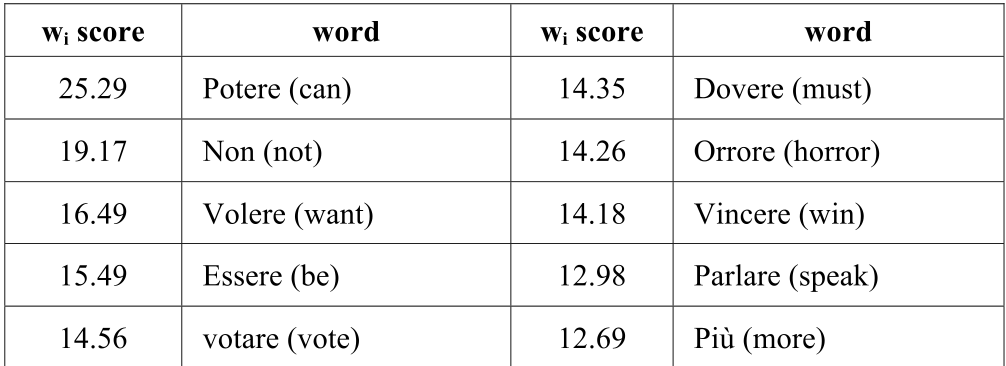
The Twitter analysis revealed a starkly different landscape. The space was dominated by Modal Verbs—potere (can), volere (want), and dovere (must).
- Insight: On social media, courage is framed as a civic tool. It is linked to votare (voting) and parlare (speaking out). It isn't just a feeling; it's a social obligation in the face of "horror" or political change.
Deep Insight: Why This Matters
The most striking result is the transition of courage from a state of mind (in surveys) to a behavioral necessity (on Twitter).
- Ablation of Subjectivity: LSA allows psychologists to step back and let the data speak. By using a "bottom-up" approach, they discovered that fear is indeed an integral part of the Italian definition of courage, but its expression changes based on the social context.
- Clinical Potential: The authors suggest that LSA can be used in counseling. By mapping a patient's discourse into these conceptual spaces, a therapist could see if a patient's view of courage is focused on self-efficacy or if they feel overwhelmed by perceived risks.
Conclusion & Future Work
The study proves that LSA is more than just an Information Retrieval tool; it is a cognitive lens. Future research could expand this to other "strengths" (like hope or optimism) or apply it in real-time to monitor the collective psychological resilience of a population during crises.
Takeaway: Courage isn't the absence of fear; it's the mathematical vector that moves us from "wanting" to "doing," regardless of the difficulty.