
Beyond Recency and Frequency: Predictive Caching via Latent Social Diffusion
A latent social approach to YouTube popularity prediction
The paper introduces a latent social approach for predicting YouTube video popularity within campus networks to optimize in-network caching. By combining an information diffusion model over an inferred latent social graph with a power-law based inter-arrival time frequency model, the authors achieve a 14% improvement in cache hit rates over the standard LRFU baseline.
TL;DR
Can we predict what you'll watch on YouTube by looking at your neighbors' screens? This paper moves beyond traditional "dumb" caching (like LRU/LFU) by treating video requests as a viral outbreak. By inferring a hidden social network from network traces, the authors improved cache hit rates by 14%, effectively reducing network congestion by anticipating viral cascades.
Background: The Staleness of Traditional Caching
In the world of Information Centric Networking (ICN), the Least Recently/Frequently Used (LRFU) scheme is king. It assigns scores based on how recently and how often a video was watched. However, LRFU is blind to human behavior. It handles "staleness" poorly—a video that was popular last week might still occupy cache space today simply because its aggregate score hasn't decayed fast enough, even if its "viral" lifespan has ended.
The authors argue that video consumption is not a series of independent events but a social diffusion process. Even without explicit "Friend" lists from Facebook, people in a campus network influence each other's viewing habits.
The "Latent Social" Intuition
The core insight is that social links are latent (hidden). If User A watches a video and shortly after, User B (who often watches what A watches) requests the same video, there is a probable "edge" between them.
1. Inferring the Network
Using Maximum Likelihood Estimation, the system learns an adjacency matrix , where represents the probability that user will "infect" user with a video recommendation.
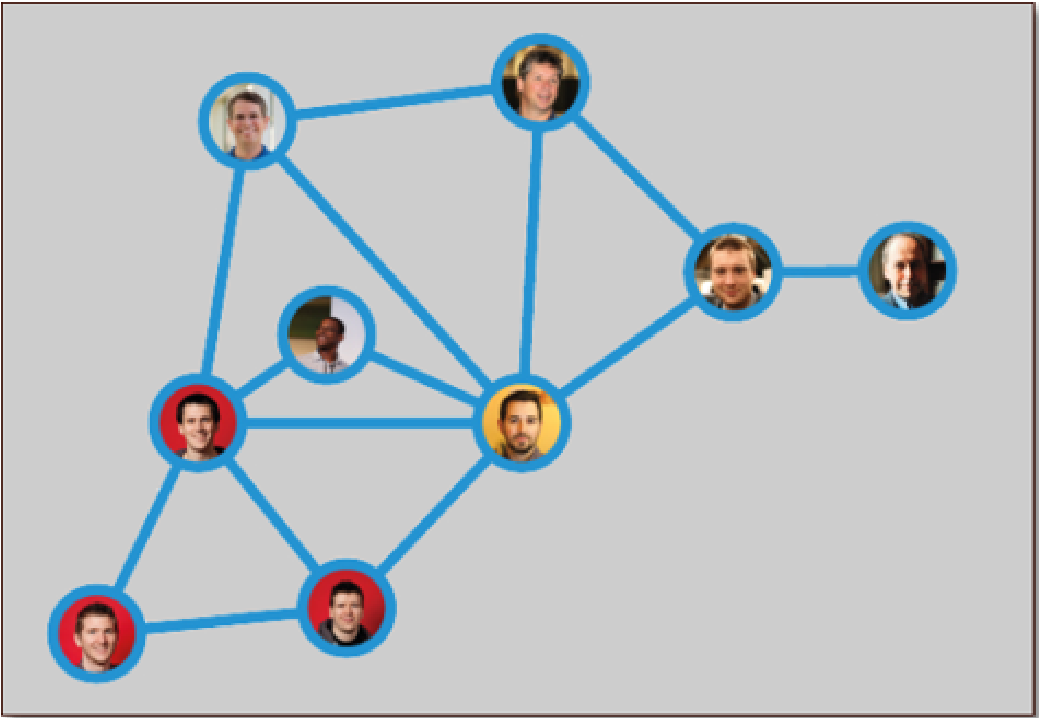 Fig 1: A conceptual latent social graph where directed edges represent sharing probabilities inferred strictly from request history.
2. The Epidemic Model (S-I)
The authors treat videos like viruses. Once a user (node) watches a video, they transition from Susceptible (S) to Infectious (I). They then have a probability of spreading that video to their neighbors based on the learned graph and an incubation time (the delay between one person watching and their Peer watching).
Methodology: The Combined Score
The paper doesn't rely solely on social diffusion. It uses a hybrid approach:
- Viralness: Measures the "acceleration" of views (a second-derivative test for popularity).
- Inter-arrival Time: Uses a Power-Law distribution to model the time between consecutive requests, much better than LRFU at identifying when a video has gone "stale."
- Diffusion Score: The sum of probabilities that currently "uninfected" users will watch a video in the next time window.
The final "Combined" score: This formula elegantly balances users who are part of the social graph and those who act independently ("consensus" behavior).
Experimental Results
Testing on 120 hours of real YouTube traffic from UMass Amherst, the results were striking:
- Baseline (LRFU): The starting point.
- Inter-Arrival approach: 11.6% improvement.
- Combined Social + Inter-Arrival: 13.2% improvement across the entire network.
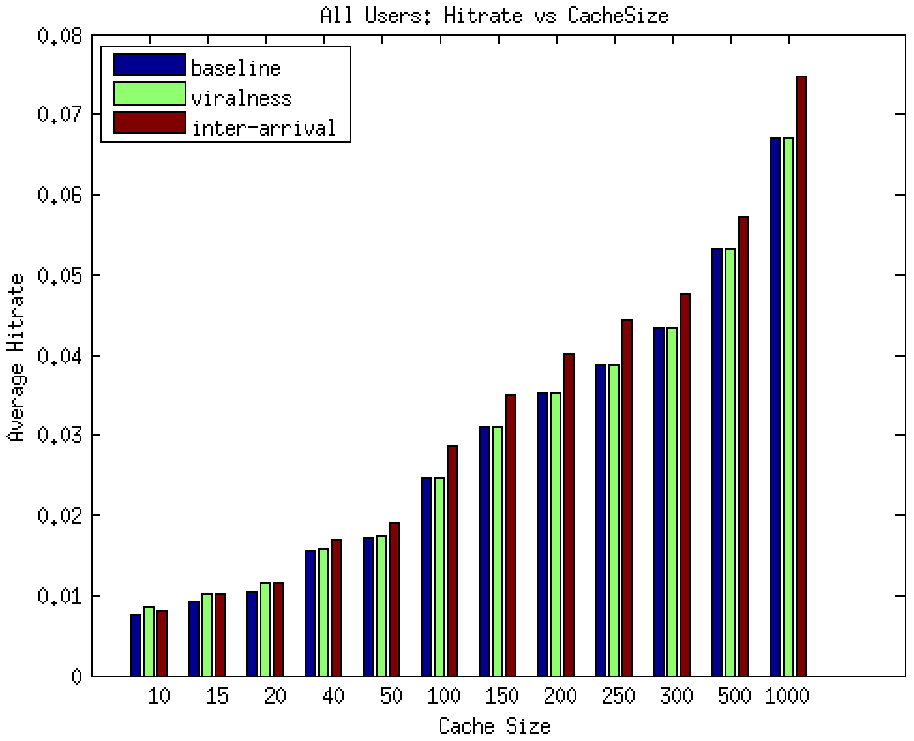 Fig 2: Comparison of consensus approaches. The Inter-arrival model (red line) consistently outperforms the baseline across all cache sizes.
Crucially, for the "connected component" of users (those with clear social ties), the hit rate improvement reached 21.1%. This proves that when social signals are strong, they are far more predictive than simple frequency statistics.
Critical Analysis & Takeaways
Why it works:
Traditional LRFU models "what" is popular. This model explains "why" it spreads. By capturing the contagion effect, the cache can pre-emptively store content before the "peak" of a viral cascade hits the local network.
Limitations:
- Isolated Vertices: The social model fails for the ~60% of users who don't show clear sharing patterns.
- External Influence: Not all views come from the local network; news, blogs, and global trends (External Influence) account for about 30% of traffic, which the latent graph cannot "see."
Future Outlook
This work sets the stage for "Social-Aware Networking." As we move toward 6G and edge computing, your local router might soon be running latent graph inference. Instead of just reacting to traffic, the network of the future will predict the next "viral" hit based on your proximity to the early adopters.