
LaBAC: Solving the Social Network Access Control Crisis with Lattice Theory
A Lattice-Based Access Control Model for Social Networks
This paper introduces LaBAC (Lattice-based Access Control), a novel user-centric model designed for large-scale social networks. By mapping user attributes to lattice elements and leveraging partial order relationships, the system achieves high-efficiency access control decisions and fine-grained privacy protection.
TL;DR
As social networks scale to billions of users, checking "Is Bob a friend of a friend of Alice?" becomes a computational nightmare. LaBAC proposes a shift from expensive graph-traversals to Lattice-based comparisons. By treating user attributes as ordered elements in a lattice, the system can make complex authorization decisions in constant/logarithmic time, even when messages are forwarded across thousands of users.
Background: The Graph Paradox
Current social media giants rely on relationship-based models. However, there's a fundamental paradox:
- Dynamic Volatility: Friendships and status change every second.
- Deep Forwarding: When User A's post is forwarded by B, C, and D, calculating if User E can see it requires traversing a complex, multi-hop path.
Current SOTA graph-based models often cap friendship checks at "two levels" (friends of friends) because checking the 3rd or 4th level is too latency-intensive for live production environments.
Methodology: The Core Intuition
The authors argue that a user's "trustworthiness" in a social context can be distilled into Attributes. Instead of looking at who you know, they look at what you are.
1. Lattice Element Definition
A user is represented as a tuple , including:
- Follower/Following counts ()
- VIP Status ()
- Engagement metrics (Comments , Forwards )
2. Architecture & Policy Appending
Rather than storing a flat list of rules, LaBAC constructs a Hasse diagram (a visual representation of the lattice). Policies are "appended" to the nodes. Because of the Partial Order Relation, if a user satisfies a high-level node in the lattice, the system can instantly infer their permissions without checking every single individual rule.
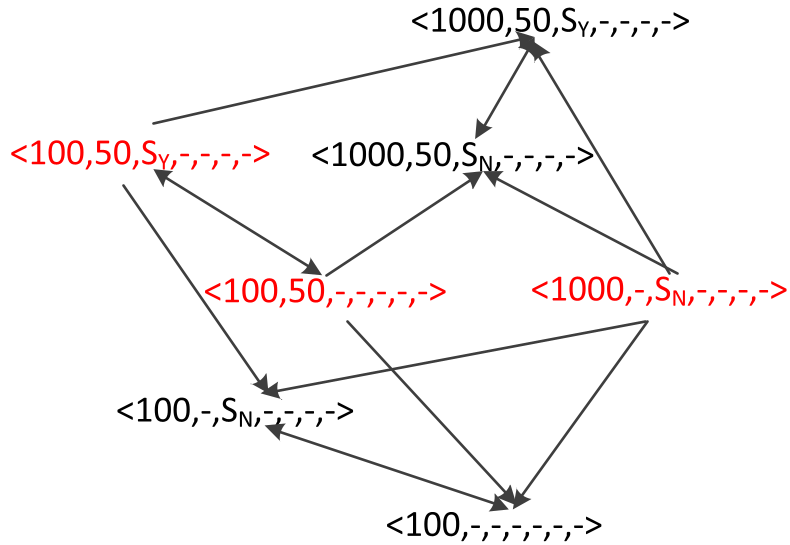 Figure 1: Example of an attribute-based lattice where nodes represent varying levels of user status.
Why Lattice is Superior
The mathematical beauty of Lattice Theory here lies in the Least Upper Bound (LUB) and Greatest Lower Bound (GLB).
- Efficiency: In a linked list of 10,000 policies, you might need 10,000 comparisons. In a Lattice, thanks to the partial order, you only need comparisons—literally 13 vs 10,000 in the authors' tests.
- Multi-user Operations: For a "Forward" operation involving multiple users, the lattice can represent the collective permission status as a single lattice comparison.
Experimental Results
The evaluation focused on the scalability of the decision engine.
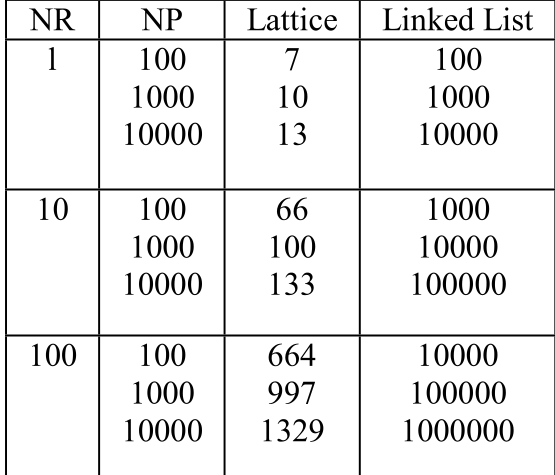 Figure 2: Number of comparisons required for Lattice vs. Linked List. The gap widens exponentially as the number of policies grows.
While a graph-based check for a social network of 10 million users might require 40,000 comparisons to verify a 2-hop relationship, LaBAC maintains constant speed regardless of the network's global connectivity. Furthermore, the memory overhead is minimal, requiring only roughly 6.33 MB to store 10,000 complex policies.
Critical Insight: The "Timely Information" Factor
One standout feature of this model is its handling of Time Decay. The value of social information decreases over time. LaBAC allows policies where the "bar for access" lowers as the message ages (e.g., "Strangers can view this post only after it is 10 days old"). This is achieved by adding a temporal unit to the policy derivation, a feat difficult to implement efficiently in static RBAC models.
Conclusion & Future Work
LaBAC demonstrates that Academic Graph Theory (specifically Lattices) isn't just for abstract math—it's a practical tool for high-concurrency systems.
- Limitations: The current model relies heavily on attribute extraction. If the attributes (like "VIP status") are spoofed or if the lattice becomes too multidimensional, the partial order results might become "Incomparable," leading to a default "Denied" state.
- Future Outlook: Integrating Machine Learning to dynamically adjust the lattice weights based on user behavior could further evolve this into an "Intelligent Access Control" system.
Editor's Takeaway: This is a classic example of "Lattice-based Access Control" (LBAC) being successfully reimagined for the social era. It trades the complexity of relationships for the structured order of attributes.