
Layered Label Propagation: Unlocking State-of-the-Art Compression for Social Networks
Layered Label Propagation: A MultiResolution Coordinate-Free Ordering for Compressing Social Networks
This paper introduces Layered Label Propagation (LLP), a coordinate-free graph ordering algorithm designed to maximize the compression of social networks and web graphs. By combining multi-resolution clusterings into a single permutation, the method achieves state-of-the-art compression ratios when used with the WebGraph (BV) framework, reaching as low as 1.8 bits per link on massive datasets.
TL;DR
Compressing massive web graphs is relatively easy when you have URLs to guide you, but social networks lack such "geographical" coordinates. This paper introduces Layered Label Propagation (LLP), a highly scalable, "coordinate-free" ordering algorithm. By leveraging multi-resolution community detection, LLP achieves unprecedented compression ratios—frequently under 2 bits per link—allowing graphs with billions of edges to fit into standard server RAM.
Background: The Coordinate Crisis
In the world of graph compression, the BV (Boldi-Vigna) scheme is the gold standard. It relies on two properties: locality (neighbors having similar IDs) and similarity (nodes sharing similar neighbor sets). For the web, ordering nodes by their URLs naturally satisfies these properties.
However, for a social network like Facebook or Flickr, there is no "URL." If you label nodes randomly, compression collapses. Previous attempts to fix this, like Gray ordering or Shingles, are either too slow to scale or fail to reveal the dense "host-like" clusters that make compression efficient.
Methodology: The Logic of Layers
The authors' core insight is that social networks contain clusters at multiple scales. A single-pass clustering (like standard Label Propagation) often results in a "giant component" that is too large to help with compression.
1. Absolute Potts Model (APM)
Instead of simple label propagation, LLP uses the Absolute Potts Model. It introduces a penalty parameter . When a node considers joining a community, it doesn't just look at how many neighbors are in that community; it discounts the move based on the community's total size. This prevents the formation of a single "super-cluster" and allows for a more granular view of the network.
2. Multi-Resolution Layering
The "Layered" in LLP comes from running APM multiple times with different values of .
- Small : Finds large, sparse communities.
- Large : Finds small, dense "cores."
The algorithm then sorts nodes by progressively refining the order: it uses the coarse labels to define "neighborhoods" and the fine labels to organize the internal structure.
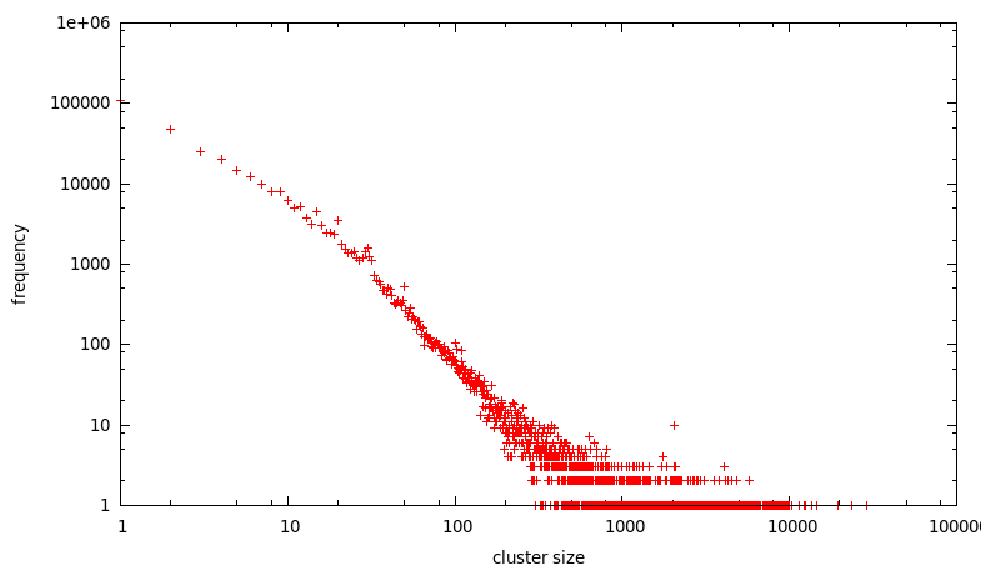 Figure 1: Distribution of cluster sizes in APM, showing the heavy-tailed nature that LLP manages.
Experiments: Breaking the 2-Bit Barrier
The authors tested LLP on massive datasets, including the UK-2007 web graph (105M nodes, 3.7B edges) and the Hollywood actor graph.
Key Performance Indicators:
- Versatility: LLP is "coordinate-free." Whether you start with a sorted list or a total random shuffle, the final compression ratio is nearly identical.
- Efficiency: Using a multi-core Java implementation, they processed 800,000 arcs per second, making it feasible to reorder a billion-node graph in a few hours.
- Density: As shown in the comparison tables, LLP+BV often halves the storage requirements compared to random ordering and beats the best-known BFS baselines by ~25%.
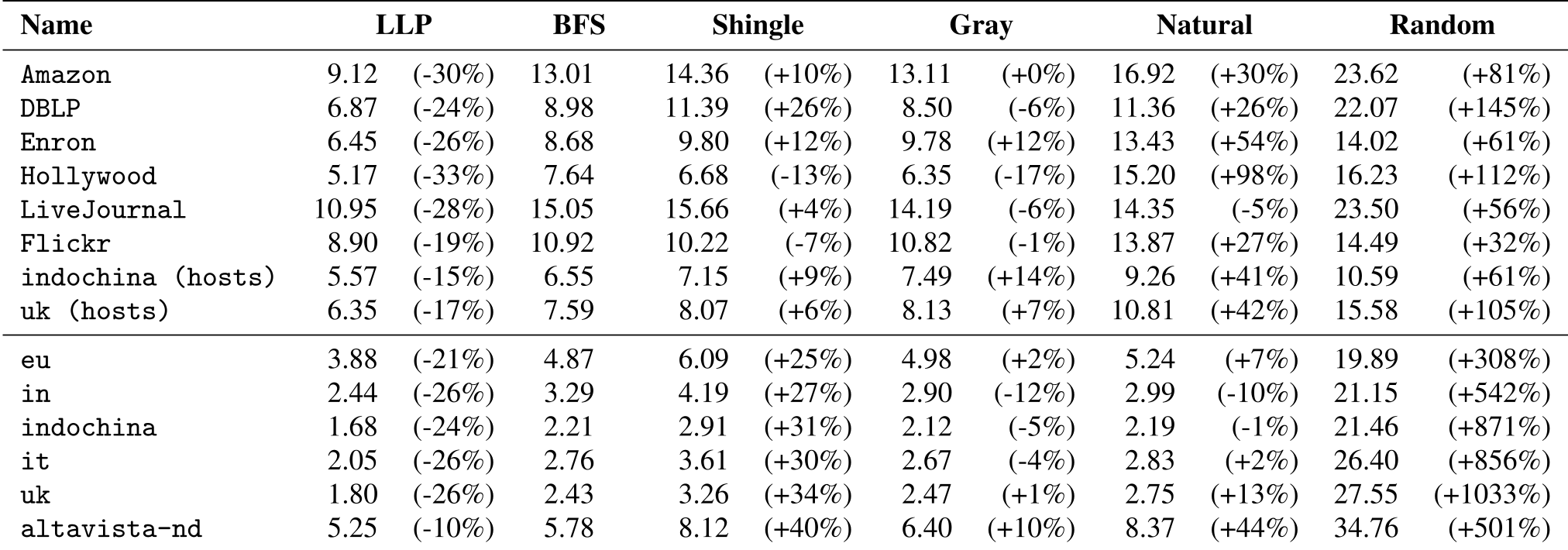 Table 1: Compression results. Note the massive gains (percentages in parentheses) over the BFS baseline.
Deep Insight: Locality vs. Similarity
The paper makes a fascinating distinction between web graphs and social networks. In web graphs, similarity (copying neighbor lists) drives compression. In social graphs, locality (reducing the numerical gap between neighbor IDs) is the primary engine. LLP is uniquely effective because it optimizes both by discovering the underlying hierarchy of the network.
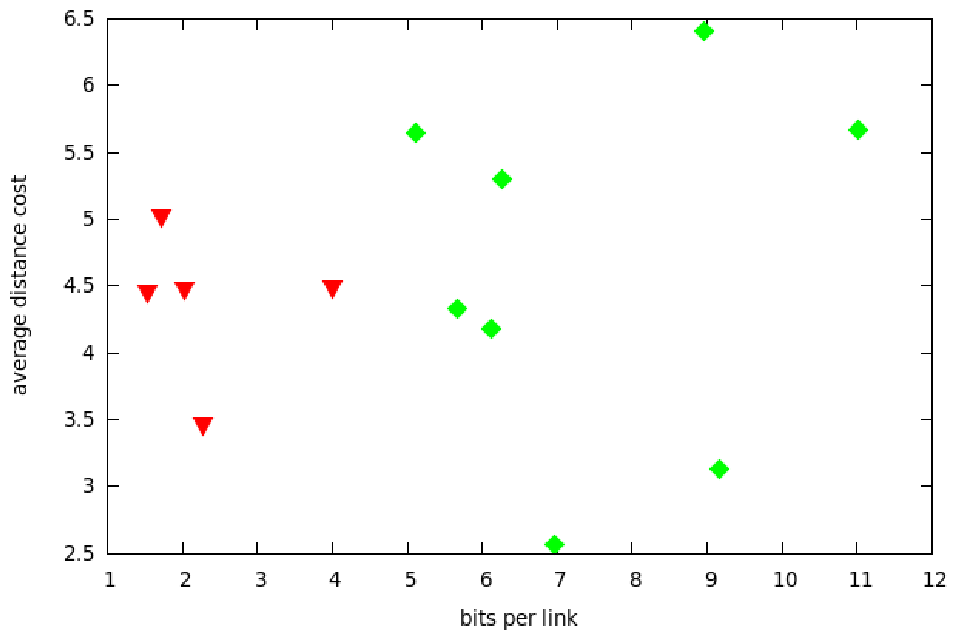 Figure 2: Correlation showing that Bits per link is highly tied to Average Gap Cost, proving that locality is king in social network compression.
Conclusion
Layered Label Propagation represents a milestone in the "intrinsic" analysis of networks. It proves that you don't need to know what a node is (a URL, an actor, or a book) to store it efficiently. By simply observing the topology, LLP reconstructs a meaningful order that enables the most dense graph storage structures available today. For researchers dealing with multi-billion edge graphs, LLP is the new baseline for main-memory graph processing.