
CAMEL: Trading Freshness for Massive Throughput in Social Networks
Lazy View Maintenance for Social Networking Applications
CAMEL is a lazy view maintenance system designed for social networking applications that optimizes throughput by balancing data freshness with computational overhead. It combines incremental maintenance, a control table mechanism, and top-k pushdown optimization to efficiently update materialized views stored in distributed memory caches.
TL;DR
Social networking platforms face a "write-heavy" paradox: traditional caches are constantly invalidated by a stream of new posts, killing performance. CAMEL solves this by strategically delaying updates. By implementing Lazy View Maintenance, it allows administrators to trade a small amount of data "freshness" for a staggering 11x increase in throughput, utilizing incremental updates and top-k query optimizations.
The Social Network Cache Problem
In platforms like Facebook or Twitter, users don't just read; they constantly append data. Every time a friend posts an update, your "Timeline" view technically changes.
In a standard architecture, a write to the database invalidates the cache. As shown in the study's preliminary data, when the write/read ratio reaches 1.0, cache hit rates plummet to ~60%, quadrupling the load on the database server compared to a 90% hit rate scenario.
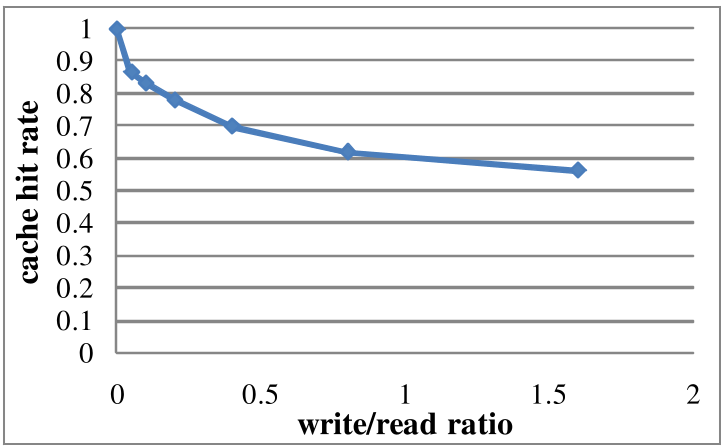
The authors argue that for social media, Rigid Consistency is overkill. Users usually don't mind if a post appears a few minutes late. This "Eventual Consistency" is the loophole CAMEL exploits.
Methodology: How CAMEL Stays Fast
CAMEL (Cache-based Adaptive Materialization with Lazy maintenance) utilizes three core technical pillars:
1. Incremental & Lazy Maintenance
Instead of rebuilding the entire timeline (Join of friend and message tables), CAMEL uses the Differentiation Step. It only calculates the delta:
By being "Lazy," it waits until a batch of messages () accumulates before running the update, significantly reducing the "per-message" overhead.
2. Top-K Pushdown Optimization
A "Timeline" is essentially a Top-K query (the latest 20 posts). Standard SQL would join thousands of messages then pick the top 20. CAMEL pushes the Top-K logic inside the join:
- Find the Top-K messages for each individual friend first.
- Union those small sets.
- Perform a final Top-K.
This reduces the data volume flowing through the join operation by orders of magnitude.
3. Systematic Architecture
The system uses a Control Table (Hotspot) to only materialize views for active users, saving memory and maintenance cycles.
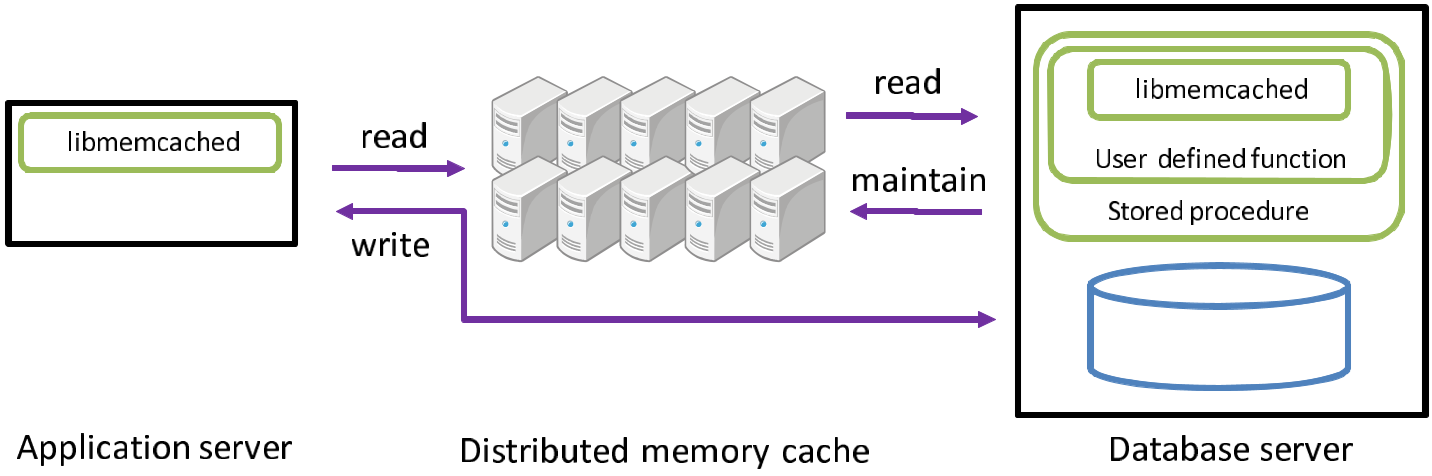
Experiments & Results
The researchers tested CAMEL against Eager Maintenance (update immediately) and Cache Invalidation (delete and rebuild).
- Throughput Gains: At a batch size () of 1000 messages, CAMEL was 11.2x faster than eager maintenance.
- The Cost of Speed: This 11x speedup reduced "Freshness" to 38.0%. However, with a smaller batch of 100, they still achieved 6.13x speedup with a much healthier 66.2% freshness.
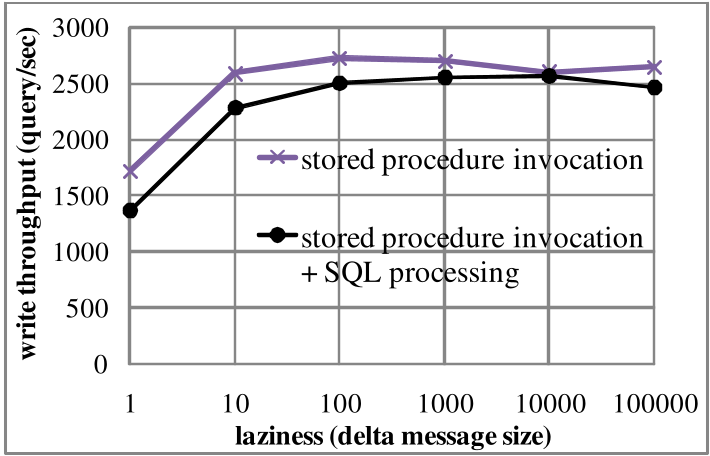
Interestingly, the study found that the bottleneck isn't the SQL processing itself, but the overhead of updating the distributed memory cache (e.g., memcached) across multiple network nodes.
Critical Insight: The "State Bug"
One of the primary challenges in lazy maintenance is the State Bug. If you update the base table but delay the view update, the "before image" of the data is lost. CAMEL avoids this by using Differential Tables to store temporary updates, ensuring that when the view eventually updates, it uses the correct historical context without slowing down standard reads.
Conclusion
CAMEL proves that for high-scale web applications, Consistency is a Dial, not a Switch. By allowing system administrators to tune this dial, CAMEL provides a robust framework for handling the massive write-throughput of modern social networks.
Future work in this area likely involves applying these "Lazy" principles to more complex graph-based notifications and geographical "near-miss" proximity alerts where the computational cost of maintenance is even higher.