
SSN-LDA: Transforming Document Models into Structural Community Detectors
An LDA-based Community Structure Discovery Approach for Large-Scale Social Networks
The paper introduces SSN-LDA (Simple Social Network Latent Dirichlet Allocation), a hierarchical Bayesian model for community discovery in large-scale social networks. By treating communities as latent variables and social actors as distributions over these communities, the method identifies group structures using only the topological connections of the network.
TL;DR
Community discovery in massive networks often hits a wall due to computational complexity or over-reliance on metadata. SSN-LDA pivots the famous Latent Dirichlet Allocation (LDA) model from "topics in text" to "communities in topology." By treating an actor's neighbors as a "profile," it uncovers institutional and topical clusters in networks with hundreds of thousands of nodes using efficient Bayesian inference.
Problem & Motivation: The Scalability Trap
In the era of massive social graphs, finding "who belongs with whom" is computationally expensive. Traditional algorithms like Girvan-Newman (based on edge betweenness) are elegant but scale poorly (), making them unusable for networks like CiteSeer or NanoSCI.
The authors identify a specific gap: while some probabilistic models exist, they often require semantic data (like the text of papers). But what if you only have the links? The challenge is to extract "hidden meaning" from sparse connection matrices without falling into the NP-complete trap of minimum-cut partitioning.
Methodology: Social Networks as "Documents"
The core insight of SSN-LDA is a clever mapping of the NLP domain onto Graph Theory:
- Corpus Total Social Network.
- Document A Social Actor's Interaction Profile (SIP).
- Word A neighboring Social Actor.
- Topic The Latent Community.
The SIP (Social Interaction Profile) Innovation
A major problem with using pure topology is sparsity. If an author has only two co-authors, the "document" is too short for LDA to learn anything meaningful. To solve this, the authors proposed three representations, with 012-SIP being the most effective:
- 01-SIP: Standard adjacency (direct neighbors).
- 012-SIP: Includes neighbors-of-neighbors, giving them lower weight. This "densifies" the profile, providing the Bayesian model with more context.
- k-SIP: Uses the frequency of interactions (e.g., number of co-authored papers).
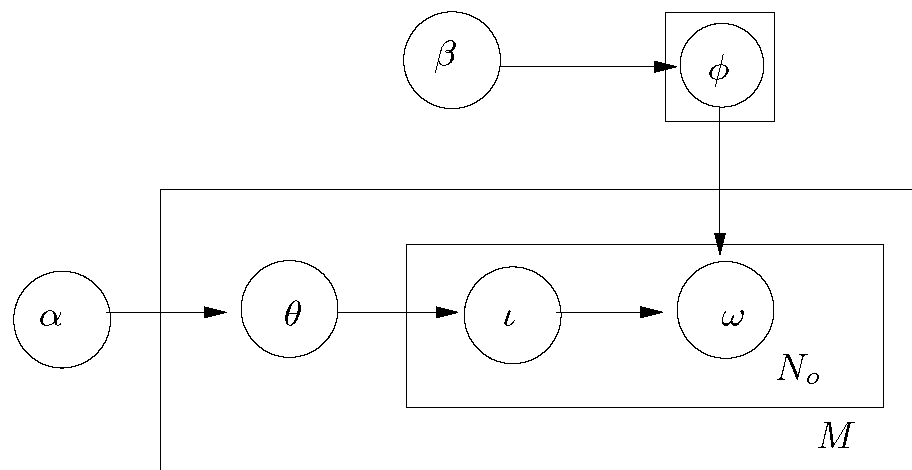
The generative process assumes each actor is a mixture of multiple communities. Through Gibbs Sampling, the model iteratively updates the probability of an actor belonging to a community based on the assignments of their neighbors.
Experiments: Real-World Academic Clusters
The model was tested on the CiteSeer (Computer Science) and NanoSCI (Nanotechnology) networks, both featuring over 200,000 nodes.
Quantitative Compactness
Using Perplexity (a measure of how well the model predicts unseen connections) and Clustering Analysis, the authors proved that the 012-SIP representation allows the model to find significantly more compact communities.
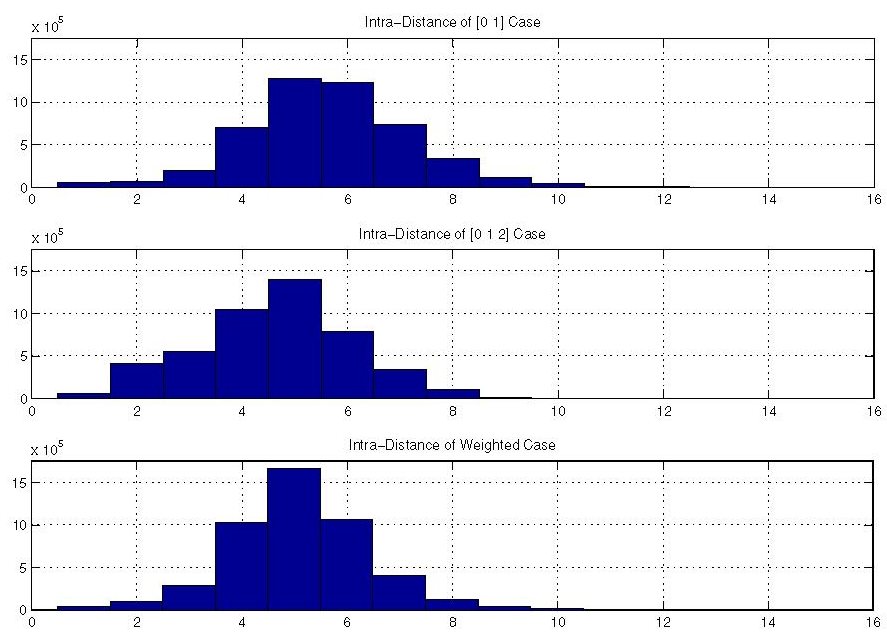 Figure: The shortest distance distributions show that SSN-LDA effectively clusters nodes with close proximity.
Qualitative Discovery
The results revealed two types of communities:
- Institution-based: Groups of researchers from the same university (e.g., UMass Amherst or UC Berkeley) who collaborate across different sub-fields.
- Topic-based: Groups spanning different institutions but sharing a research niche (e.g., AI/Machine Learning or Information Retrieval).
Critical Analysis & Conclusion
Takeaway: SSN-LDA successfully bridges the gap between Bayesian NLP and Graph Mining. Its reliance on only topological data makes it a "universal" detector for any network where links signify relationship strength.
Limitations:
- The "K" Problem: The number of communities () must be predefined, which is difficult in evolving networks.
- Computational Bottleneck: While more efficient than edge-betweenness, Gibbs sampling on millions of nodes still requires significant burn-in periods.
Future Outlook: The authors suggest this could be the key to Name Disambiguation. If two "John Smiths" appear in the same community, they are likely the same person; if they appear in vastly different clusters (e.g., High Energy Physics vs. Human-Computer Interaction), they are distinct individuals. This remains a fertile ground for identity recognition in massive datasets.