
From Robespierre to Hashtags: The Computational Mechanics of Leaderless Revolutions
Why Are Contemporary Political Revolutions Leaderless? An Agent-Based Explanation
This paper presents an Agent-Based Model (ABM) to explain the shift from leader-led historical revolutions to the leaderless uprisings of the modern era, such as the Arab Spring. By simulating social interactions, the study demonstrates that social network technologies can substitute for charismatic leadership (e.g., Robespierre or Lenin) by facilitating mass mobilization and preference revelation across geographical boundaries.
TL;DR
Historical revolutions were defined by the "Great Man"—charismatic leaders like Mao or Khomeini who galvanized the masses. Modern uprisings, notably the Arab Spring, are paradoxically leaderless. This paper utilizes an Agent-Based Model (ABM) to prove that social media isn't just a communication tool—it is a structural substitute for leadership, capable of sustaining mass mobilization through decentralized connectivity.
The Leadership Paradox
Why did the French Revolution need a Robespierre while the Egyptian revolution of 2011 seemed to move as a "swarm"?
The author, Alessandro Moro, argues that the bottleneck of any revolution is mass mobilization. In a pre-digital world, revolutionary fervor stayed local and died out unless a "charismatic leader" with extraordinary persuasive power could bridge disparate groups. Today, social network technology performs this "bridging" automatically.
Methodology: Simulating Rebellion
The model places agents on a 2D grid (a torus) where they decide to be "Quiet" or "Active" based on a threshold rule:
- : The agent's inherent grievance.
- : The "persuasion" they feel from their neighbors, leaders, or their social media feed.
- : The fear of arrest (which drops as the crowd grows—the "safety in numbers" effect).
The Two Paths to Revolution
- The Leader Path: A few "Leader" agents are added with (double the average influence). They act as anchors, keeping the rebellion alive even when the police start making arrests.
- The Network Path: No leaders exist. Instead, a percentage of agents are "connected" to each other regardless of where they are on the grid.

Core Insight: The Presence of a Substitute
The results from the simulations are striking in their clarity.
1. The Necessity of the Charismatic Leader
In a world without social media, the simulation shows that "local-only" influence leads to flickering, isolated riots that the state easily crushes. However, once one or two charismatic leaders are introduced, the active agent count (red line) stays persistently high.
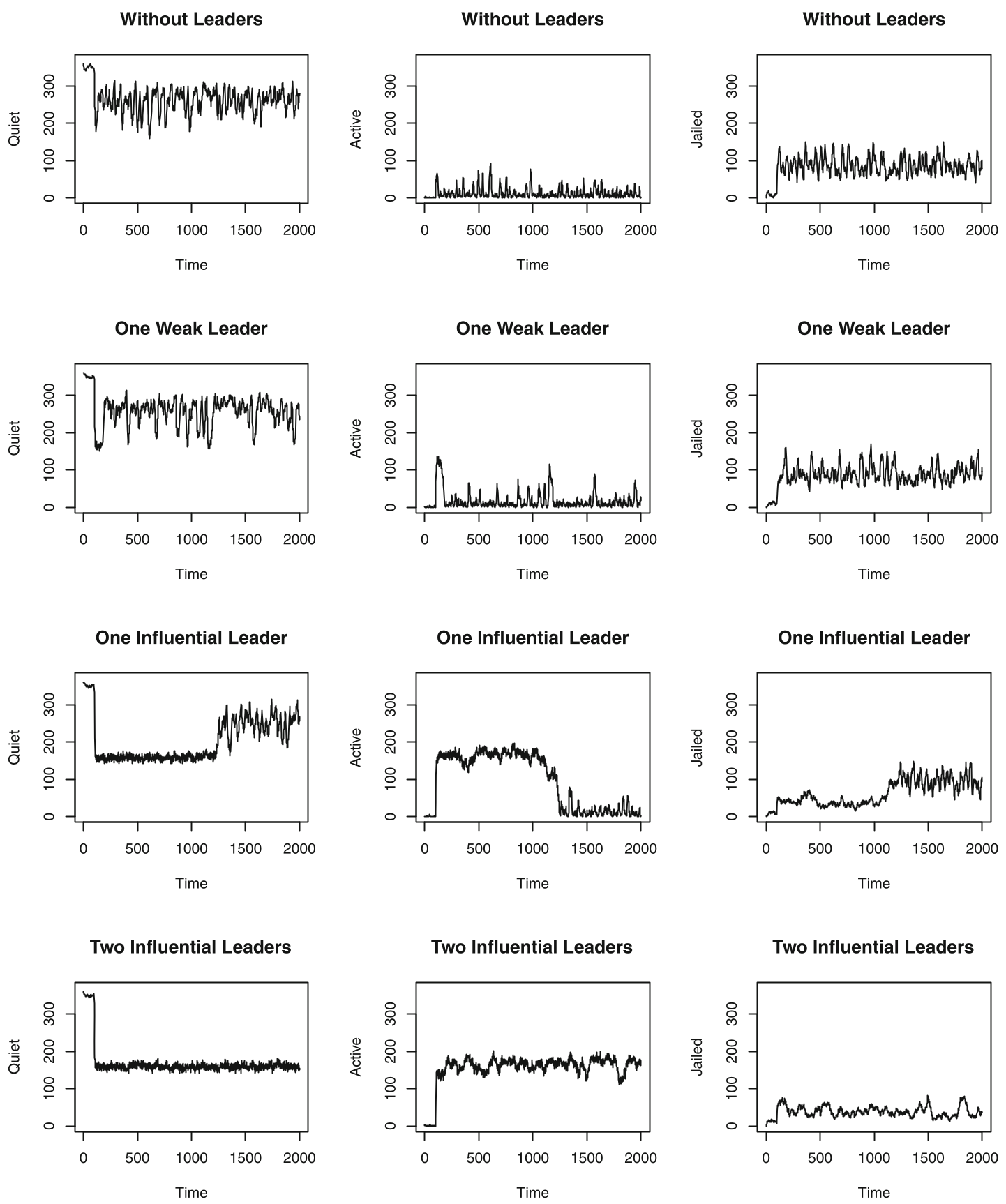 Figure 1: Without networks, the movement needs leaders to avoid dying out.
2. The Power (and Limit) of the Network
When social media is introduced, even with zero leaders, a successful revolution occurs if the connectivity is between 5% and 10%. The network acts as an "invisible leader," spreading persuasion faster than the government can arrest people.
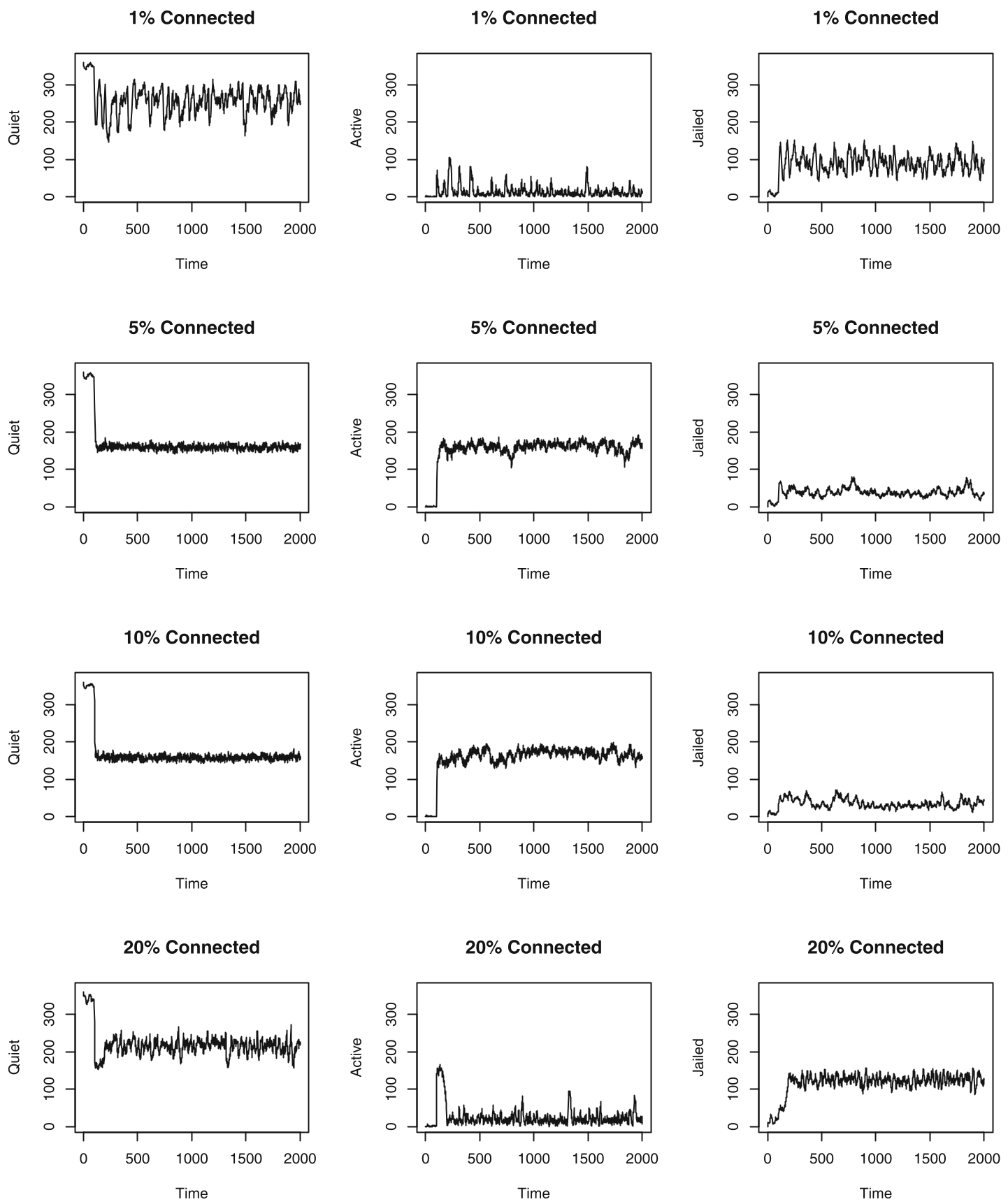 Figure 2: At 5-10% connectivity, the "active" population explodes without a single leader.
The "Dilution" Effect: Interestingly, at 20% connectivity, the revolution fails. Why? Because the network becomes "too average." By including too many moderate or unpersuasive agents in the digital feed, the average intensity of pro-revolutionary propaganda drops below the threshold required to sustain the risk of arrest.
Critical Analysis & Conclusion
This work provides a rigorous mathematical intuition for the "Digital Arab Spring." It suggests that:
- Democratization of influence can be a double-edged sword. While it enables leaderless starts, it requires a "Goldilocks zone" of connectivity—enough to spread the fire, but not so much that the signal gets lost in the noise.
- Limitations: The model assumes "grievance" is static, whereas in reality, government crackdowns can increase grievance (resentment) or decrease it (fear). Furthermore, the "dilution effect" at 20% might be an artifact of how the average persuasion is calculated, which might not reflect how modern algorithms prioritize high-engagement (extreme) content.
Final Takeaway: The era of the "charismatic revolutionary" is being replaced by the "charismatic network." The technology itself has become the Robespierre of the 21st century.