
Decoding Project Success: Why Leadership Competence Must Match Complexity
Relationships Between Leadership and Success in Different Types of Project Complexities
This study investigates how project complexity moderates the relationship between a project manager's leadership competencies (EQ, MQ, IQ) and project success. Utilizing a cross-sectional survey of 119 projects, it validates a three-dimensional complexity framework (Fact, Faith, Interaction) and identifies how different complexities influence the effectiveness of specific leadership traits.
TL;DR
Project success isn't just about following processes; it’s about the fit between a leader's psychological makeup and the specific "flavor" of project complexity. This study proves that Emotional Intelligence (EQ) and Managerial Competence (MQ) are the real drivers of success, but their effectiveness is heavily moderated by whether a project is complex due to technical facts, uncertain "faith," or human interactions.
Background: Beyond the Iron Triangle
For decades, project management was obsessed with the "Iron Triangle"—Time, Cost, and Quality. However, the reality of modern engineering and IT projects is far more nuanced. A project can be "late" and "over budget" (like the Sydney Opera House) yet remain an undisputed success. This paper shifts the focus from what is being managed to who is managing it and in what context.
The Problem: The "One Size Fits All" Fallacy
Most organizations assign project managers based on technical seniority or availability. The authors argue this is a mistake because:
- Leadership isn't General: Different challenges require different leadership profiles.
- Complexity is Multidimensional: It’s not just about "size." A small project with conflicting stakeholders is often more complex than a massive, predictable construction job.
Methodology: The Three Types of Complexity
The researchers developed a unique framework to categorize the "environment" part of the Person-Environment fit:
- Complexity of Fact: Dealing with massive amounts of interdependent information and people (The "Structural" challenge).
- Complexity of Faith: Dealing with uniqueness and high uncertainty (The "Unpredictability" challenge).
- Complexity of Interaction: Dealing with transparency, politics, and stakeholder empathy (The "Relational" challenge).
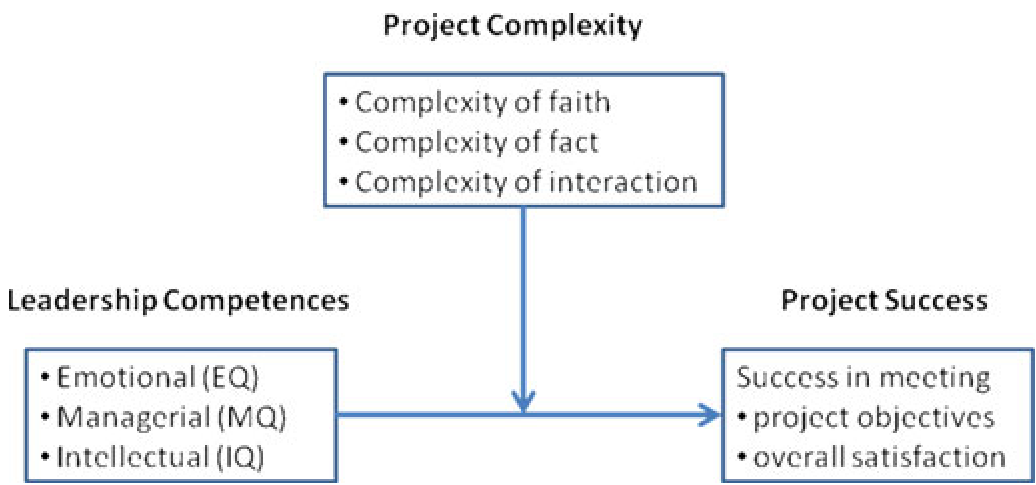 Figure 1: The Research Model showing how Complexity moderates the path between Leadership and Success.
Key Insights: Why EQ Wins
The study’s findings challenge the traditional "Intellectual" view of engineering management:
1. The Stability of EQ
Emotional Intelligence (EQ) was found to be the most consistent predictor of success. While Managerial (MQ) skills are important, their effectiveness fluctuates wildly depending on the project's complexity. EQ remains a stable anchor across almost all sectors.
2. The Direct Impact of Interaction
Surprisingly, Complexity of Interaction has a direct effect on project success. Projects with high interaction are not just "harder"—they actually provide a fertile ground where high-EQ leaders can exert the most influence.
3. The Diminishing Returns of MQ and EQ in "Faith" Projects
In projects characterized by high "Complexity of Faith" (high uncertainty), the relationship between leadership and success actually weakens. This implies that in highly volatile environments, leadership alone isn't enough; you need structural supports and robust change management processes to survive.
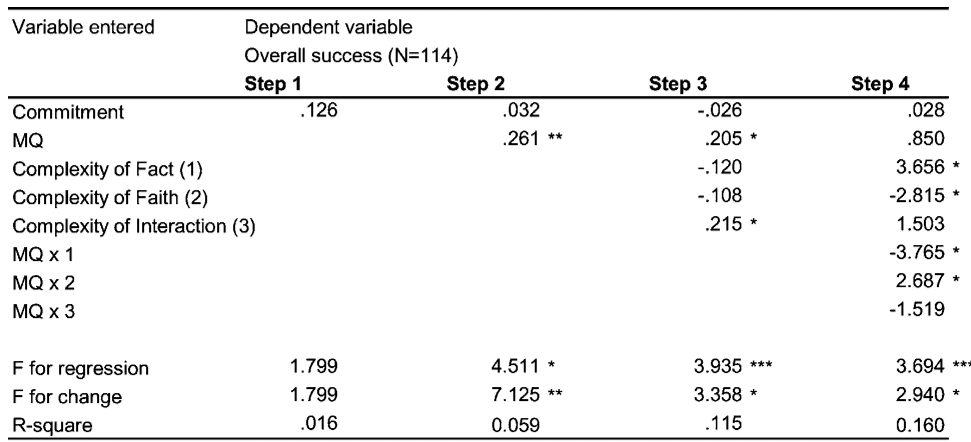 Table 1: Hierarchical regression results demonstrating the moderating effects of Fact and Faith on MQ performance.
Strategic Takeaways for Technical Leaders
- Stop Hiring for IQ Alone: The study found that Intellectual Competence (IQ) had almost no significant correlation with improving project results from "good to great." Vision and critical analysis are table stakes; EQ is the differentiator.
- Staffing for Complexity:
- High Interaction? Assign your most empathetic, socially aware leader.
- High Fact/Faith? Even your best leaders will struggle; these projects need more than just a "great personality"—they need extreme managerial rigor and institutional support.
- Common Language: The "Fact, Faith, and Interaction" model provides a universal language for IT, Engineering, and Organizational Change managers to share lessons across industries.
Conclusion
This paper serves as a critical reminder that "people make processes work." As projects become increasingly international and multidisciplinary, the project manager's ability to navigate emotional and relational complexity (EQ/Interaction) is no longer a "soft skill"—it is the core technical requirement for success.
Limitations
The study relies on self-reported data from project managers, which can introduce bias. Additionally, the sample was heavily weighted toward the IT sector in North America; future research should investigate if these "DNA" markers of leadership hold true in more traditional manufacturing or emerging tech ecosystems in Asia.