
HSPF: Decoding the Dual Social Influence in Local Event Recommendations
Learn to Recommend Local Event Using Heterogeneous Social Networks
This paper introduces Heterogeneous Social Poisson Factorization (HSPF), a probabilistic framework for event recommendation in Event-Based Social Networks (EBSNs). By extending Bayesian Poisson Factorization, the model uniquely fuses online group memberships and offline activity co-participation with their respective tie strengths to provide highly accurate Top-N recommendations.
TL;DR
The Heterogeneous Social Poisson Factorization (HSPF) model bridges the gap between our digital social circles and our physical interactions. By modeling the "tie strength" of both online and offline friendships within a Poisson framework, it significantly improves event recommendation accuracy on platforms like Meetup, proving that who we meet in person influences us more than who we follow online.
Background & Positioning
In the landscape of recommender systems, Event-Based Social Networks (EBSNs) represent a unique challenge. Unlike Netflix (movies) or Amazon (products), EBSNs like Meetup and Douban connect the digital world with physical, "face-to-face" reality. This paper positions itself as a specialized evolution of Social Poisson Factorization, moving from a single-channel social view to a heterogeneous dual-channel view.
Problem & Motivation: The Online-Offline Gap
Most social recommenders treat "friends" as a flat category. However, in EBSNs, your relationship with a fellow group member (Online) is fundamentally different from someone you've attended ten hiking trips with (Offline).
The authors identified two major gaps in prior SOTA:
- Homogeneous Bias: Previous models didn't distinguish between online and offline ties.
- Binary Relationships: They ignored "Tie Strength" (the frequency or intensity of interaction).
The intuition is simple: Your attendance is driven by your personal preference (instinct) plus the behavior of your friends, weighted by how close you are to them.
Methodology: The HSPF Framework
The core of HSPF lies in its modified Poisson distribution for user-event interactions. The probability of a user attending event is calculated as the sum of three components:
- User Preference (): The latent alignment between user tastes and event attributes.
- Offline Social Influence: The weighted influence of friends you've met in person.
- Online Social Influence: The weighted influence of friends in your digital groups.
Architecture Overview
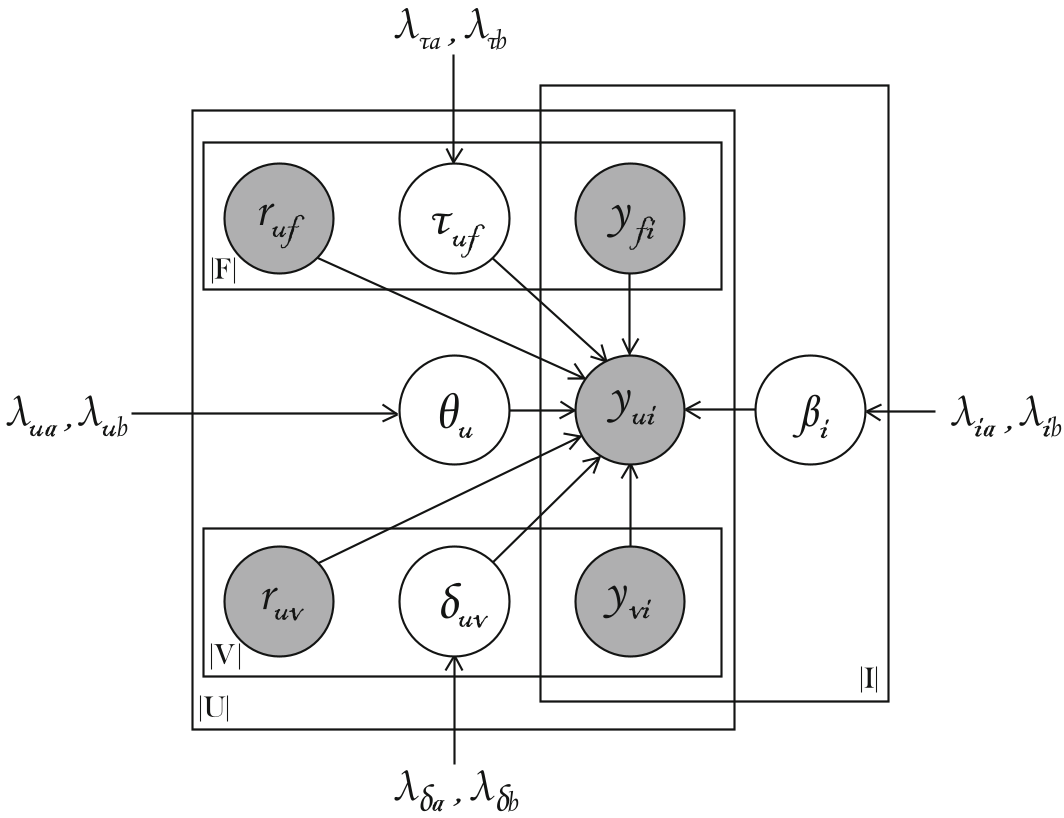 The generative process uses Gamma priors to ensure sparsity, which is critical for handling the massive, sparse matrices of city-wide event data.
To solve this efficiently, the authors used Variational Inference with auxiliary variables. This transforms the complex posterior distribution into a set of closed-form update equations, allowing the model to scale to datasets with hundreds of thousands of users.
Experiments & Results
The authors tested HSPF against heavyweights like Factorization Machines (FM) and Collective Matrix Factorization (CMF) using Meetup data from Chicago and Phoenix.
Performance Comparison
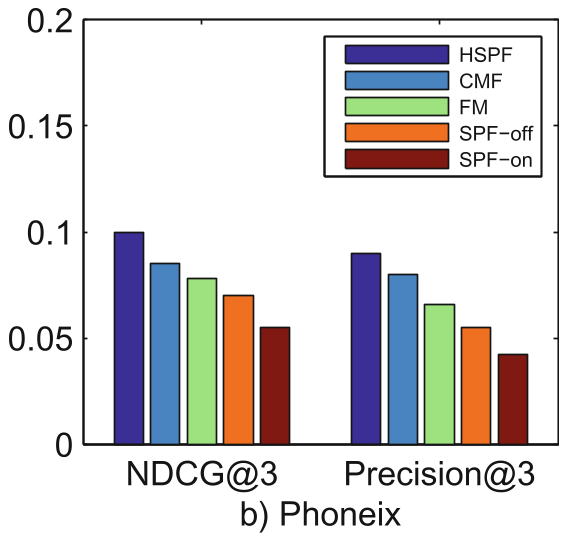 HSPF consistently leads in NDCG and Precision across different recommendation list sizes (N).
The "Offline Power" Insight
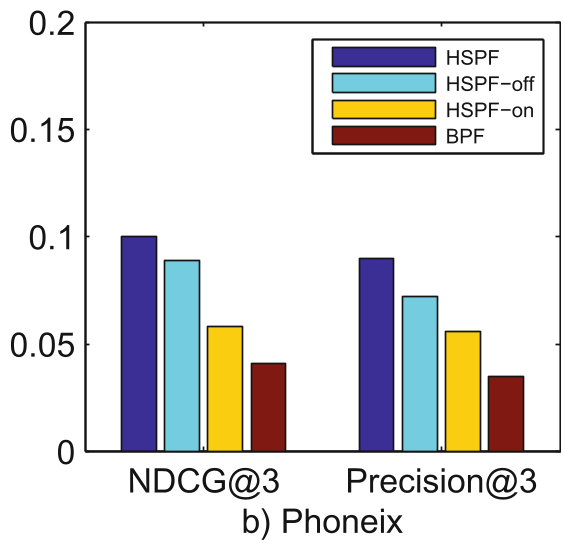
A fascinating takeaway from the ablation study (comparing HSPF-on vs. HSPF-off) is that Offline social networks contribute more to recommendation accuracy than Online ones. This validates the "Physical Proximity" theory: face-to-face communication creates stronger social bonds and higher behavioral contagion than mere group membership.
Critical Analysis & Conclusion
Takeaway
HSPF is a robust model for any platform that operates at the intersection of social networking and physical activity. By distinguishing between types of influence and measuring their strength, it moves recommendation closer to how humans actually make social decisions.
Limitations & Future Work
While HSPF excels at social modeling, it currently treats "distance" and "time" indirectly through interaction counts. The authors acknowledge that explicitly integrating spatio-temporal constraints (e.g., "how far is the user willing to travel at 8 PM?") is the next frontier for this research.
Final Prediction
As "Hyper-local" services grow, we expect to see more models like HSPF that treat physical interaction as the "gold standard" signal, rather than just another digital click.