
LA vs. EDM: Parallel Universes or a Converging Future? A Topic Modeling Perspective
Comparison of learning analytics and educational data mining: A topic modeling approach
This study presents a comparative analysis of Learning Analytics (LA) and Educational Data Mining (EDM) using Structural Topic Modeling (STM) and keyword frequency analysis. By processing 681 empirical articles from 2015-2019, the authors identify thematic overlaps and distinct research focuses within the educational AI ecosystem.
TL;DR
Is there a real difference between Learning Analytics (LA) and Educational Data Mining (EDM)? While researchers have debated this for a decade, this paper uses Structural Topic Modeling (STM) to prove that while their "ancestries" differ, their "trajectories" are colliding. LA remains the practitioner’s choice (focusing on social learning and feedback), whereas EDM remains the architect’s playground (focusing on algorithms and predictive performance).
The "Same Species" Paradox
For years, the academic community has treated LA and EDM like fraternal twins: they look similar and hang out in the same settings (LMS, MOOCs), but they insist they are different. Traditionally, EDM was seen as the "reductionist" sibling—breaking down data to find new patterns—while LA was the "holistic" one, trying to understand complex systems to help teachers.
The motivation for this study was simple: Does the data actually support this boundary? By analyzing nearly 700 papers from 2015 to 2019, Lemay et al. aimed to see if these fields are truly distinct or just two labels for the same transition toward AI-driven education.
Methodology: Let the Machine Find the Topics
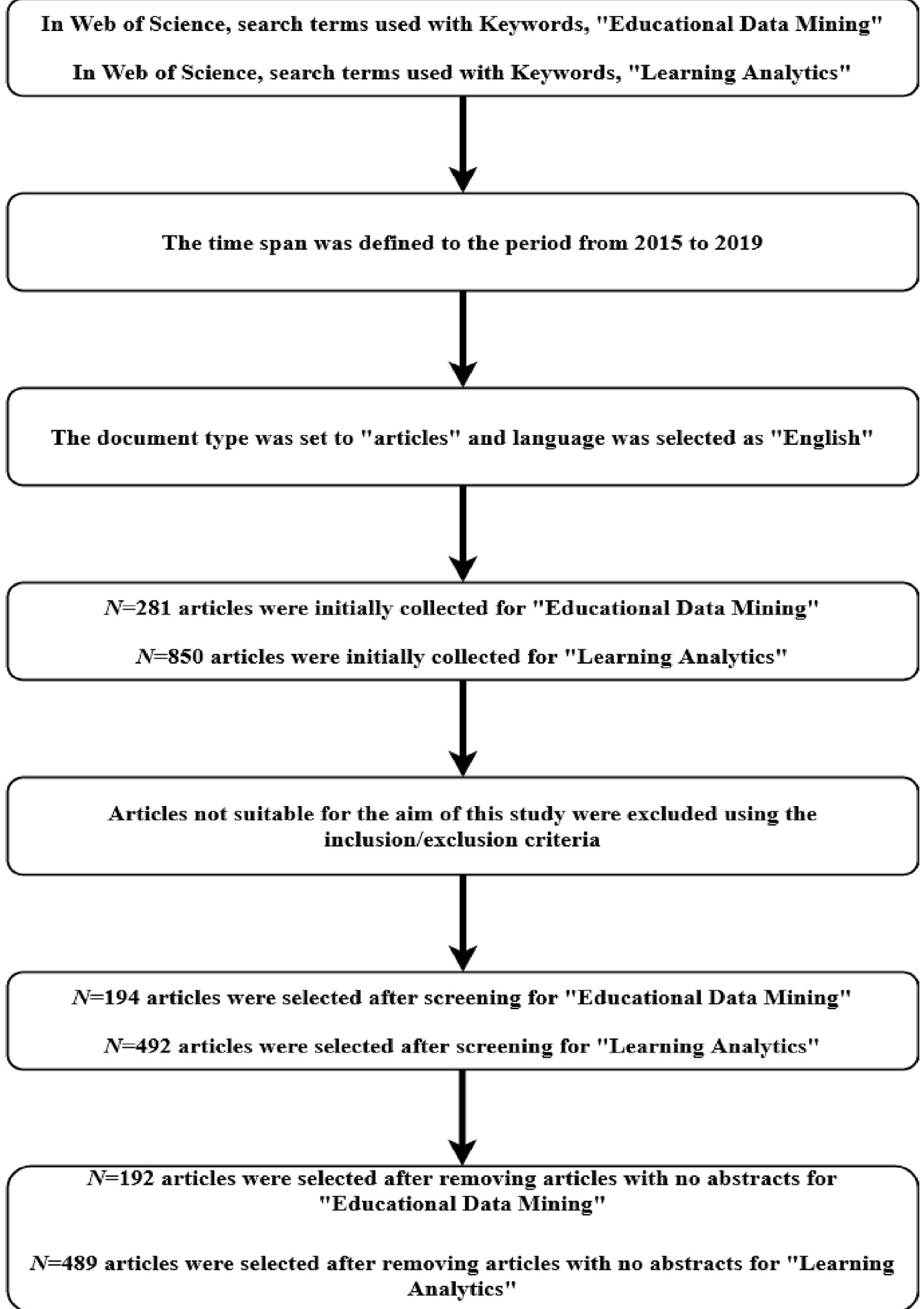
The researchers didn't just read the papers; they used a Structural Topic Modeling (STM) pipeline to extract latent themes from abstracts.
The Pipeline:
- Corpus Selection: 192 EDM and 489 LA articles from High-impact databases.
- Refinement: Trimming stopwords (common words like "results" or "study") to reveal the "meat" of the discourse.
- Topic Discovery: Running diagnostic tests (Held-out likelihood and Semantic Coherence) to determine that 5 topics best represented the landscape.
Core Insights: The "Flavor" of the Research
The STM results revealed a fascinating split in priorities.
Learning Analytics (LA) | The Practice-Oriented Field
The dominant topics in LA centered on student performance, feedback tools, and social interactions.
- Topic 4 (The Leader): Academic performance and engagement in online courses.
- Topic 3 (The Differentiator): Social Network Analysis (SNA). LA is deeply interested in how groups collaborate and discuss.
Educational Data Mining (EDM) | The Method-Oriented Field
EDM abstracts were far more likely to mention technical procedures.
- Topic 1 (The Leader): Predicting performance via algorithms and classification.
- Topic 2 (The Specificity): A strange but persistent focus on Engineering courses, suggesting EDM is currently less "generalizable" than LA.
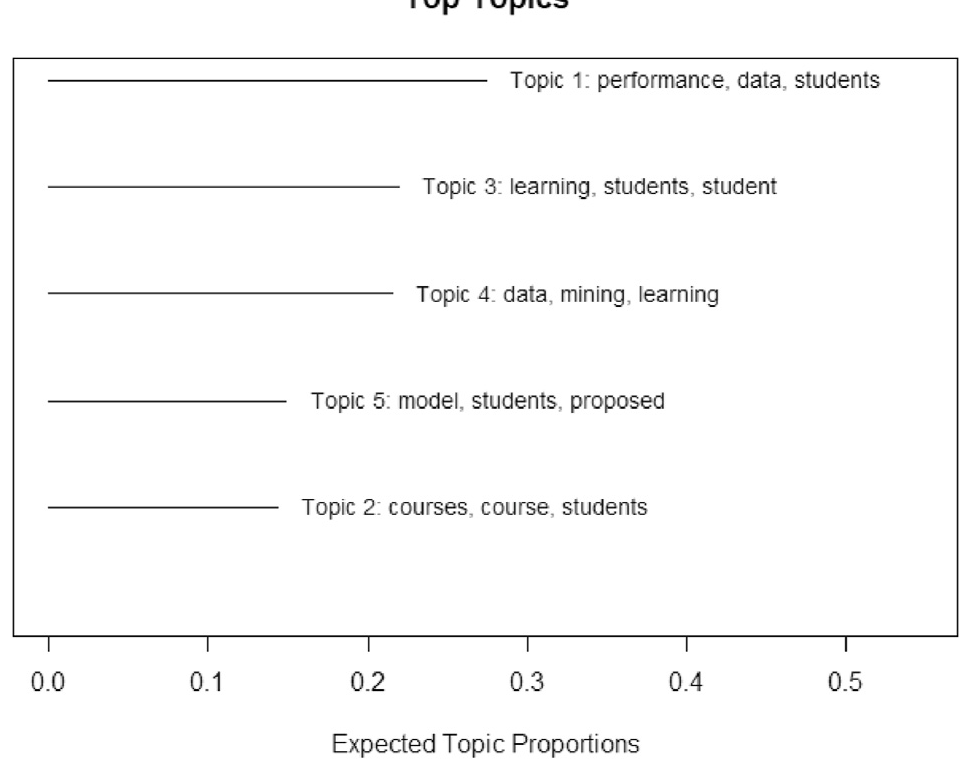 Above: The distribution shows Topic 4 (Performance/Engagement) as the heavyweight in LA research.
The Great Convergence (2015–2019)
The most striking part of the study is the temporal trend. By 2019, both fields began to obsess over the same thing: Student Behavior.
Keywords like "Machine Learning" and "Prediction" saw an upward trend across the board. However, a significant "Discipline Blind Spot" was identified: Ethics and Privacy. Despite the "Big Data" boom, discussions on data ownership and algorithmic bias were virtually non-existent in the core topics of either field during this period.
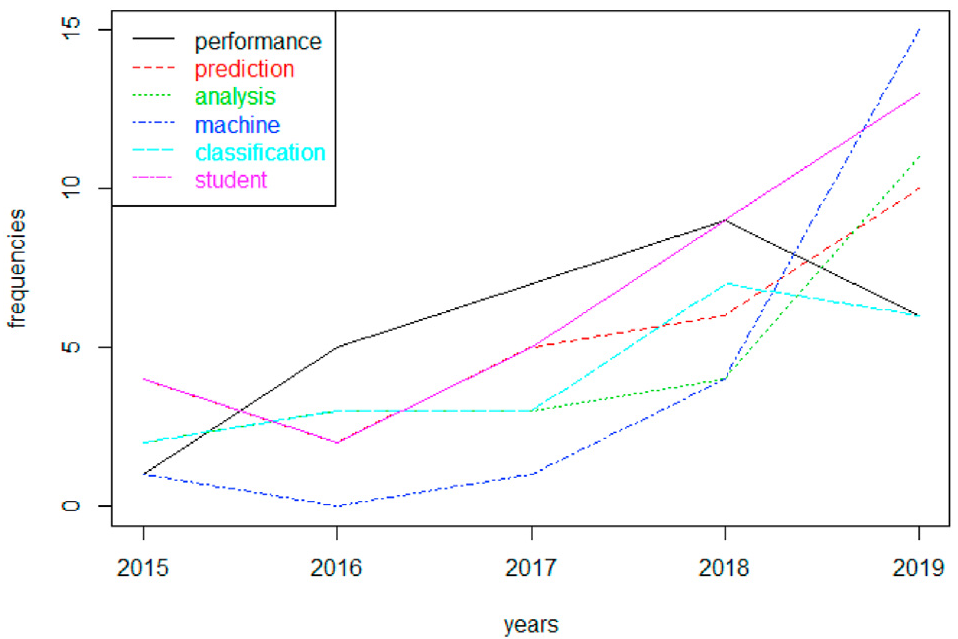 Above: Keyword analysis over time shows the rise of "Machine" and "Prediction" in the EDM space, with LA following a similar technical tightening.
Takeaway: Practical Implications
This paper confirms that the wall between LA and EDM is porous.
- For EDM Researchers: There is a desperate need to move beyond "Engineering" datasets to avoid demographic bias.
- For LA Researchers: While the focus on practice is great, the field must adopt more robust technical standardization.
- For Both: The lack of "Privacy" as a core topic is a ticking time bomb. As these models move from the lab to the "general market," ethical transparency will become the new SOTA.
In summary: stop worrying about the label. Whether you call it EDM or LA, the goal is the same—optimizing learning through data. The next frontier isn't just "mining" the data, but doing so ethically and actionably.