
CommNet-Explore: Transcending Human-Designed Cooperation in Multi-Robot Exploration
Learning to Cooperate in Decentralized Multi-robot Exploration of Dynamic Environments
This paper introduces CommNet-Explore, a decentralized multi-robot exploration framework that utilizes Deep Reinforcement Learning (DRL) and the Communication Neural Network (CommNet) to learn autonomous cooperation strategies. It achieves high-efficiency exploration in dynamic, obstacle-rich environments, outperforming traditional human-designed frontier-based methods in both planning speed and robustness.
TL;DR
In the world of multi-robot systems, cooperation is usually dictated by rigid, human-designed rules. CommNet-Explore flips the script by using Deep Reinforcement Learning (DRL) to allow robots to learn their own communication and action protocols. By optimizing for entropy reduction in Occupancy Grids, this approach achieves faster planning and higher robustness in dynamic environments compared to traditional frontier-based methods.
The Wall of "Pre-Designed" Strategies
For decades, multi-robot exploration has relied on three pillars: frontier-based, cost-utility, and market-based approaches. While effective in static maps, these methods hit a wall when:
- Complexity Scales: Humans cannot anticipate every spatial constraint or interaction.
- Environments Shift: Static rules struggle when obstacles appear dynamically or when team members leave the system (energy depletion).
- Computational Overhead: Coordinating frontiers for large teams often leads to exponential growth in planning time.
The authors' insight is simple: if DRL can master complex individual behaviors (like locomotion), it can also master collective behaviors—specifically, what to communicate and how to act on that information.
Methodology: The Architecture of Cooperation
The backbone of this approach is CommNet, a neural network that allows agents to broadcast continuous vector representations of their states to neighbors.
1. Environmental Modeling & Entropy
The robots represent the world via an Occupancy Grid. Instead of just looking for "frontiers," the goal is framed mathematically as Uncertainty Reduction. The agent's reward is primarily driven by the change in the grid's entropy (): This encourages agents to move toward areas that maximize information gain.
2. Learned Communication
Unlike traditional systems that send specific coordinates, CommNet agents transmit hidden states that are processed through multi-layer networks. This allows the system to develop a "shared language" tailored to exploration.
 Caption: The conceptual flow of decentralized UAVs exchanging local views to reach global consensus in a dynamic disaster zone.
3. Curriculum Learning for Dynamics
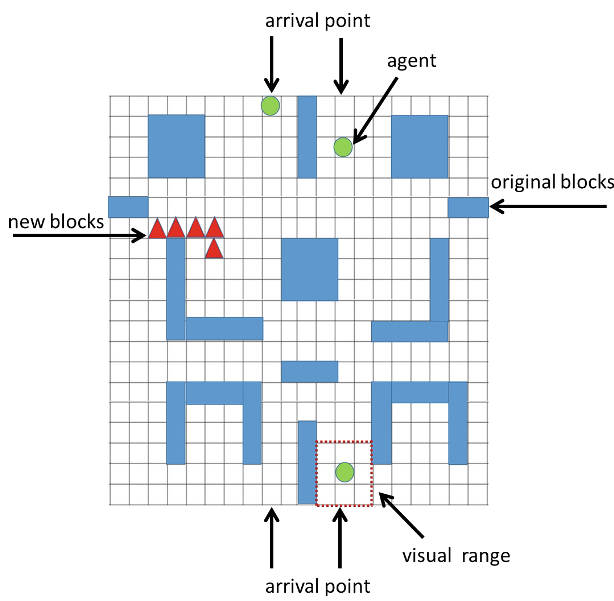
To handle dynamic obstacles, the authors utilized Curriculum Learning, gradually increasing the frequency of obstacle generation. They also simulated agent "life cycles," forcing new agents to rapidly integrate into the team and exiting agents to hand off observations efficiently.
Experimental Performance: Learning vs. Designing
The team evaluated CommNet-Explore against two baselines: Coordinated Frontier and Nearest Frontier.
Efficiency & Robustness
The most striking result is the efficiency gain. While the Coordinated Frontier approach struggles with a 230ms planning bottleneck, CommNet-Explore makes decisions in just 30ms.
| Approach | Planning Time (ms) | Exploration Ratio (%) |
|---|---|---|
| CommNet-Explore | 30 ± 10 | 92.6 ± 4.3 |
| Coordinated Frontier | 230 ± 20 | 87.4 ± 6.7 |
| Nearest Frontier | 35 ± 5 | 90.4 ± 5.2 |
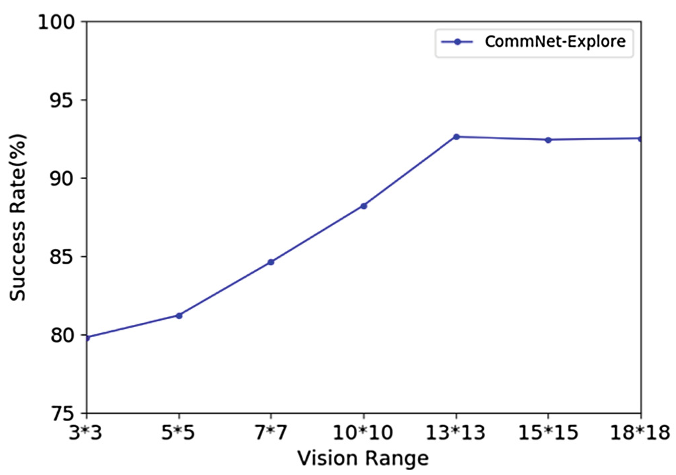
As dynamic obstacles increased, the "human-designed" methods saw sharp drops in success rates, whereas the learned policy remained resilient due to its learned adaptability.
 Caption: Comparison of success rates across different vision ranges and environmental complexities.
Understanding the "Shared Language"
Through t-SNE visualization (a technique to map high-dimensional data into 2D space), the researchers peeked into the robots' "conversations." They found distinct clusters in the communication vectors, proving that agents were sending specific, context-aware signals when navigating high-traffic areas like narrow corridors or connection points between rooms.
 Caption: (Left) t-SNE visualization of communication clusters. (Right) Spatial intensity of communication norms, showing agents communicate most at critical maze junctions.
Critical Analysis & Conclusion
CommNet-Explore provides a compelling proof-of-concept for replacing heuristics with learned policies in robotics. Its strength lies in its real-time decision-making and intrinsic adaptability.
Limitations:
- The study assumes a relatively stable communication channel. In real-world search-and-rescue (e.g., underground or collapsed buildings), bandwidth is often limited or intermittent.
- The localization is assumed to be perfect; integrating SLAM (Simultaneous Localization and Mapping) noise would be the next logical step.
Future Outlook: The ability to train communication via back-propagation opens the door for End-to-End Exploration Systems where perception, communication, and control are optimized simultaneously for the specific geometry of the task environment.