
Beyond Uniformity: Learning Social Diffusion Through Node Attributes
Learning Diffusion Probability Based on Node Attributes in Social Networks
This paper introduces an attribute-based Asynchronous Independent Cascade (AsIC) model that estimates link-level diffusion probabilities and time-delays as functions of node attributes. By formulating the task as a maximum likelihood problem, the researchers provide an iterative update algorithm that efficiently learns diffusion dynamics from sparse observation data.
TL;DR
Information doesn't spread uniformly across a social network; it depends on who is talking to whom. This paper moves away from estimating million-parameter link weights toward a smarter, attribute-driven approach. By linking diffusion probability directly to node characteristics (homophily), the authors create a model that is robust against data sparsity, resists overfitting, and identifies the truly influential nodes that "one-size-fits-all" models miss.
Background: The Sparsity Trap
In classical Information Diffusion (ID) research, models like the Independent Cascade (IC) rely on a fixed probability for information to jump from node to node . In a network with 10,000 nodes and 200,000 links, you would theoretically need to estimate 200,000 different probabilities. Given that we usually only observe a handful of viral cascades, this is a mathematical nightmare—a classic case of the "curse of dimensionality."
Most researchers "cheat" by assuming a uniform probability across all links. This paper argues that this simplification isn't just lazy; it’s analytically dangerous.
Methodology: The AsIC Global Parameter Profile
The authors extend the Asynchronous Independent Cascade (AsIC) model. Instead of treating every link as an independent variable, they define the diffusion probability () and the time-delay () using a functional dependency on node attributes:
- Diffusion Probability (): Modeled via a logistic sigmoid function of the dot product between a global weight vector and a link attribute vector .
- Time-Delay (): Modeled via an exponential function of weights .
This transforms the problem from estimating parameters to estimating parameters, where is the number of attributes (e.g., 10-20), significantly regularizing the model.

The learning is achieved through an Expectation-Maximization (EM)-like iterative algorithm. By proving that the Hessian of the objective function is non-positive definite, the authors guarantee that the algorithm will always converge to a stable solution using Newton's method.
Experimental Results: The Failure of Uniformity
The researchers tested their approach on three real-world datasets: Japanese Blog networks, Enron Emails, and Wikipedia.
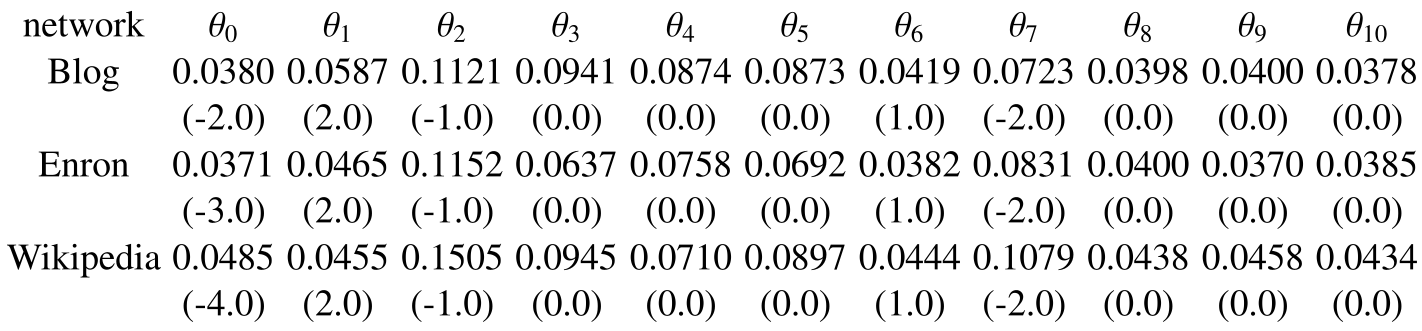
1. Parameter Recovery
The algorithm recovered the "true" underlying weights of node attributes with high precision across all networks, even with very few observed cascades.
2. The Influence Gap
The most striking finding is the comparison of Influence Degree (). The authors compared the true influence (based on attribute-dependent links) against their estimation () and a "Uniform" assumption ().
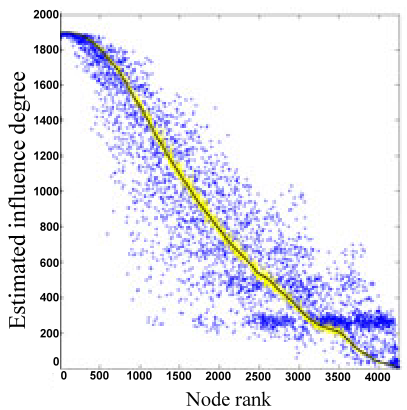
As shown in Figure 1, the uniform assumption (blue markers) deviates wildly from the truth. In the Blog network, the error for the uniform assumption was over 5.5 times higher than the attribute-based model. This proves that if the real world is heterogeneous (which it is), using average probabilities makes your influence maximization strategy essentially useless.
Critical Insight: Why This Matters
The core value of this work lies in its Inductive Bias. By encoding the intuition that "similar people influence each other" directly into the mathematical structure of the IC model, the authors allow the model to generalize. If we see a tech-savvy user influence another tech-savvy user once, the model can infer that similar interactions will likely happen elsewhere in the network, even on links it has never seen active.
Conclusion and Limitations
This paper provides a mathematically rigorous bridge between social theory (homophily) and machine learning (MLE). While the specific choice of attribute functions () is somewhat simple, the framework is extensible.
Future Work could involve:
- Integrating more complex, non-linear attribute mappings (e.g., using Neural Networks as the function approximator).
- Applying this to dynamic networks where attributes or link structures change over time.
- Testing the robustness of the model when node attributes are missing or noisy.
For practitioners in viral marketing or digital forensics, the takeaway is clear: know your nodes to understand your network.