
Automating Auction Design: Learning Optimal Discrete Bid Levels via Bayesian Inference
Learning Environmental Parameters for the Design of Optimal English Auctions with Discrete Bid Levels
The paper introduces an automated framework for designing optimal English auctions with discrete bid levels, moving beyond the traditional assumption of continuous bid increments. It proposes a Bayesian machine learning approach to estimate critical environmental parameters—expected bidder participation and valuation distributions—solely by observing historical closing prices.
TL;DR
Most English auctions in the real world (like eBay) don't allow for infinite price granularity; they use discrete bid levels. This paper provides a mathematical bridge between "ideal" auction theory and practical constraints. By using Bayesian Learning, the authors enable an automated auctioneer to "guess" the number of bidders and their budget distributions just by looking at past final prices, then mathematically optimize the bid steps to squeeze out maximum revenue.
Context: The Gap Between Theory and Practice
In classical mechanism design (e.g., Myerson, 1981), we often assume a "continuous" world where bidders can outbid each other by a penny or less. However, in digitized or oral auctions, increments matter. Large increments speed up the auction but leave money on the table; small increments maximize revenue but take too long.
The authors identify a major hurdle: To set the perfect increments, you need to know:
- How many people are actually "in the room" (not just those who bid, but those watching).
- The statistical distribution of their valuations.
Methodology: The Core Logic
The authors' contribution is three-fold: the revenue formula, the optimization algorithm, and the learning mechanism.
1. The Revenue Equation for Infinite Uncertainty
The paper derives a closed-form expression for expected revenue () that doesn't rely on a fixed number of bidders , but rather on a mean participation rate modeled as a Poisson process.
2. Finding the Optimal Levels
Since the revenue function involves complex interactions between neighboring bid levels (), the authors use a Jacobi iteration algorithm. It effectively "wiggles" each bid level one by one until the total expected revenue is maximized.
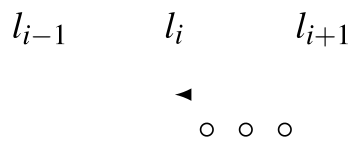 Figure 1: The logic behind how an auction ends at level depends on whether the highest bidder was already the "leader" or a new challenger.
3. Bayesian Parameter Estimation
This is where the "AI" comes in. The auctioneer maintains a "belief" (probability distribution) over the possible values of (number of bidders) and (valuation spread). Every time an auction ends, the closing price provides a "signal" to update this belief using Bayes' Theorem:
u | ext{data}) \propto P( ext{data} | u) P( u)$$ ## Experimental Insights The research reveals a fascinating "Inductive Bias" in bid levels: * **Uniform Distributions**: Optimal increments should actually *decrease* as the price goes up (get finer near the end). * **Exponential Distributions**: Increments should follow a U-shape, getting finer in the middle and wider at the high end. 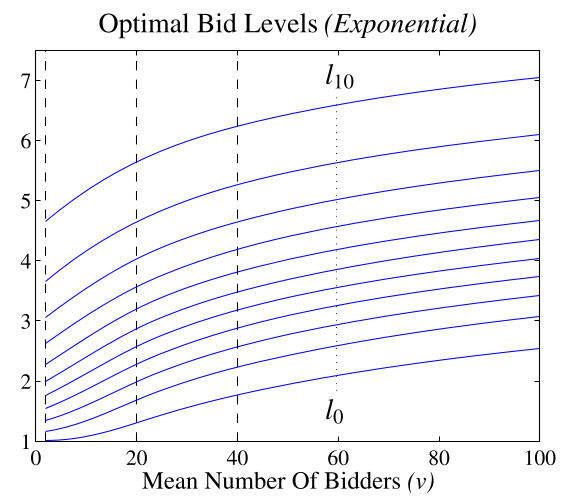 *Figure 2: Optimal bid levels for different bidder counts ($ u$). Note how the spacing changes based on the distribution type.* ### Convergence and Revenue The Bayesian approach is remarkably efficient. Even with a "flat" prior (no initial idea of the market), the system converges to the true environmental parameters within roughly 10-20 auctions. Crucially, the revenue generated by these "learned" levels consistently outperforms the industry-standard fixed-increment approach. 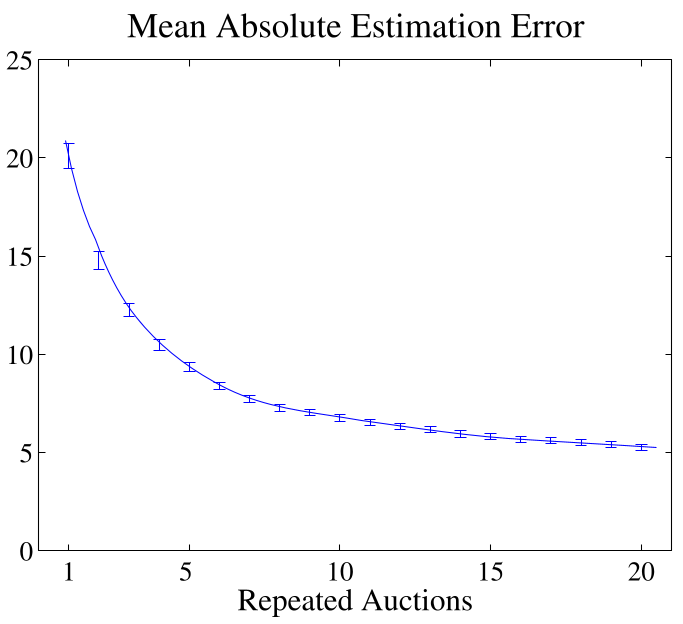 *Figure 3: Mean estimation error drops sharply, proving that closing prices are a "sufficient statistic" for practical auction tuning.* ## Critical Analysis & Future Outlook This work is a cornerstone for **Autonomous Trading Agents**. It treats mechanism design not as a static math problem, but as an online learning problem. **Limitations**: - The model assumes bidders don't change their behavior based on the auctioneer's learning (non-strategic bidders). - As the number of parameters grows (e.g., complex valuation shapes), the "Grid Search" for Bayesian updates becomes computationally expensive ($O(n^d)$). **Future Impact**: The authors suggest moving toward **Variational Inference** to handle higher-dimensional parameter spaces. This paves the way for sophisticated "Hyper-Heuristic" auctioneers that can identify the very *type* of market they are in (Model Selection) while simultaneously optimizing the rules of engagement. ## Takeaway If you are building an automated marketplace, don't just pick a $0.50 increment because it "feels right." By observing where your auctions close, you can mathematically derive a custom "ladder" of bid levels that maximizes your take while minimizing communication overhead.