
bSF: Bridging Physics and Probability for Socially Aware Navigation
16136_Learning Generative Socially Aware Models of Pedestrian Motion.
The paper introduces a Bayesian Generative Social Force model (bSF) for pedestrian motion prediction, integrating deep probabilistic layers into the classical physics-inspired social force framework. It achieves state-of-the-art Average Displacement Error (ADE) on the ETH and UCY benchmarks by capturing complex multi-agent interactions and latent intentions.
Executive Summary
TL;DR: This work presents a Bayesian Generative Social Force model (bSF) that transforms the classic, deterministic Social Force Model into a hierarchical probabilistic framework. By explicitly modeling latent variables like "crossing intention" and "contextual awareness," it provides a more robust and interpretable solution for predicting human trajectories in complex urban environments.
Background: Within the landscape of trajectory prediction, we have long seen a tug-of-war between Physics-based models (interpretable but rigid) and Deep Learning models (expressive but opaque). This paper stands as a sophisticated "theoretical bridge," inserting Bayesian logic into the Social Force framework to handle real-world uncertainty.
Problem & Motivation: The "Blind Spot" of Determinism
Existing pedestrian models often suffer from two extremes:
- Determinism: Classic Social Force Models assume humans follow fixed mathematical "forces." They provide a single trajectory, failing to account for the fact that a pedestrian might choose to pass a vehicle on the left or the right.
- Lack of Context: Most models ignore "intention." Does the pedestrian see the car? Are they planning to cross at the zebra crossing? Without answering these latent questions, long-term prediction becomes a guessing game.
The author's insight is that human motion is not just about physical repulsion; it's a hierarchical decision process influenced by awareness, social norms, and physical constraints.
Methodology: The Hierarchical DBN
The core of the paper is a Dynamic Bayesian Network (DBN) organized into three hierarchical levels.
1. The Intentional Layer (Top Level)
This level handles high-level cognitive states:
- Contextual Awareness (): Uses a sigmoid model to determine if a pedestrian is actually looking at oncoming traffic based on head orientation.
- Crossing Intention (): A Markovian state that re-weights the probability of crossing based on proximity to zebra crossings (incorporating map priors).
2. The Behavioral Layer (Middle Level)
- Stop/Walk Switch (): A binary variable that estimates "collision criticality." If the risk is too high, it triggers a "stop" state.
- Orientation (): Latent variables for body and head angles, which provide early cues for changes in motion direction before the actual displacement occurs.
3. The Stochastic Social Force Layer (Bottom Level)
Unlike the standard SFM, this layer uses an Euler-Maruyama integration to treat motion as a stochastic process. The interaction force is redefined to act orthogonally to the agent's velocity, which the author found significantly stabilizes motion dynamics compared to traditional radial forces.
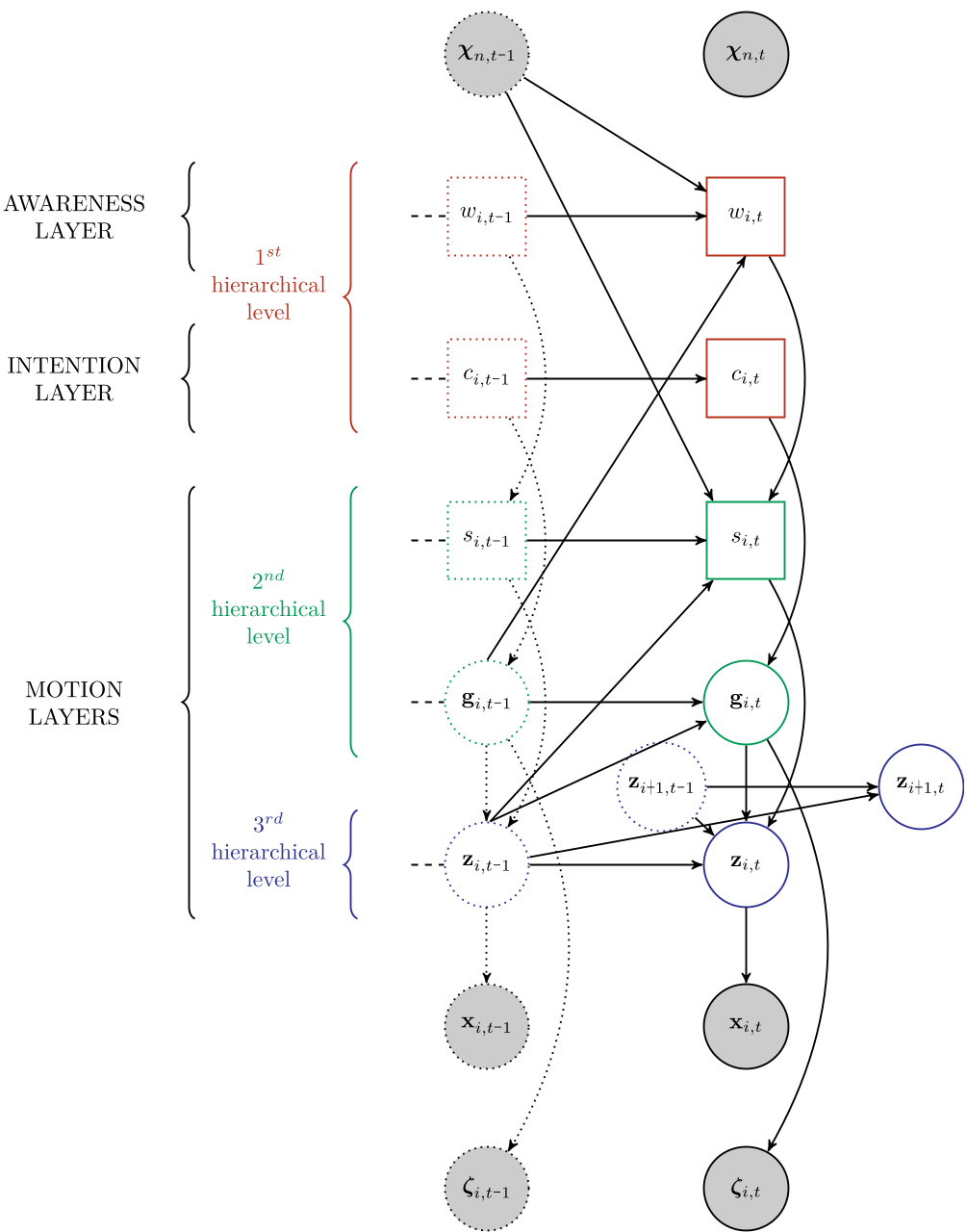 The graphical representation of the DBN, showing the hierarchical dependencies from intention down to kinematic state.
Experiments & Results: SOTA Efficiency
The author evaluated the bSF model on the standard ETH and UCY datasets.
- Quantitative Performance: The bSF model achieved an Average ADE of 0.26, surpassing the famous Social LSTM (0.27) and Social GAN (0.58). This is particularly impressive because bSF does not require the "future ground truth" of other agents to formulate its fields, unlike some social force baselines.
- Ablation Study: The experiments confirmed that removing the "Intentional Layer" significantly degraded accuracy over 3-second horizons, proving that understanding why a human moves is as important as how they move.
 Comparative results showing bSF leading in Average Displacement Error (ADE) across most benchmarks.
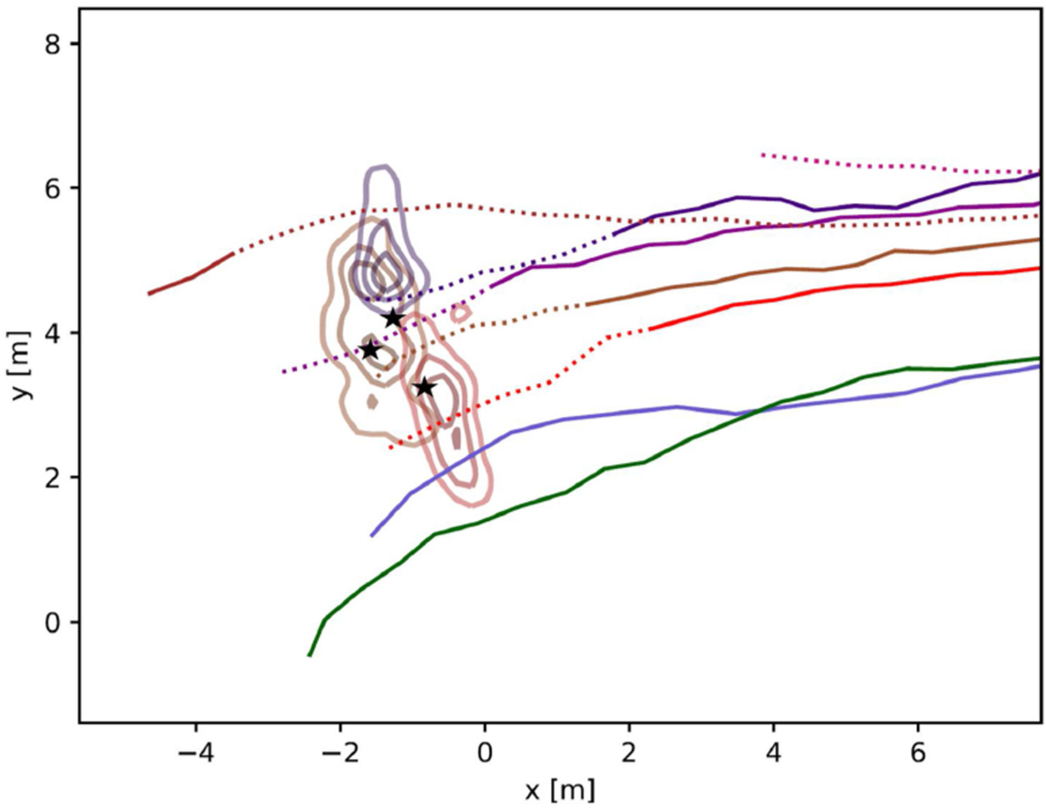 Qualitative view: bSF generates multimodal probability distributions, capturing different behavioral hypotheses in crowded scenes.
Critical Analysis & Takeaways
Key Contribution: The true value of this work is its interpretability. Unlike a GAN, where the "social rules" are buried in weights, here the social rules are explicit (e.g., "stop if collision risk > threshold"). This allows for much safer integration into autonomous vehicle stacks where "explainability" is a regulatory requirement.
Limitations: While the model excels in short-to-medium range ADE, it falls slightly behind deterministic models in Final Displacement Error (FDE) for very long-term predictions. This suggests that the "driving force" (destination-seeking) still relies on knowing the pedestrian's final goal, which is often unknown in the real world.
Future Outlook: The author suggests moving toward a hybrid approach—retaining the structured Bayesian hierarchy but using Neural Networks to parameterize the conditional local densities, potentially capturing the "best of both worlds."