
PSI: Harmonizing Individual Habits and Social Trends for Robust Location Prediction
Learning Individual Moving Preference and Social Interaction for Location Prediction
The paper introduces PSI (Individual Moving Preference and Social Interaction), a robust location prediction model that integrates internal user habits with group-level social trends. Evaluated on Porto Taxi and Geo-life datasets, PSI achieves state-of-the-art performance by quantifying the dual drivers of human mobility using ridge regression.
TL;DR
Predicting where a person will go next is easy when they follow a routine, but what if their movement is as random as a taxi driver's? The PSI (Preference and Social Interaction) model bridges this gap by combining an individual's past habits with the "collective wisdom" of social groups. By using a two-stage clustering method for POIs and a ridge regression framework, PSI achieves over 96% accuracy in ranking the next likely destination, outperforming traditional Markov-based models.
The Challenge: Beyond the "Home-Work" Routine
Most location prediction algorithms assume humans are creatures of habit. While true for office workers, many mobility patterns—especially in the gig economy (taxis, delivery)—are highly dynamic.
The authors identified two major roadblocks in current research:
- Information Loss: GRID-based methods ignore location importance, while standard POI extraction ignores "boring" but essential transit points.
- Individual Randomness: Relying solely on one person's history cannot account for external "shocks" like concerts, traffic accidents, or holidays that influence movement.
Methodology: The Dual-Engine Approach
The PSI model operates on a sophisticated pipeline designed to transform raw GPS pings into actionable insights.
1. Two-Stage POI Extraction
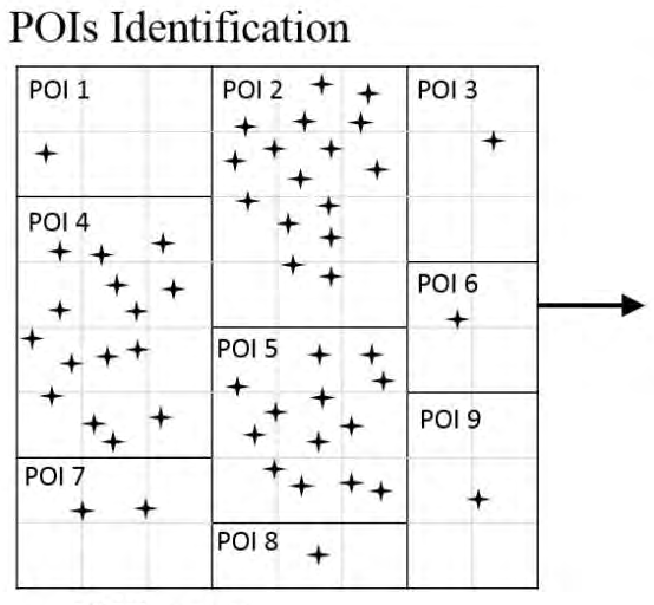
Instead of just looking at "hotspots," the authors use DBSCAN to find dense areas (Hot POIs) and then apply K-means to the remaining "noisy" data to capture "Normal POIs." This ensures the semantic trajectory is complete.
2. Modeling the "Why" and "How"
The model splits the prediction logic into two components:
- Internal Preference (IMP): Uses a decay function to give more weight to recent habits.
- Social Interaction (ESI): Clusters users based on Jensen-Shannon Divergence and mines group-level trends using Prefix-Span. This captures the "group trend"—if everyone is heading to the stadium, the taxi driver likely will too.
3. Quantitative Fusion via Ridge Regression
Instead of a "black box" neural network, PSI uses Ridge Regression to fuse these factors. This allows the model to explicitly calculate how much a user is driven by personal habit versus social trends.
Experimental Results: SOTA Performance
The model was tested against major baselines including HMM and Collaborative Filtering (TWFM).
- Accuracy: On the Porto Taxi dataset, PSI consistently achieved higher Acc@1 and MAP (Mean Average Precision) scores.
- Robustness: Even as the "randomness" (entropy) of individual movement increased, the inclusion of group-level patterns kept the prediction error low.
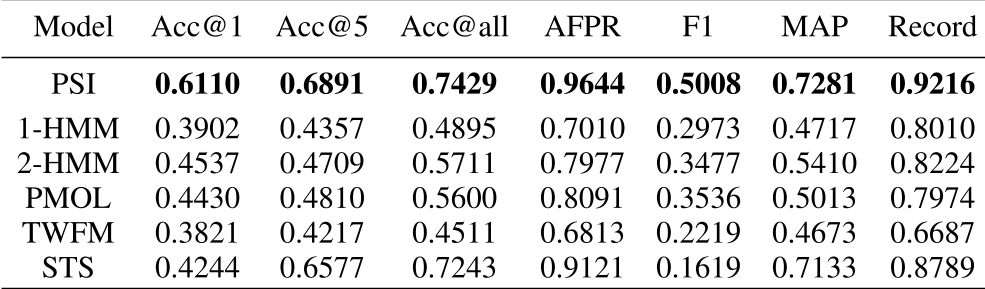
As shown in the comparison, PSI outperforms 1-order and 2-order Hidden Markov Models (HMM) by a wide margin, particularly in the Porto dataset where taxi movement is notoriously difficult to track.
Deep Insight: Habit vs. Conformity
One of the most fascinating findings of the paper is the quantification of human behavior. The study found that on average, habit (IMP) accounts for ~66.9% of movement in taxis, but social interaction (ESI) accounts for a staggering 33.1%. In more social datasets like Geo-life, the split is nearly 50/50. This proves that we are significantly influenced by our "associated groups," even when we think we are moving independently.
Conclusion
The PSI model represents a shift toward more "socially-aware" AI. By treating group patterns as a filter for individual noise, it achieves a high degree of robustness. While it currently operates on structured GPS data, the logic of balancing personal history with group trends is a blueprint for the next generation of urban computing and personal assistants.
Future Outlook: The next step for this tech lies in real-time "Data Stream Mining," where the model can update its beta coefficients on the fly as city-wide events unfold.