
Decoding Social Influence: How to Learn Why We Follow Others
Learning influence probabilities in social networks
The paper introduces a comprehensive framework for learning influence probabilities in social networks by mining historical action logs. It proposes several probabilistic models—Static, Continuous Time, and Discrete Time—and validates them on a massive Flickr dataset (1.3M nodes, 35M actions), achieving state-of-the-art predictive performance for social influence.
TL;DR
While viral marketing researchers often talk about "influentials," they rarely explain where influence probabilities come from. This paper bridges that gap by providing a mathematical framework to extract these probabilities from raw action logs. By introducing time-decaying models, the authors achieve high accuracy in predicting not just if a user will act, but when.
Background: The Missing Link in Viral Marketing
The academic world has been obsessed with "Influence Maximization"—the art of picking users to start a wildfire of adoption. However, almost all existing algorithms require a social graph with pre-labeled edges (e.g., "User A has a 0.15 chance of influencing User B"). In reality, these numbers don't exist. We only have logs: "User A joined the group at 10:00 AM" and "User B joined at 11:00 AM." This paper provides the "missing link" to transform these logs into actionable probabilities.
The Core Intuition: Time is Everything
The authors argue that influence is not a static property. If your friend buys an iPhone today, you are most likely to be influenced in the next few weeks. A year later, your purchase is probably due to a sale or a broken phone, not your friend's influence.
To capture this, they propose the Continuous Time (CT) Model, where influence decays exponentially over time:
Methodology Breakdown
The authors categorize their solutions into three primary buckets:
- Static Models: Use simple ratios (like Bernoulli trials or Jaccard similarity) to assign a fixed number to an edge.
- Continuous Time (CT) Models: Incorporate an exponential decay function. These are the most accurate but computationally expensive because they cannot be updated incrementally.
- Discrete Time (DT) Models: A clever approximation where influence is constant for a window () and then drops to zero. This allows for incremental updates, making it feasible for datasets with millions of edges.
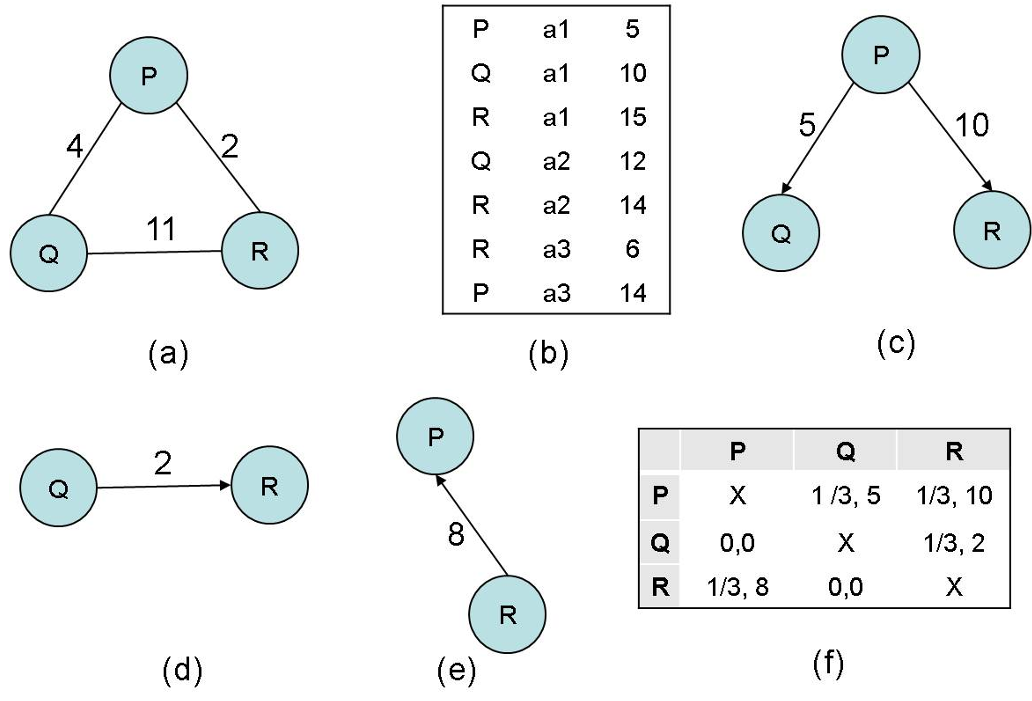 Figure: The transition from a social graph to a propagation graph based on action timestamps.
Proving Influence in the Real World (Flickr)
One of the paper's strongest contributions is the scale of its experiment. Using Flickr data, they prove that social influence is a real phenomenon—challenging critics who claim social behavior is just random correlation.
Key Breakthroughs in Prediction
The researchers found that the Discrete Time Model is the "sweet spot." It offers nearly identical performance to the complex Continuous Time model but is significantly faster to test on massive graphs.
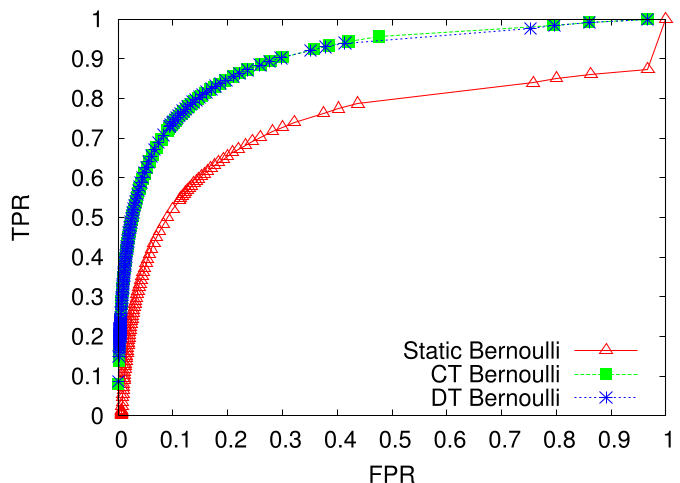 Figure: Performance comparison showing that time-conscious models (CT/DT) far outperform static metrics.
They also introduced two vital metrics:
- User Influenceability: Some people are "sheep" (easily influenced), while others are "mavens" (initiators).
- Action Influence Quotient: Some actions (like joining a niche hobby group) are highly social, while others (like tagging a photo) are personal.
Critical Insight & Future Outlook
The beauty of this work lies in its scalability. By ensuring that their functions are submodular and incremental, the authors developed algorithms that only need two passes over the data.
Limitations: The model assumes influence probabilities between neighbors are independent. In reality, "community pressure" (being influenced by 10 friends at once) might be much stronger than the sum of its parts.
Future Work: This framework lays the foundation for "Time-Aware Viral Marketing." Instead of just picking influencers, future apps could pick the perfect time to push a recommendation to maximize the chance of a chain reaction.
Conclusion
This paper transforms the abstract theory of social influence into a data-driven science. By proving that influence can be learned and predicted using nothing more than a timestamped log, it empowers platforms to better understand the hidden dynamics of their users.