
m-DNE: Mastering Social Recommendation via Multi-Granularity Dynamic Network Embeddings
Learning Multi-granularity Dynamic Network Representations for Social Recommendation
The paper introduces m-DNE (Multi-granularity Dynamic Network Embedding), a framework for online social recommendation that represents heterogeneous users and items in a shared low-dimensional space. By integrating temporal dynamics and community structures, it achieves SOTA performance in recommending both relevant users and items.
TL;DR
Recommending content in a fast-moving social stream is a "triple threat" challenge: you must handle diverse data types (users, posts, tags), massive scale (millions of nodes), and constant evolution. m-DNE (Multi-granularity Dynamic Network Embedding) solves this by embedding a Heterogeneous User-Item (HUI) network into a unified vector space. By capturing both local interactions and global community structures incrementally, it provides a scalable, SOTA solution for both friend and item recommendations.
Problem & Motivation: The Static Trap
Most recommendation engines are built on Collaborative Filtering (CF). However, CF often hits a wall in social media because:
- Cold Start: New users and items arrive every second, leaving no historical interaction for CF to analyze.
- Heterogeneity: Social networks aren't just User-Item pairs; they involve User-User social links and Item-Item semantic links (hashtags, categories).
- Dynamics: Relationships and interests fade or surge over time.
While Network Representation Learning (NRL) has emerged as a fix, existing methods like DeepWalk or LINE focus too much on local neighbors (1st/2nd order proximity), ignoring the global community structure that often defines user identity and interest clusters.
Methodology: The Core of m-DNE
The researchers proposed a three-stage pipeline to bridge the gap between local connectivity and global context.
1. The HUI Network Construction
Instead of a simple graph, m-DNE builds a Heterogeneous User-Item (HUI) network. It uses a transition probability matrix governed by three weights:
- : Importance of user-item interaction (behavior).
- : Importance of social links (trust).
- : Importance of semantic similarity (content).
2. Community-Aware Integration
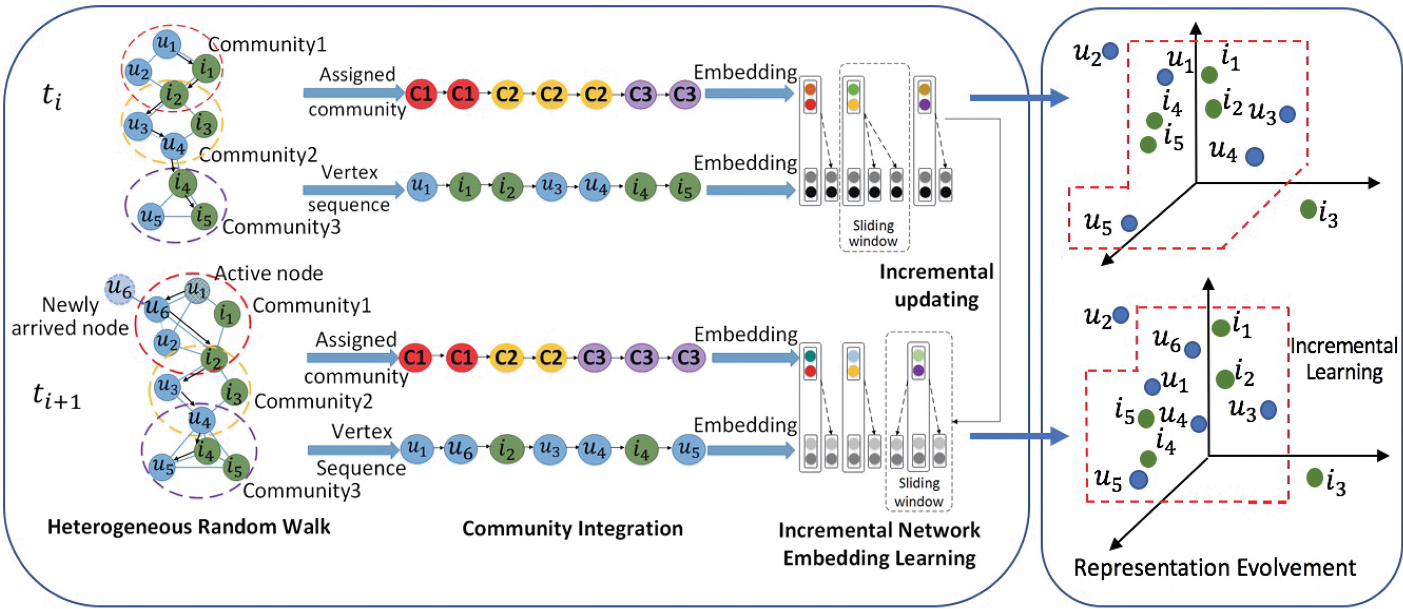
This is the "secret sauce." The model assumes every node sequence generated by a random walk belongs to a community distribution. Using Streaming Gibbs Sampling, the model assigns nodes to communities on the fly as the network evolves, capturing high-order proximity without needing a full graph recalculation.
3. Incremental Learning with Hierarchical Softmax
To make the model "online-ready," m-DNE uses an incremental update rule. When new edges or nodes appear, only the active nodes and their neighbors are updated in the embedding space. By using Hierarchical Softmax and Lock-free ASGD (Asynchronous Stochastic Gradient Descent), the system scales to millions of nodes with ease.
Experiments: Superiority in the Wild
The model was tested against heavyweights like Metapath2vec and M-NMF on three massive datasets (Twitter, Last.fm, Flickr).
SOTA Performance
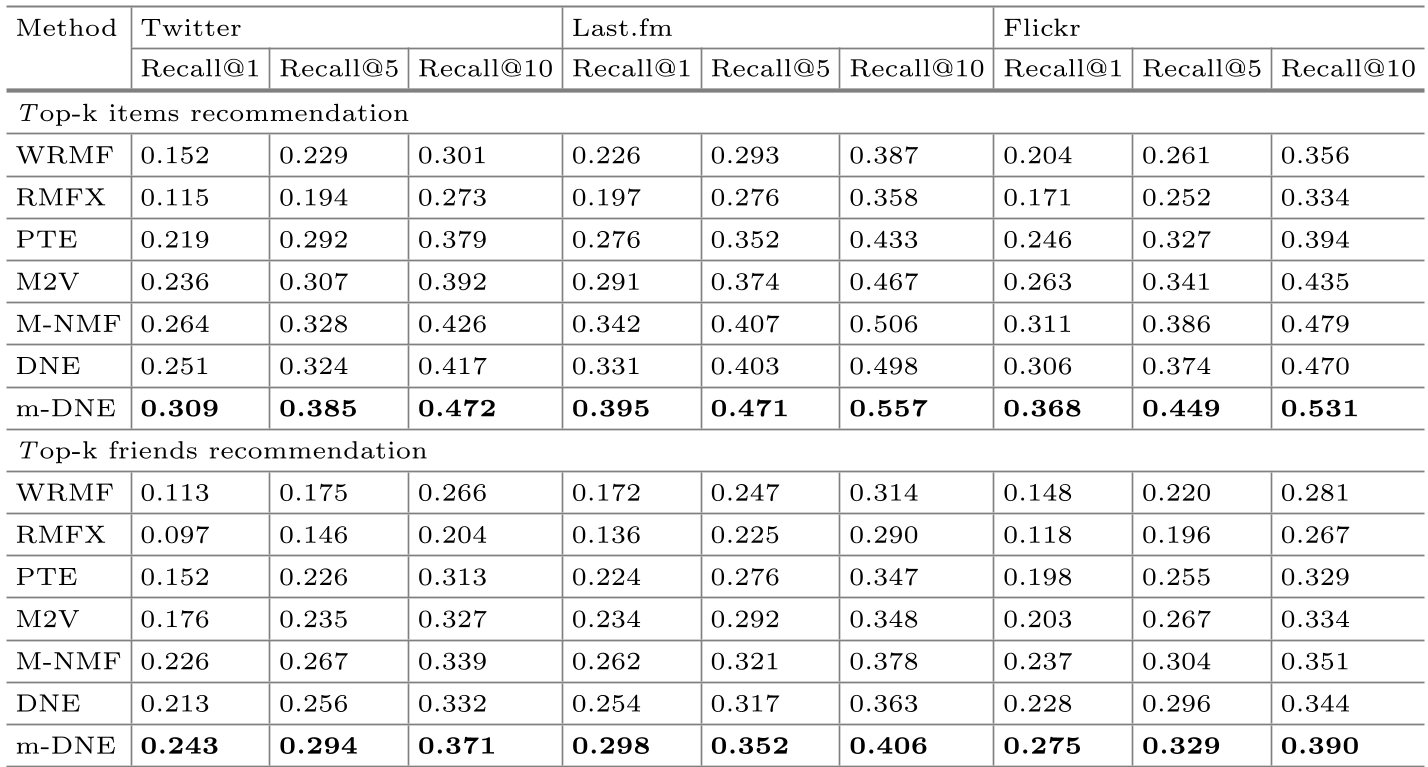
m-DNE consistently achieved the highest Recall@K across all tasks. Notably, it excelled in "Friend Recommendation," a task where traditional item-centric models typically struggle.
Solving the Cold-Start Riddle
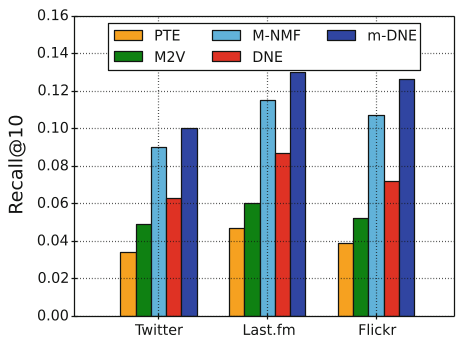
In one of the most revealing tests, the researchers isolated "cold-start" users (those with <20 interactions). While traditional matrix factorization models essentially failed, m-DNE’s ability to leverage social signals and community attributes allowed it to maintain high recommendation accuracy.
Critical Insight & Future Outlook
The primary contribution of m-DNE is the realization that node identity is tied to community belonging. By treating a community anchor as a first-class citizen in the embedding optimization (averaging node and community vectors), the model gains a robust inductive bias that protects it against the noise of sparse individual data.
Limitations: While m-DNE handles structural dynamics well, it still relies on a time-decay function for "freshness." Future iterations could benefit from integrating RNNs or Transformers to capture short-term shifting user intent more granularly.
Takeaway for Practitioners: If you are building a recommendation system for a dynamic, multi-relational environment, don't just look at who a user follows; look at the community they are gravitating toward.