
PTPMF: Decoding the Individual Weight of Strong and Weak Ties in Social Recommendation
Learning Personalized Preference of Strong and Weak Ties for Social Recommendation
The paper introduces PTPMF (Personalized Social Tie Preference Matrix Factorization), a social recommendation method that distinguishes between strong and weak ties. It leverages Jaccard's coefficient and a learnable threshold to classify social connections and achieves SOTA performance on four real-world datasets across multiple metrics.
TL;DR
Most social recommender systems treat all your friends equally. PTPMF (Personalized Social Tie Preference Matrix Factorization) breaks this mold by recognizing that some users are influenced by their inner circle (Strong Ties), while others are swayed by broader, more diverse acquaintances (Weak Ties). By learning a personalized "tie preference" for every user, the model achieves a significant leap in recommendation accuracy, especially for "cold-start" users who haven't rated many items yet.
Problem & Motivation: The "Flat" Social Network Fallacy
In social science, the Granovetter's Theory suggests that while strong ties (close friends) are trustworthy, weak ties (acquaintances) are the primary bridges for new information.
Existing Social Recommenders (like SMF or SoRec) usually treat the social graph as a binary constraint: you are either connected or you aren't. Even the rare models that did distinguish between tie types assumed a "one-size-fits-all" approach—assuming everyone values strong ties more. In reality, trust is personal. A tech enthusiast might trust an acquaintance's gadget review (Weak Tie) more than their best friend's (Strong Tie) if that acquaintance is an expert. Ignoring this Personalized Tie Preference results in sub-optimal recommendations.
Methodology: The PTPMF Architecture
The core innovation of PTPMF lies in its ability to simultaneously learn three things:
- Who is a strong/weak tie: It uses Jaccard’s Coefficient (neighbor overlap) but doesn't fix the threshold ; it learns it.
- User Latent Vectors: It creates separate "influence" vectors ( and ) representing the collective wisdom of a user's strong and weak ties respectively.
- The Personalized Switch (): A probability variable that determines how much a specific user weighs the "weak tie" signal versus the "strong tie" signal.
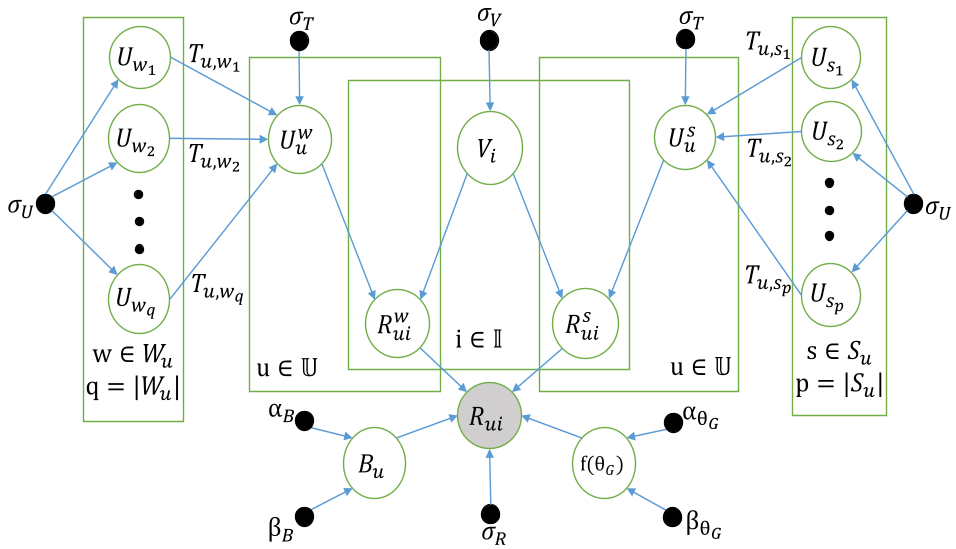
The model uses Maximum A Posteriori (MAP) inference and gradient descent to optimize these parameters. Unlike standard Matrix Factorization, the objective function includes a delicate balance of social regularization terms that allow the model to learn the optimal "separation" of ties that results in the highest rating accuracy.
Experiments & Results: Proving the Power of Personalization
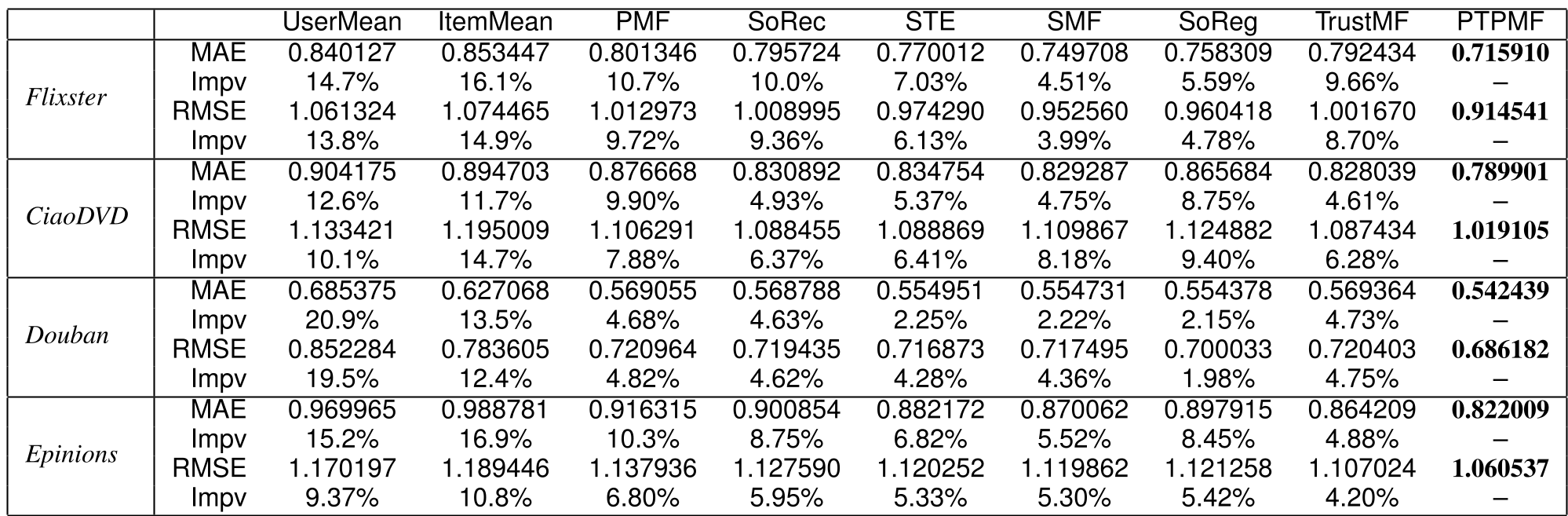
The authors tested PTPMF against eight baselines (including big names like TrustMF and SoRec) across four massive datasets: Flixster, CiaoDVD, Douban, and Epinions.
1. Robust Performance Gains
PTPMF consistently outperformed all competitors. On the Flixster dataset, it achieved a 10.7% improvement over standard PMF and nearly 4% over the best social baseline (SMF) in terms of MAE.
2. Solving the Cold-Start Problem
For users with fewer than 5 ratings ("cold-start"), social signals are the only lifeline. PTPMF showed the most significant lead in these scenarios, proving that accurately weighting tie types is more effective than just "averaging" your friends' opinions.
3. The Learnt Threshold Advantage
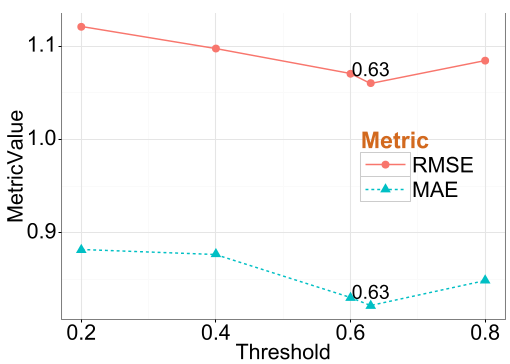
One of the most interesting findings was that the optimal threshold varied significantly by dataset. By allowing the model to learn the threshold rather than fixing it at 0.5, the authors saw a clear drop in error (RMSE/MAE).
Critical Insight & Conclusion
PTPMF validates a core sociological intuition: Trust is heterogenous. The success of this model suggests that future recommender systems should move away from global social assumptions and toward models that can adapt to the "social personality" of each user.
Limitations: The model uses a global threshold for the whole network. Ideally, as the authors suggest, even the definition of a "strong tie" should be personalized, as different people perceive the "closeness" of their network differently.
Future Outlook: Integrating these concepts into Graph Neural Networks (GNNs) with attention mechanisms could further refine how influence propagates through these multi-typed social edges.