
Hierarchical Hubs: Deciphering the Speed of Learning in Social Trees
Rate of learning in hierarchical social networks
This paper investigates the social learning rate in hierarchical -ary rooted trees for binary hypothesis testing. It establishes that error probabilities at the root converge to zero at a sub-exponential rate, specifically , under both non-Bayesian majority dominance and Bayesian likelihood-ratio fusion rules.
TL;DR
In large-scale organizations—from military units to corporate hierarchies—information is filtered and passed upward. This paper provides a rigorous mathematical proof that these networks can "learn" the truth even if individuals are fallible. However, the learning speed is sub-exponential, governed by the branching factor (). The larger the groups within the tree, the faster the organization converges on the correct decision.
The "Herding" Trap and the Tree Solution
In linear social networks, we often see herding: if the first few people pick Restaurant A, everyone else follows, even if their own senses suggest Restaurant B is better. This leads to a total failure of collective wisdom.
The authors pivot to Hierarchical Tree Structures, where agents only observe their direct subordinates. This structure is the "worst-case" for speed because the root is maximally distant from the actual data (the leaf agents), but it is the most resilient against the cascading errors found in sequential models.
Methodology: The Math of Groupthink
The core of the paper lies in how an agent at level aggregates binary messages. The authors examine two specific fusion rules:
- Majority Dominance (Non-Bayesian): A simple democratic vote. If most subordinates say "Hypothesis 1," the supervisor sends "1" up the chain.
- Bayesian Likelihood-Ratio Test: A more sophisticated approach where each supervisor knows the error rates of their subordinates and calculates a statistically optimal summary.
The Recursive Engine
The authors define as the function that transforms the error rate of a subordinate into the error rate of a supervisor. For an odd-numbered branching factor , the recursion follows:
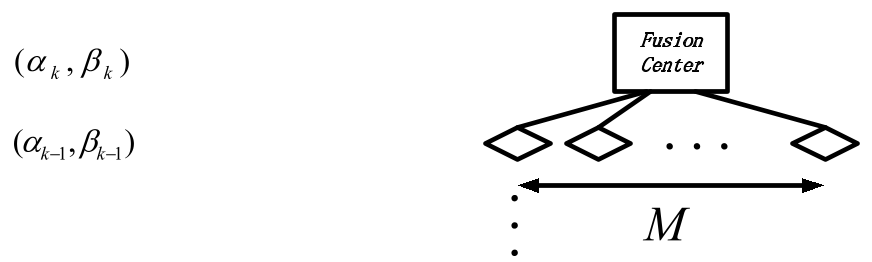 Fig 1: The information flow from leaf measurements (circles) through relay diamonds to the final root decision.
Key Insights: Why Branching Factor Matters
The most striking discovery is the Convergence Rate. The error probability doesn't vanish instantly; it follows a scaling law:
What does this mean in plain English?
- Sub-exponential Learning: Unlike a flat network where error drops like , in a tree, the "depth" slows things down.
- The Power of : As the branching factor grows, the exponent approaches 1. This means a "wide" tree (like a modern flat corporation) learns much faster than a "tall, narrow" tree (like a traditional bureaucracy).
Experimental Results & Comparison
The authors highlight that in Even-ary Trees (e.g., ), a simple majority rule fails to improve the error rate—a tie-break eventually stalls the learning. However, by using an Alternative Majority Dominance (alternating tie-break rules between levels), they can recover a learning rate of .
 Theorem 1 suggests that the rate of learning is bounded by these specific logarithmic factors, providing a roadmap for network architects.
Critical Analysis & Conclusion
This work bridges the gap between signal processing and social science. By proving that the Bayesian likelihood-ratio test (locally optimal) achieves the same asymptotic rate as the globally optimal strategy, the authors suggest that "selfish" or "myopic" local optimization is actually sufficient for an organization to reach peak performance.
Limitations: The model assumes agents are perfectly reliable and measurements are independent. In reality, "fake news" or correlated biases (a common boss's influence) could significantly degrade these rates.
Future Work: The next frontier is analyzing Correlation. If leaf agents live in the same "echo chamber," does the hierarchical structure still manage to filter out the noise? This paper provides the mathematical foundation to answer that pressing question.