
Beyond Manual Engineering: Learning Affect-Salient Features for Robust Speech Emotion Recognition
Learning Salient Features for Speech Emotion Recognition Using Convolutional Neural Networks
This paper introduces a novel Speech Emotion Recognition (SER) framework using Convolutional Neural Networks (CNN) to automatically learn affect-salient features. By combining unsupervised learning via Sparse Auto-Encoders (SAE) with a supervised Salient Discriminative Feature Analysis (SDFA) stage, the method achieves state-of-the-art performance across multiple benchmark datasets, significantly outperforming traditional hand-crafted acoustic features.
TL;DR
Recognizing emotion in speech is notoriously difficult because a person's voice carries far more information about their identity and surroundings than their actual mood. This paper presents a breakthrough CNN-based framework that doesn't just "extract" features—it learns to separate pure emotional signals from the "noise" of speaker variation and environmental distortion through a process called Salient Discriminative Feature Analysis (SDFA).
The "Cocktail Party" Problem of Emotion Recognition
In the realm of Affective Computing, researchers have long struggled with the volatility of Speech Emotion Recognition (SER). Traditional methods rely on hand-crafted features like pitch, Mel-frequency cepstral coefficients (MFCC), and energy. However, these features are "entangled." A person’s pitch might rise because they are angry, but it might also be naturally high because of their gender or age.
The authors argue that existing hand-tuned sets cannot sufficiently characterize emotional content across different scenarios. To solve this, they treat SER not as a signal processing problem, but as a representation learning problem.
Methodology: The Two-Stage Disentanglement
The proposed CNN architecture processes raw spectrograms through a sophisticated hierarchy designed to filter out nuisance factors.
1. Unsupervised Local Invariants
Before looking at labels, the model uses a Variant of Sparse Auto-Encoder (SAE) to learn kernels from unlabeled data. This stage focuses on extracting Local Invariant Features (LIF). By using patches of different scales ( and ), the network captures the fundamental "textures" of the spectrogram—intensity patterns and frequency shifts—invariant to minor shifts in time or frequency.
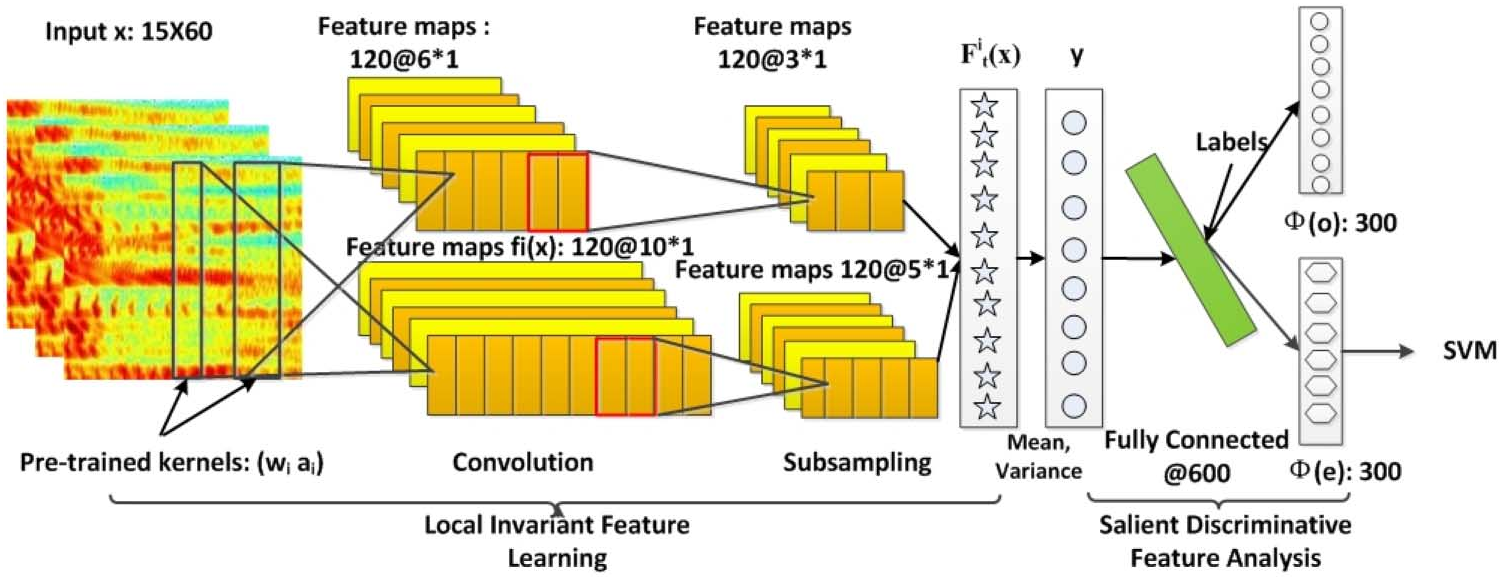 Figure 1: The CNN architecture involving convolutional layers for LIF and a fully connected layer for SDFA.
2. The SDFA Objective: Saliency and Orthogonality
The real magic happens in the Salient Discriminative Feature Analysis (SDFA) layer. The network splits the internal representation into two distinct blocks:
- : The Affect-Salient block (targeted at emotion).
- : The Non-Discriminative block (capturing speaker identity, noise, etc.).
To ensure these two blocks don't overlap, the authors introduced a novel objective function. It doesn't just minimize prediction error; it enforces orthogonality. By forcing the "sensitivity vectors" of these blocks to be perpendicular in the mathematical space, the model ensures that the emotional features are truly independent of the speaker's background characteristics.
Experimental Proof: Robustness in the Wild
The researchers tested their model against four major datasets (SAVEE, Emo-DB, DES, MES) spanning different languages (English, German, Danish, Mandarin).
Visualizing the Disentanglement
One of the most striking results is the feature visualization. When comparing the same emotion ("Surprise") across two different speakers, the affect-salient features () remained nearly identical, while the non-discriminative features () absorbed all the speaker-specific differences.
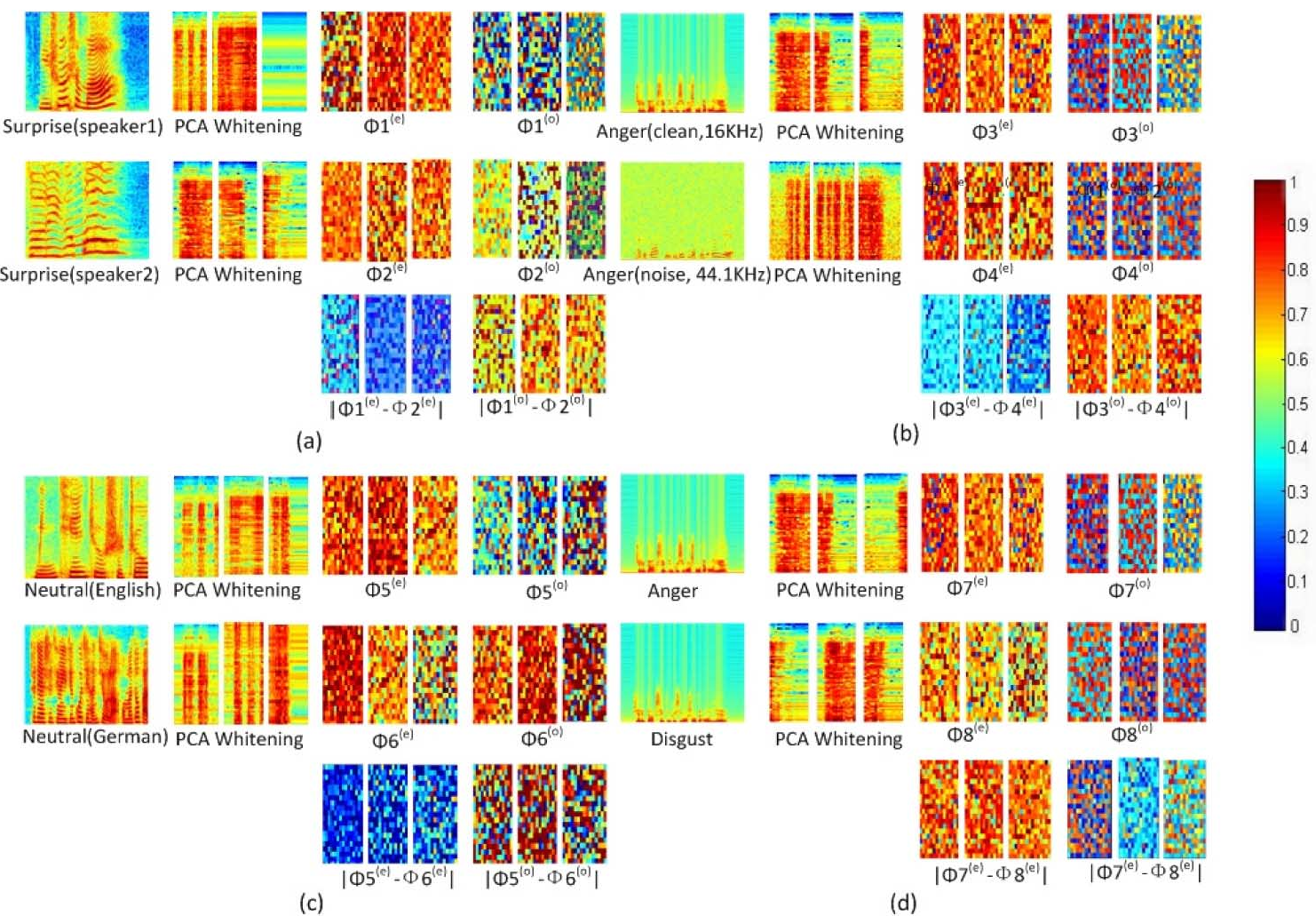 Figure 2: Visualization showing that affect-salient features remain stable across speakers, while noise-related features capture the differences.
Beating the Baselines
The performance metrics (Table I & II) confirm that SDFA consistently outperforms the "openEAR" toolkit—a gold standard in the industry.
- In Noisy Environments: SDFA maintained high accuracy where traditional features (A1, RAW) plummeted.
- Cross-Language Scenarios: Even when trained on English and tested on German, the learned features captured the universal "physics" of emotion better than hand-crafted rules.
Deep Insight: Why This Matters
This paper marks a shift from "describing" speech to "deconstructing" it. By mathematically encoding the intuition that emotion is a distinct "layer" of a signal that can be separated from the speaker's identity via orthogonality, the authors provide a template for robust signal processing in any domain where signal-to-noise ratios are low.
Future Outlook
While the results on laboratory-recorded datasets are stellar, the next frontier remains naturalistic, spontaneous speech. Real-world emotions are subtle and continuous rather than "prototypical." However, the SDFA framework's ability to ignore environmental distortion suggests it is well-positioned for these more difficult "in-the-wild" applications.
Conclusion
By introducing the first feature-learning framework for SER, Mao et al. have demonstrated that AI can "unmix" the complex audio cocktail of human speech. Their work proves that affect-salient features are not found by better microphones, but by better mathematical constraints on how deep networks represent information.