
Beyond Static Groups: Adaptive Privacy via Reinforcement-Style Learning in OSNs
Learning to Share: Engineering Adaptive Decision-Support for Online Social Networks
The paper introduces "Learning to Share," an adaptive software architecture for Online Social Networks (OSNs) that provides decision support to mitigate privacy risks like cross-posting. By utilizing parametric Markov chains (PMCs) and runtime monitoring, it dynamically classifies contacts into "super," "safe," or "risky" groups to optimize the balance between social benefit and privacy.
TL;DR
Static privacy settings are failing us. When a contact "copy-pastes" your private post to a wider audience (cross-posting), traditional OSN barriers crumble. This paper introduces a Learning to Share architecture: an adaptive system that monitors real-time social interactions to predict privacy risks and social rewards, dynamically suggesting the safest and most beneficial audience for every post.
Behind the Motivation: The "Cross-Posting" Trap
In the current OSN landscape (Facebook, LinkedIn), we rely on "Friend Groups." The authors point out a glaring flaw: these groups assume social trust is static.
Consider the "Tom and Ann" scenario: Tom is a close friend who receives your private post. He copy-pastes it to his wall, which is visible to Ann—someone you intentionally excluded. Facebook can't block this because it's technically a "new" post. The authors argue that OSNs need to detect these behaviors over time and adjust sharing recommendations accordingly.
Methodology: High-Stakes Logic and Markov Chains
The core of the "Learning to Share" approach is treating a friend's behavior as a Parametric Markov Chain (PMC).
1. Modeling Interaction as Probabilities
The system models two parallel processes for every contact:
- Social Interaction (M1): The probability of likes and comments.
- Reshare Behavior (M2): The probability of a contact resharing a post based on its sensitivity level ().
2. The Feedback Loop
The architecture follows a classic MAPK-like loop (Monitor, Analyze, Plan, Execute):
- Monitor: An OSN wrapper tracks likes, comments, and similarity-based cross-posts.
- Learning Engine: Updates the PMC parameters using a Bayesian algorithm with "Observation Ageing." This ensures that recent "betrayals" or "interactions" weigh more heavily than old history.
- DSS (Decision Support System): Uses the model to calculate a score for every friend.
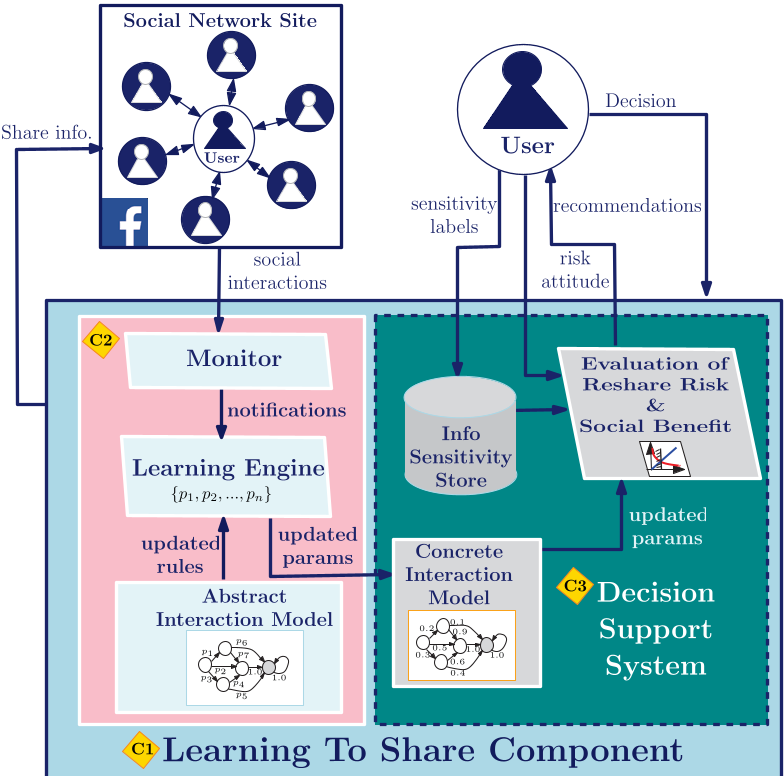 Figure 1: The proposed architecture separating OSN-specific wrappers from the core learning logic.
Mathematical Intuition: Risk vs. Reward
The system doesn't just look at risk; it looks at Utility.
Social Benefit (): This formula balances the immediate reward (likes/comments) against the long-term interaction potential.
Privacy Risk (): Here, represents the user's risk posture (how much they hate privacy leaks), and is the damage associated with a specific sensitivity level.
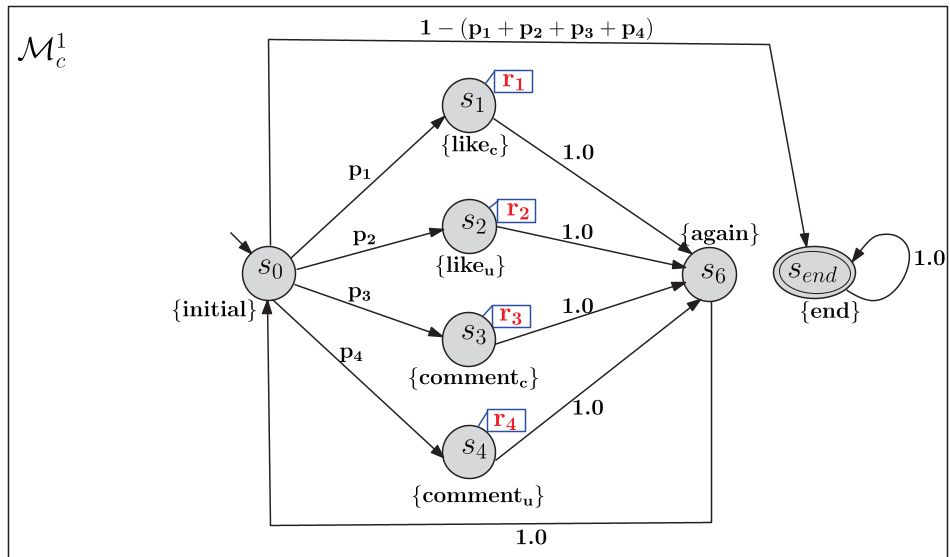 Figure 2: PMC model capturing interaction states between a user and a contact.
Experimental Insight: From Theory to UI
The paper categorizes friends into three distinct "buckets":
- Super Friends: Highly active and privacy-respecting (High Benefit, Low Risk).
- Safe Friends: Socially quiet but won't leak your data (Low Benefit, Low Risk).
- Risky Friends: Likely to reshare or cross-post sensitive content (High Risk).
By implementing this as a Facebook plugin, the authors demonstrate that users can receive "warnings" when they are about to include a "Risky Friend" in a sensitive post, allowing them to prune their recipient list on the fly.
Critical Analysis & Future Outlook
The "Learning to Share" framework is a significant step toward Contextual Integrity in software engineering. However, two challenges remain:
- The Cold Start Problem: How does the system judge a new friend? The paper suggests questionnaires, but in practice, users rarely fill them out.
- Detection Accuracy: Detecting "cross-posting" via text/image similarity is computationally expensive and potentially invasive if handled by a third-party plugin.
Ultimately, this work proves that privacy shouldn't be a wall, but a filter—one that learns who actually values your confidence while maximizing your social reach.