
Reconstructing the Social Fabric: Learning Latent Networks from Web Documents
Learning Social Networks from Web Documents Using Support Vector Classifiers
The paper proposes a supervised learning framework to reconstruct social networks from incomplete data by transforming relationship extraction into a binary text classification task. Using Support Vector Classifiers (SVM) on aggregated document vectors from web resources (FOAF database), the method effectively predicts missing ties in sparse social graphs.
TL;DR
How do you map a social network when most of the connections are hidden? This paper presents a framework that treats relationship discovery as a text classification problem. By merging the web footprints (blogs, CVs, Homepages) of individuals into "Relationship Vectors" and applying a Support Vector Machine (SVM) with strategic down-sampling, the authors successfully predict missing links in highly sparse FOAF (Friend Of A Friend) datasets.
Background: Beyond Simple Similarity
In the early days of social mining, researchers often relied on descriptive data—essentially just visualising known links. Predictive mining usually fell back on simple document similarity: "If Person A and Person B have similar keywords, they must be friends."
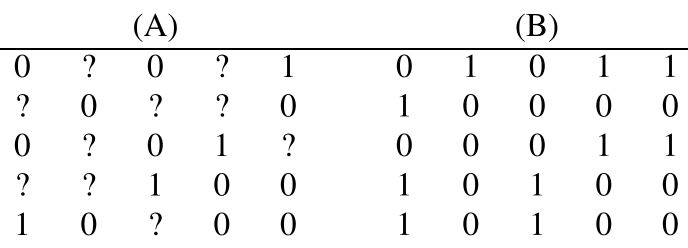
The authors of this paper argue that this is insufficient. A relationship is more complex than a shared vocabulary; it requires a unique feature space. Moreover, they identify a structural hurdle: Sparsity. In a real social network, the number of "broken" ties (people who don't know each other) outweighs "connected" ties by thousands to one. This creates a lethal class imbalance for standard Machine Learning models.
Methodology: Aggregating the "Actor-Term Matrix"
The core innovation lies in how the authors represent a "tie." Instead of comparing two vectors, they merge them.
- Actor Modeling: Every person is represented by a document vector using
tf.idfweighting. - Relationship Modeling: To represent the potential link between Actor and Actor , the authors use a MAX operator to aggregate their vectors: The intuition here is that the MAX operator preserves the most salient features of both individuals, creating a "condensed" representation that is more discriminative for a classifier than simple MIN or Product operators.
Overcoming the Sparsity Trap
Because social networks are sparse, a classifier trained on raw data will simply learn to predict "No Relation" for everyone to achieve 99.9% accuracy.
To solve this, the authors employed Majority Class Down-sampling. By intentionally throwing away a large portion of the "No Relation" examples during training, they forced the SVM to pay attention to the rare "Connected" examples.
Experimental Insights
The method was tested on a real-world FOAF database containing over 210,000 triples. After filtering for actors with downloadable web content, the authors focused on a sub-network of 254 actors.
Key Results:
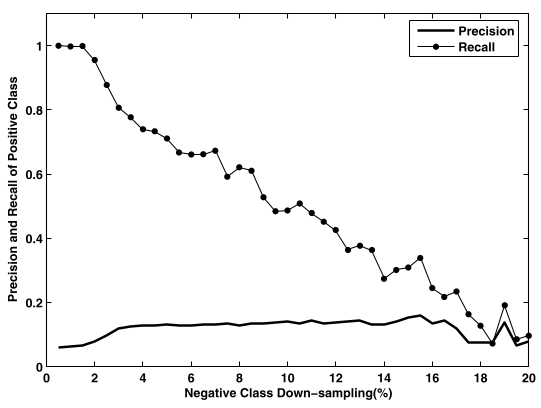
- Performance Boost: Without down-sampling, the macro-averaged F-measure sat at 0.50. With optimal sampling (around 10% of negative cases), it rose to 0.6012.
- The Recall-Precision Tradeoff: The system achieved very high Recall (finding most of the real friends) at the cost of Precision. In social discovery tasks, this is often preferred—it is better to suggest a potential friend who isn't one than to miss a critical connection entirely.
As seen in the visualisations below, varying the down-sampling rate drastically changes the density of the "predicted" network.
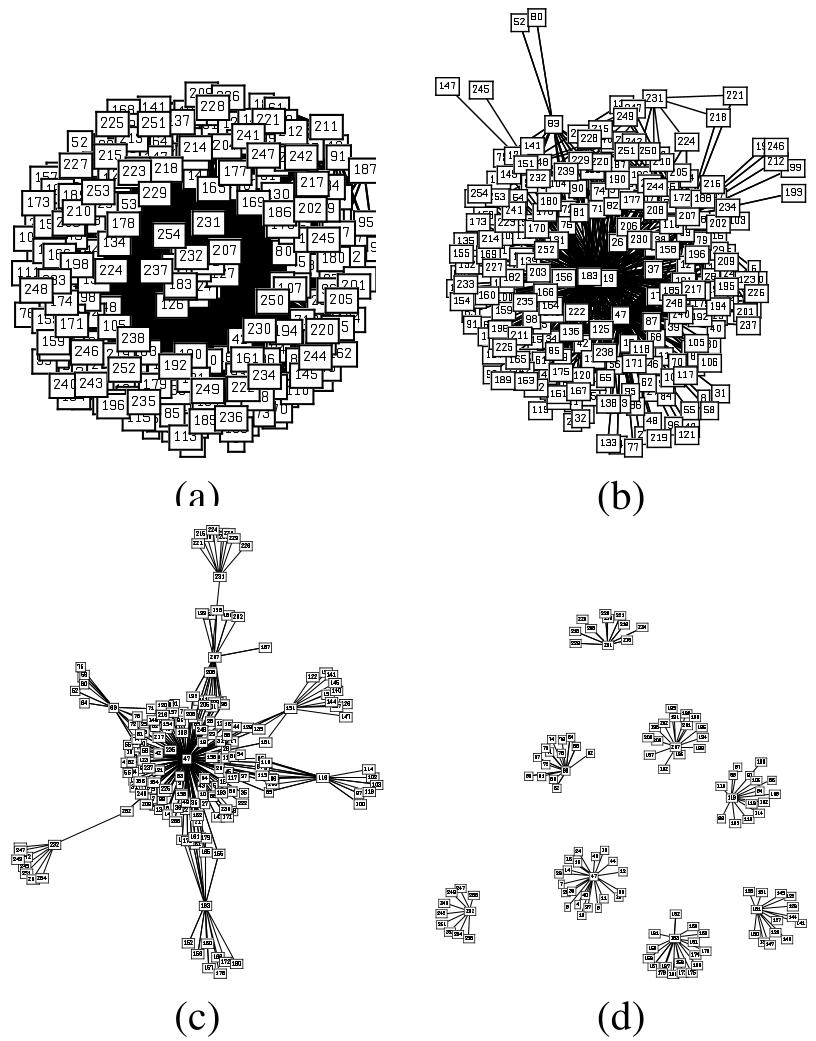 Figure: Extracted social networks with various down-sampling: (a) 1%, (b) 10%, (c) 15%, and (d) 20% of negative examples.
Critical Analysis & Conclusion
This paper provides a robust bridge between Text Mining and Social Network Analysis.
Strengths:
- Recognizes that network sparsity is class imbalance.
- Moves beyond "similarity" to "relational feature vectors."
Limitations:
- The precision is notably low (~13%). While high recall is good for discovery, the number of false positives might overwhelm a user in a real-world recommender system.
- The study uses a linear kernel SVM; exploring non-linear kernels or modern graph embeddings might capture deeper semantic overlaps.
Final Takeaway: This research highlights that the "unstructured" web—our blogs and homepages—contains enough latent signal to reconstruct our "structured" social lives, provided we handle the mathematical imbalance of human silence.