
Beyond the Screen: How Learning Style and Social Media Habits Shape Digital Intelligence
14768_How Learning Style and Social Media Behaviour Influence Undergraduates' Information Literacy Level in China.
This study investigates how internal learning styles (information processing dimension) and external social media behaviors (consumption vs. creation) influence information literacy among Chinese undergraduates. Utilizing social constructivism theory and a quantitative survey of 698 students, the research establishes a significant linkage model and validates that reflective learning styles and content consumption positively correlate with higher information literacy levels.
TL;DR
In an era of information overload, having a high "Information Literacy" (IL) level is no longer optional—it's a survival skill. This research delves into the Chinese undergraduate population to uncover a counter-intuitive truth: being hyper-active on social media might actually be hurting your ability to process information. By analyzing the interplay between internal learning styles and external behaviors, the study provides a roadmap for "digital wisdom."
The Core Conflict: Why Being "Online" Isn't Enough
In the digital age, we often assume that "digital natives"—students who cresced with smartphones—are naturally information-literate. However, the authors argue that literacy is a social construction process.
The pain point is clear:
- Prior Work often treated social media as a monolithic entity, ignoring the difference between browsing information and creating noise.
- Subjective Traits like learning styles are frequently ignored in favor of environmental factors.
The researchers hypothesized that information literacy is not just about what you use, but how your internal cognitive preferences (Information Processing dimension) filter that usage.
Methodology: The Social Constructivist Lens
The study relies on the Social Constructivism Theory, which posits that knowledge is built through social negotiation and individual subjective construction.
1. The Variables
- Internal Factor: Learning Style (Active vs. Reflective).
- External Factors: Social Media Behavior (Content Consumption vs. Content Creation).
- The Outcome: Information Literacy Level (measured via the ILT framework).
2. The Model Architecture
The researchers constructed a linkage mechanism to see how these factors interact.
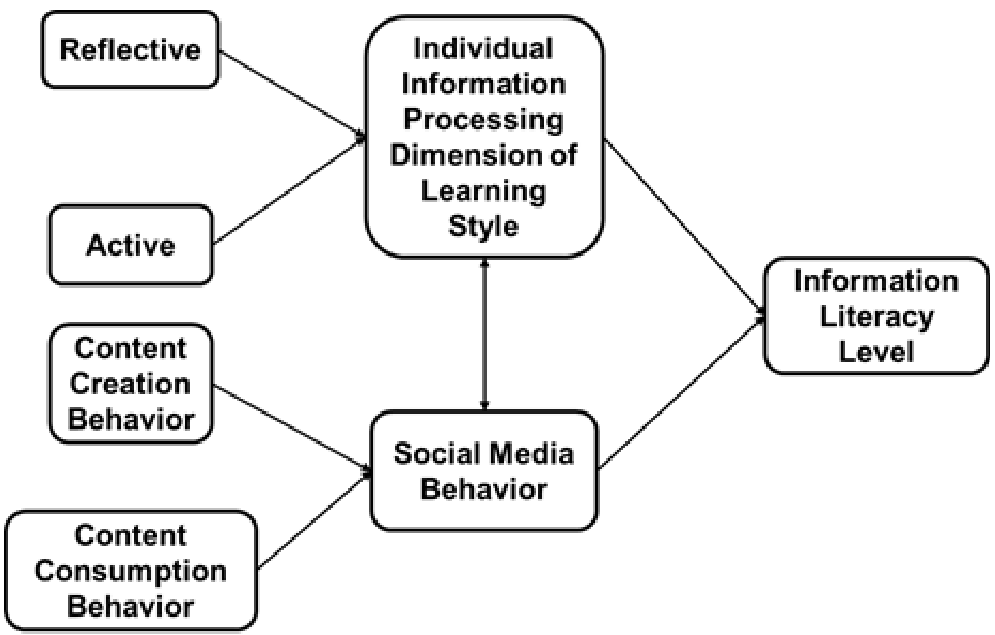 Note: This model illustrates the dual path of internal cognition and external social interaction.
Key Findings: The "Creation" Paradox
The results from 698 valid responses across major Chinese provinces (Zhejiang, Jiangsu, Shanghai) revealed several high-impact insights:
1. The Reflective Advantage
Reflective learners (those who think first and act later) consistently showed higher information literacy than Active learners. While Active learners engage more frequently with social media, they are often less critical of the content they ingest.
2. The Negative Impact of "Content Creation"
Surprisingly, Content Creation had a negative correlation with information literacy.
- Why? The authors suggest that content creation often involves subjective reprocessing and emotional sharing, which can be "not conducive to the judgment of information."
- Contrast: Content Consumption (browsing, searching, evaluating) was positively correlated with literacy levels.
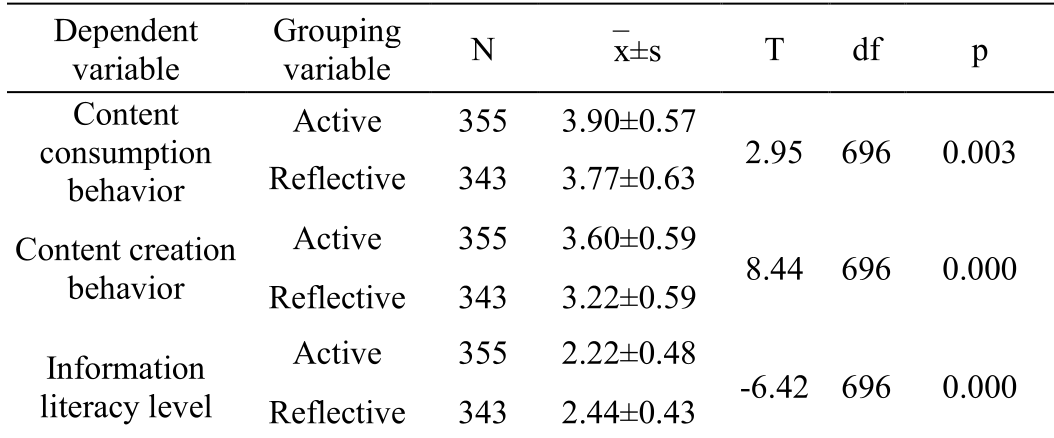 Table showing that while Active learners are more "active" in creation (3.60 vs 3.22), Reflective learners are higher in literacy (2.44 vs 2.22).
3. The Major Gap
Students in the Liberal Arts (Law and Arts) demonstrated significantly lower information literacy compared to Engineering and Management majors. This suggests that the rational/logical training in STEM fields may provide better "Inductive Bias" for digital information screening.
Critical Insights & Takeaways
For the Individual
- Recognize your style: If you are an "Active" learner, you are prone to impulsive sharing. Slow down.
- Diversity is key: Reflective learners should avoid "filter bubbles" by intentionally increasing their content consumption from diverse, multi-dimensional sources.
For Educators
Social media is not the enemy. The study found that students with high GPAs (4-5) actually practiced more social media behaviors. The key is rational use. University management should move away from banning social media and toward integrating it into specialized information literacy curricula.
Limitations & Future Outlook
While the study provides a robust quantitative baseline, it relies on self-reported questionnaire data. Future research could benefit from analyzing actual log data from social media platforms to observe real-time information processing behaviors.
The Bottom Line: Information literacy is a muscle. It is strengthened by the reflection of the internal mind and the careful consumption of the external world. To be truly literate in 2026, we must stop creating noise and start practicing discernment.