
Decoding Emotions: How Echo State Networks Solve the Inter-Subject Variability Problem
Learning to decode human emotions with Echo State Networks
This paper introduces an inter-subject emotion valence recognition system using Echo State Networks (ESN) to process Event Related Potentials (ERPs). By leveraging Intrinsic Plasticity (IP) for reservoir tuning and a novel iterative feature selection method, the authors achieved a SOTA inter-subject classification accuracy of 98.1% for positive vs. negative valence.
TL;DR
Recognizing human emotions from brain waves (EEG) is easy for a single person but remarkably hard across a group because every brain "speaks" a slightly different dialect. This paper introduces a breakthrough using Echo State Networks (ESN) and Intrinsic Plasticity (IP) to find a "universal language" of emotion, boosting cross-subject accuracy to an unprecedented 98.1%.
Problem & Motivation: The Variability Wall
In Affective Neuroscience, the goal is to create "virtual sensors" that detect hidden emotional states. While intra-subject models (training and testing on the same person) work well, inter-subject generalization usually hits a wall.
Why? Because Event Related Potentials (ERPs)—the tiny electrical spikes in response to a stimulus—vary wildly due to skull thickness, electrode placement, and individual psychological differences. Most prior work struggles to cross the 80% accuracy threshold for unseen subjects. The authors hypothesized that the nonlinear dynamics of a reservoir could map these chaotic signals into a more stable, discriminative space.
Methodology: Reservoir Computing as a Feature Filter
The core of the approach lies in Reservoir Computing (RC), specifically Echo State Networks. Unlike standard RNNs, only the output (readout) of an ESN is trained, making it computationally efficient.
1. Intrinsic Plasticity (IP) Tuning
Instead of using a raw random reservoir, the authors apply Intrinsic Plasticity. This biologically inspired rule adjusts the excitability (gain and bias) of each neuron to ensure the output matches a Gaussian distribution. This maximizes the entropy of the reservoir, ensuring it captures the richest possible information from the input ERPs.
2. The Iterative "Viewpoint" Algorithm
The most novel contribution is how they select features. Instead of using all reservoir states, they search for the "best viewpoints":
- Step 1: Map 252 ERP features into a 500-neuron reservoir.
- Step 2: Calculate the equilibrium states (steady-state activations) for each stimuli.
- Step 3: Iteratively combine these states (2D → 3D → 4D) and test which combinations best separate "Positive" from "Negative" valence.
 Figure 1: The standard ESN structure used as the foundation for the feature extraction process.
Experiments & Results: Crushing the Baseline
The researchers tested their method on 26 subjects viewing high-arousal images. They compared their ESN-extracted features against raw features and Deep Neural Networks.
Key Findings:
- Low Dimensionality, High Power: Using just two reservoir neurons (2D features) outperformed the entire original 252-feature set in clustering tasks (78.8% vs 55.7%).
- Classification Superiority: With 4D feature vectors and an SVM, the system reached 98.1% accuracy.
- Reservoir Scale: Accuracy scaled positively with the number of neurons, with 300-500 neurons providing the most stable "search space" for finding top-performing combinations.
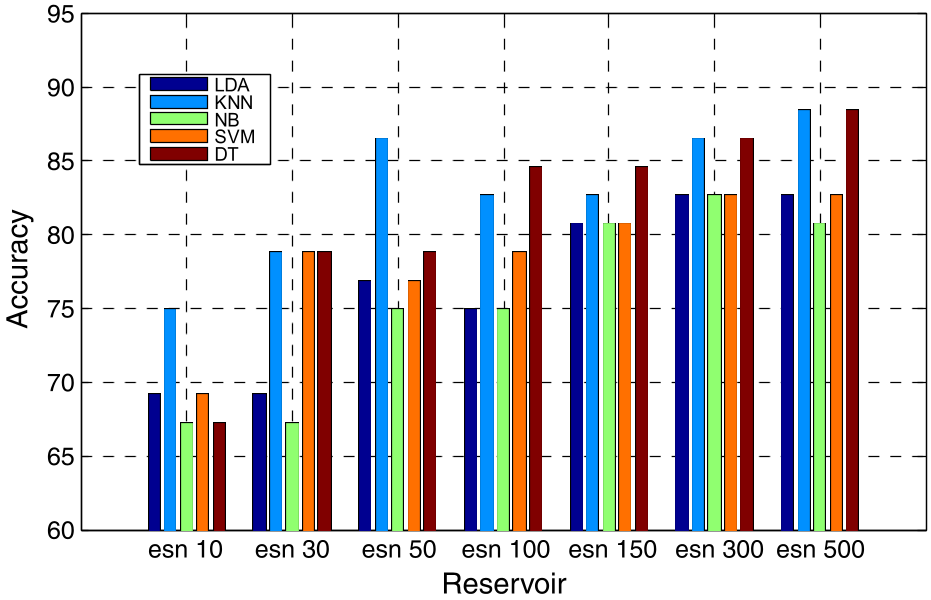 Figure 2: Classification accuracy improvement as the dimensionality of selected reservoir features increases from 2D to 4D.
Comparison with DNNs:
Interestingly, standard Deep Neural Networks (Auto-encoders) only achieved 60% accuracy on the same task. The ESN's ability to maintain the "physical meaning" of the temporal features while applying nonlinear transformation proved far more effective for small-sample biological data.
Critical Analysis & Conclusion
Why it Works:
The ESN acts as a non-linear projector. By searching for specific neuron combinations, the algorithm identifies "neural signatures" that are persistent across different human brains, effectively filtering out the "noise" of individual subject variability.
Limitations:
The search for optimal feature combinations is computationally expensive (). While the authors used a heuristic (keeping only the top 20 combinations per step), finding the absolute global optimum in a massive reservoir remains a challenge.
Takeaway:
This work demonstrates that for complex biological signals like EEG, "bigger" models (like DNNs) aren't always better. Instead, using a stable, entropy-maximized reservoir to transform the feature space can unlock hidden patterns that are invisible to traditional linear or deep learning models.