
Learning to Rank for Education: Bridging Pedagogical Needs and Search Technology
Learning to Rank for Educational Search Engines
This paper introduces a specialized Learning to Rank (LTR) framework for educational search engines, specifically targeting K-12 students. By leveraging the LambdaMART algorithm with domain-specific features (grade, course, and document type) and a novel click propagation strategy for singleton queries, the authors achieve a significant improvement in retrieval effectiveness (NDCG@5 +14% over baseline).
TL;DR
Educational search engines serve a unique audience—K-12 students whose search behaviors are heavily influenced by their grade level and specific subjects. This research demonstrates that a one-size-fits-all ranking model is suboptimal. By using Learning to Rank (LTR) with domain-specific features and a clever Click Propagation algorithm for rare queries, search effectiveness can be boosted by over 14%, directly improving the educational material discovery process.
The Motivation: Why General Search Fails Students
Generic search engines treat a 4th grader looking for "photosynthesis" the same as an 8th grader. However, their cognitive abilities and content needs differ wildly. In educational platforms like Turkey's Vitamin, the challenge is twofold:
- Diverse Content Types: Materials range from animations and summaries to interactive quizzes.
- The Cold Start Problem: Many educational queries are unique "singletons" with zero click history, rendering standard behavioral features useless.
The authors argue that by baking "Grade" and "Course" information directly into the machine learning models, we can create a ranker that understands the learner as much as the query.
Methodology: Building the Educational Ranker
The core of the approach lies in Feature Engineering and Model Specialization.
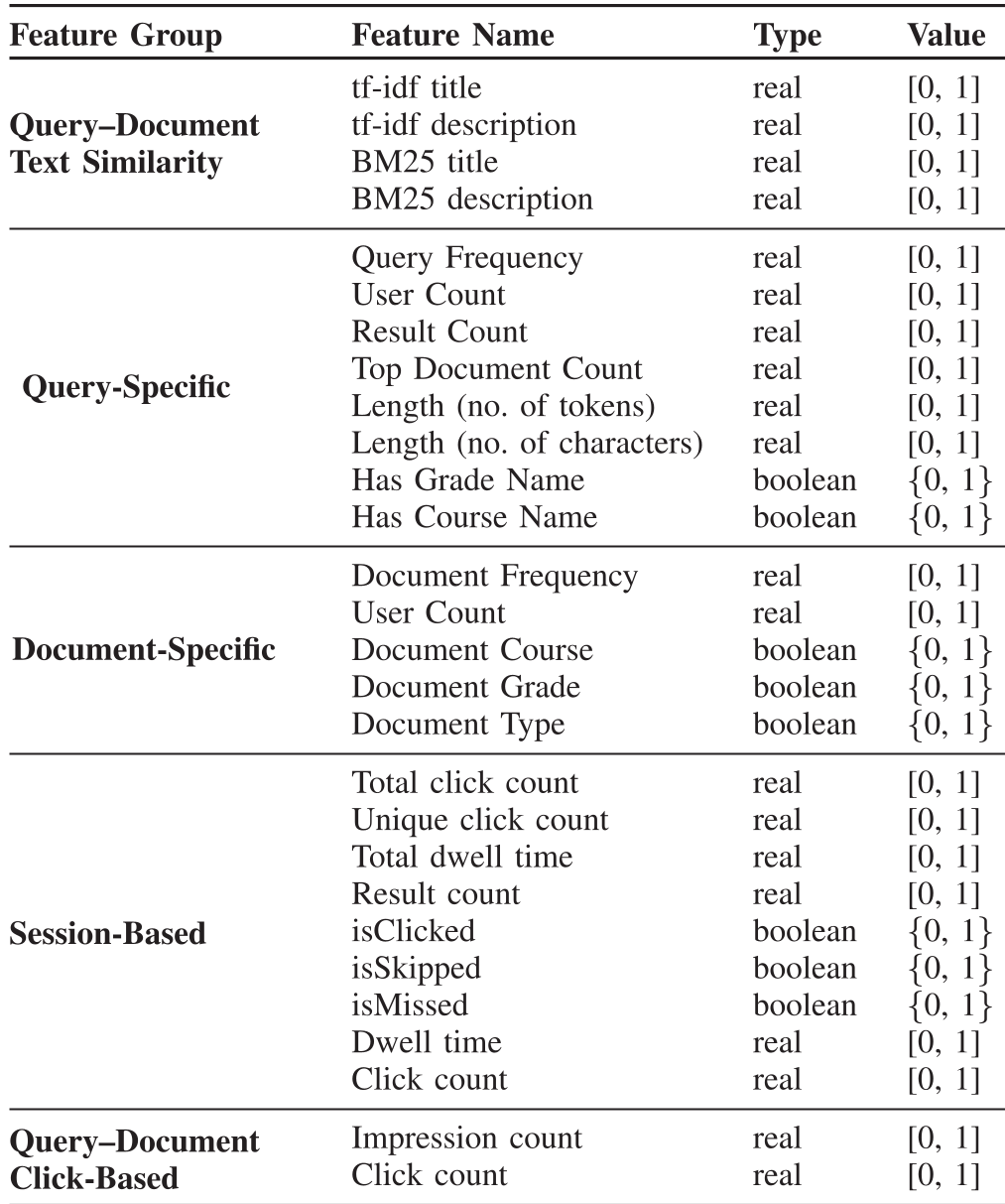
1. Feature Engineering
The authors categorized 50 features into five groups. While typical textual similarity (BM25) and session-based features were included, the "secret sauce" was the Document-Specific category, capturing the intended course (Math, Science) and the target grade level.
2. Specialized Models
Instead of a single "General LTR" model, the authors experimented with:
- Grade-Specific Models: Learning that a 4th grader might prefer visual animations while an 8th grader needs textual depth.
- Course-Specific Models: Recognizing that searching for "Math" requires different ranking logic (perhaps looking for exercises) than "History" (looking for videos).
3. Click Propagation for Singleton Queries
To handle queries with no clicks, the authors developed an algorithm that finds "similar" queries based on:
- Grade Similarity: Do the students belong to the same year?
- Textual Similarity: Are the query strings semantically close?
- Result Overlap: Do both queries retrieve any of the same documents?
By "borrowing" click counts from these similar neighbors, the model can make an educated guess about which results will be helpful for the new, unique query.
Experimental Results
The researchers compared their LambdaMART model against traditional baselines (BM25) and modern Neural IR models (DSSM, DRRM).
Quantitative Breakdown
- General LTR Model: Outperformed the native search engine significantly (NDCG@5 of 0.77 vs 0.63).
- Grade-Specific Gains: Using a model trained specifically for the user's grade outperformed the general model by roughly 1%, proving the value of user-context.
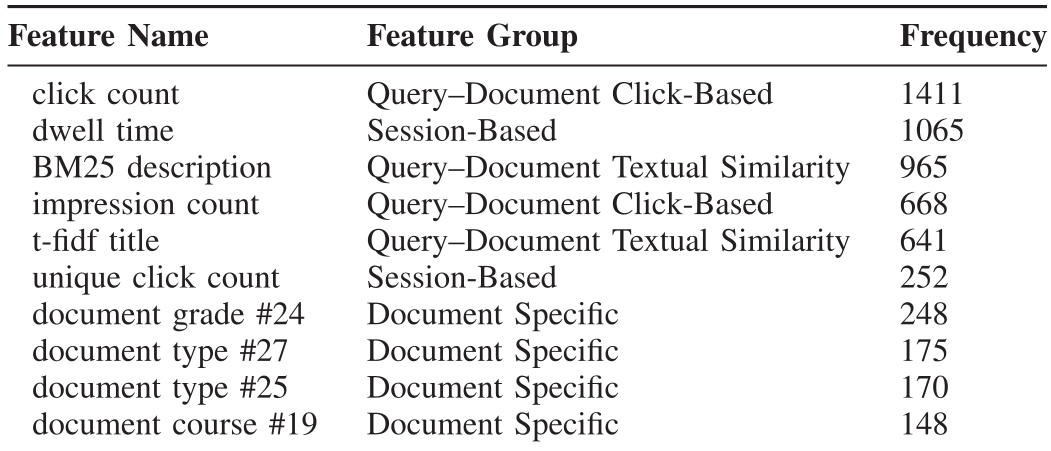
- Feature Importance: The "Click Count" feature was the most influential, but "Document Grade" and "Document Type" appeared in the top 10, validating their domain-specific approach.
Surprisingly, the General LTR model outperformed the Neural IR models. The authors attribute this to the limited size of the training set—reminding us that in vertical domains, well-engineered "traditional" ML often beats "hungry" deep learning models.
Deep Insight & Conclusion
The most striking takeaway from this work is that domain knowledge trumps black-box clustering. Automated query clustering (a common LTR technique) yielded inferior results compared to simply grouping queries by "Grade" or "Course."
Limitations & Future Work
While the results are strong, the paper notes that it focuses on Navigational/Topical Relevance. A true educational search engine should eventually rank results based on Learning Gains (e.g., "does this document actually help the student pass the test?"), which requires complex post-search assessment.
In conclusion, this research provides a robust blueprint for vertical search engines. If you know who your user is (their grade) and what they are studying (the course), don't just throw that data into the feature vector—use it to build a specialized brain for your search engine.