
AUDM: Bridging the Gap Between Multi-Platform Social Networks via Adaptive Metric Learning
Learning user distance from multiple social networks
The paper introduces AUDM (Adaptive User Distance Measurement), a novel metric learning model and algorithm designed to compute user distances across multiple social networks. By integrating AdaBoost with metric learning, it effectively maps users from distinct platforms into a shared potential feature space while achieving state-of-the-art results in link prediction tasks.
TL;DR
Social network data is notoriously sparse, making it hard to measure how "close" two users are. The AUDM (Adaptive User Distance Measurement) algorithm solves this by "borrowing" knowledge from related networks (e.g., using LinkedIn data to improve Facebook link predictions). By combining Metric Learning with AdaBoost, it achieves a linear-time solution that boosts prediction accuracy (AUC) by over 8% on large-scale datasets.
Problem & Motivation: The Silo Effect in Social Graphs
Most social network analysis happens in a vacuum—a single network like Twitter or Douban. However, users are multi-faceted; they might be quiet on a professional network but hyper-active on a hobbyist forum.
The authors identify two fatal flaws in prior work:
- Data Sparseness: In a single network, most users have very few neighbors, leading to models that over-fit to local noise.
- Structural Incompatibility: You can't just "merge" two networks. A dense network will overwhelm a sparse one, and user similarities in one context (e.g., sharing a movie taste) might not imply a connection in another (e.g., being real-world friends).
Methodology: Synergy of Topology and Boosting
The core of AUDM lies in its ability to embed multiple networks into a potential feature space while respecting two critical constraints:
- Topological Invariance: Neighbors must remain closer than non-neighbors.
- Community Preservation: Users within the same community should cluster together in the embedded space.
The Boosting Mechanism
Unlike standard metric learning, AUDM uses a Weight-boosting framework. It treats the embedding process as a series of "weak learners." If a user pair's distance is incorrectly estimated, the boosting algorithm increases the weight of that constraint in the next iteration. This is particularly effective for "Long Tail" users—those with very few connections who benefit most from the "transfer" of knowledge from other networks.
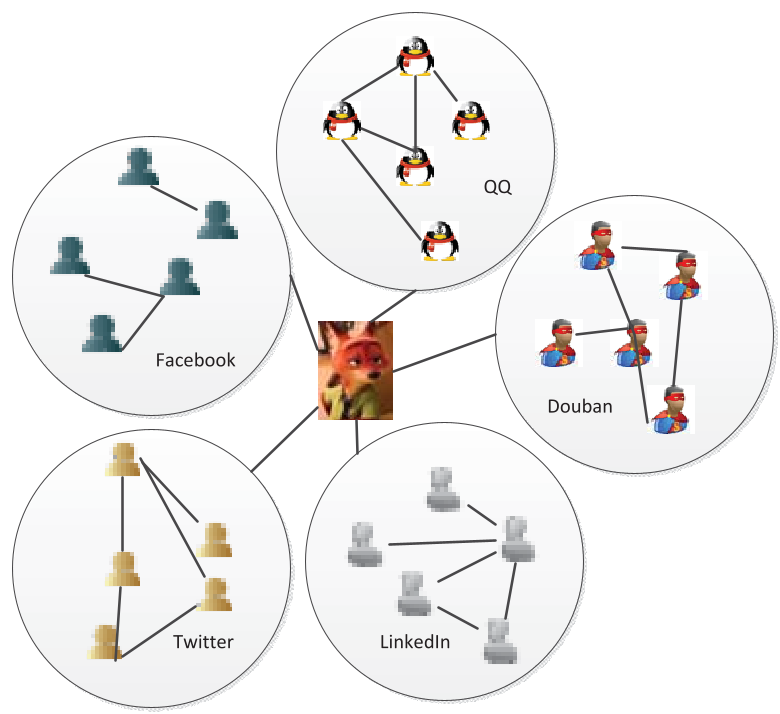 Figure 1: Conceptual view of a user existing across multiple heterogeneous social networks.
Experiments & Results: Real-World Scalability
The authors tested AUDM on a massive dataset from Douban, comparing online "attention" links with offline "familiarity" links.
Performance Gains
AUDM didn't just win; it dominated the SPML (Structure Preserving Metric Learning) baseline:
- AUC Improvement: +0.0805
- MAP (Mean Average Precision) Improvement: +0.0602
Computational Efficiency
One of the most impressive feats is the linear time complexity . As the number of social links increases, the computation time grows linearly, not exponentially. This makes the model viable for production-scale environments with millions of users.
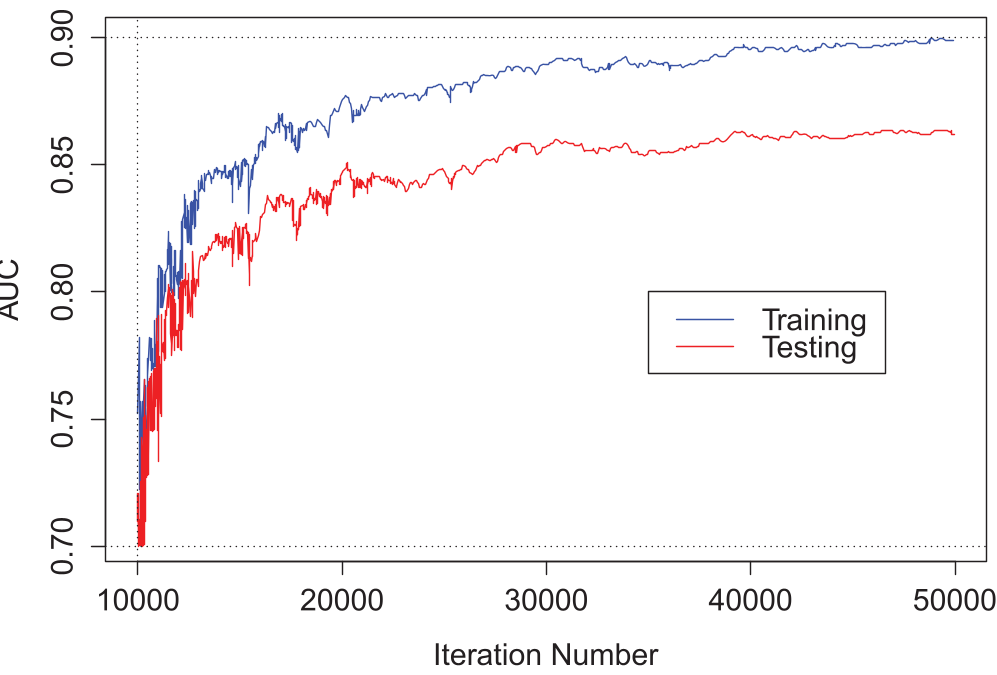 Figure 2: AUDM shows rapid convergence, stabilizing after a few iterations, which is crucial for large-scale training.
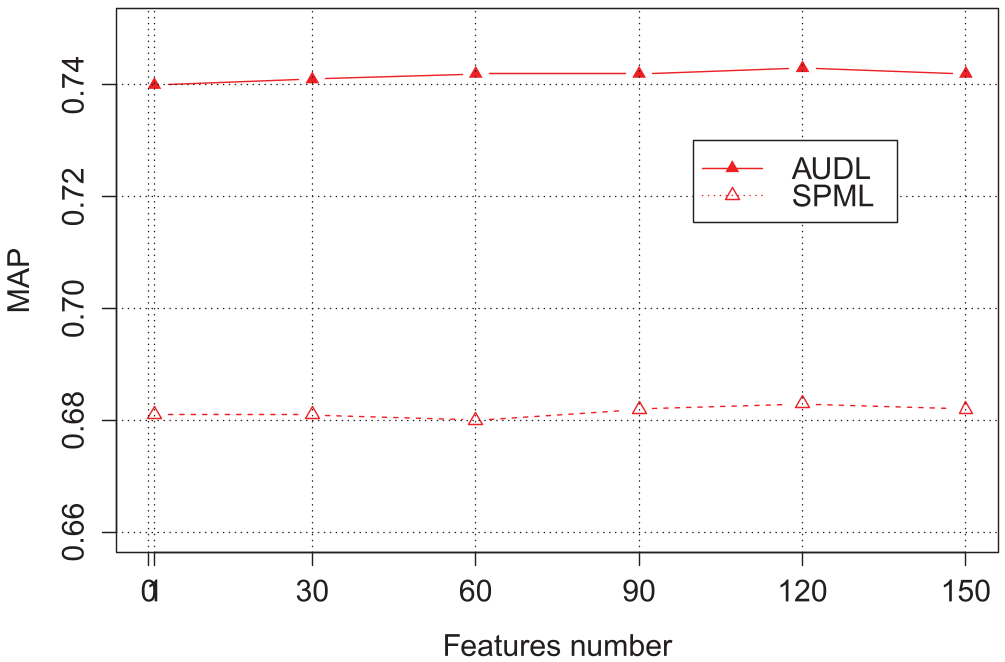 Figure 3: Accuracy improvement specifically for "Long Tail" users, proving that cross-network knowledge effectively solves the sparseness problem.
Critical Insight: Why Does It Work?
The success of AUDM suggests that user distance is not a static attribute but a latent manifold. By using AdaBoost to adaptively reweight the importance of different features and constraints, the model identifies which "knowledge" from a related network is actually transferable and which is just noise.
Limitations & Future Work
While AUDM is powerful, it currently assumes a relatively static feature set. The authors suggest that future iterations could tackle Cold-Start Community Detection, where a new network has almost no links, by relying even more heavily on the distance metrics learned from established "anchor" networks.
Conclusion (Takeaway)
AUDM represents a significant step forward in Multi-Network Fusion. It offers a mathematically rigorous yet computationally efficient way to leverage the "echoes" of user behavior across the digital universe to build better, more predictive social models.