
Learning Without Training: Unveiling the Implicit Weight Dynamics of In-Context Learning
Learning without training: The implicit dynamics of in-context learning
This paper introduces "contextual blocks" to demonstrate that In-Context Learning (ICL) in LLMs is mathematically equivalent to an implicit weight update. By proving that a Transformer forward pass with context equals a context-free pass with modified MLP weights, the authors establish ICL as a form of implicit low-rank finetuning.
TL;DR
One of the greatest mysteries of Large Language Models (LLMs) is how they "learn" from a prompt without updating a single parameter. This paper reveals that In-Context Learning (ICL) isn't just like finetuning; it is mathematically equivalent to it. The authors prove that the stacking of attention layers with MLPs allows the model to implicitly patch its own weights with rank-1 updates that exactly mimic the effect of the context.
Context as a Weight Modification
In standard machine learning, the boundary between "training" (changing weights) and "inference" (processing data) is rigid. However, the emergent capability of ICL blurs this line. The authors of this work at Google Research propose that we shouldn't view ICL merely as a clever way to re-organize internal representations. Instead, they provide a framework where the context itself acts as an implicit low-rank finetuning update.
The core intuition is simple yet profound: A forward pass with a prompt can be replaced by a forward pass without a prompt, provided we apply a specific, minimal "patch" to the model's Feed-Forward Network (MLP) weights.
Methodology: The Minimal Token-Patch
The math focuses on Contextual Blocks. By defining a "context vector" (the difference in layer output with and without a chunk of context), the authors derive the Minimal Token-Patch .
This patch is defined as the unique matrix that minimizes the Frobenius norm while ensuring functional equivalence at the pre-activation level. For a standard MLP layer with weights , the update formula is:
This rank-1 matrix essentially "bakes" the context directly into the first layer of the MLP.
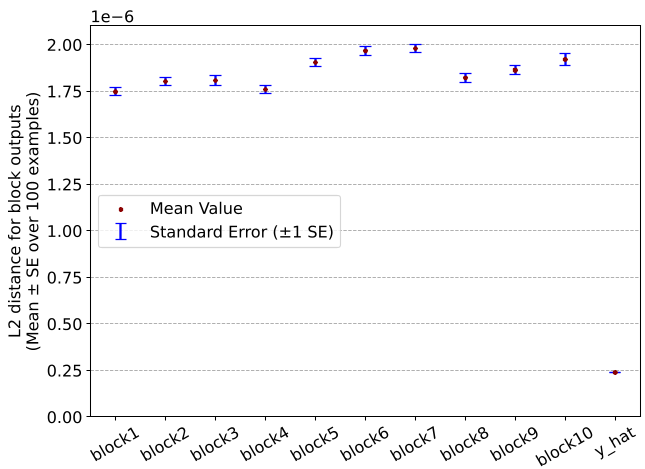 Figure 1: Numerical verification showing that the 'Patched' weight pass (red) perfectly matches the 'Full Context' pass (blue) in a 10-layer Transformer.
Why Transformers Excel while RNNs Struggle
A fascinating contribution of this paper is its use of implicit dynamics as a diagnostic tool. The authors compared Attention-based layers to RNN layers and analyzed the "marginal gradient updates" as context length increased.
As seen in the results, Attention-based layers generate smooth, converging weight updates. In contrast, RNN updates exhibit unstable, non-converging "chaotic" behavior. This provides a mechanistic explanation for why Transformers are superior at long-context adaptability compared to traditional recurrent architectures: they are inherently better at stabilizing the implicit learning process.
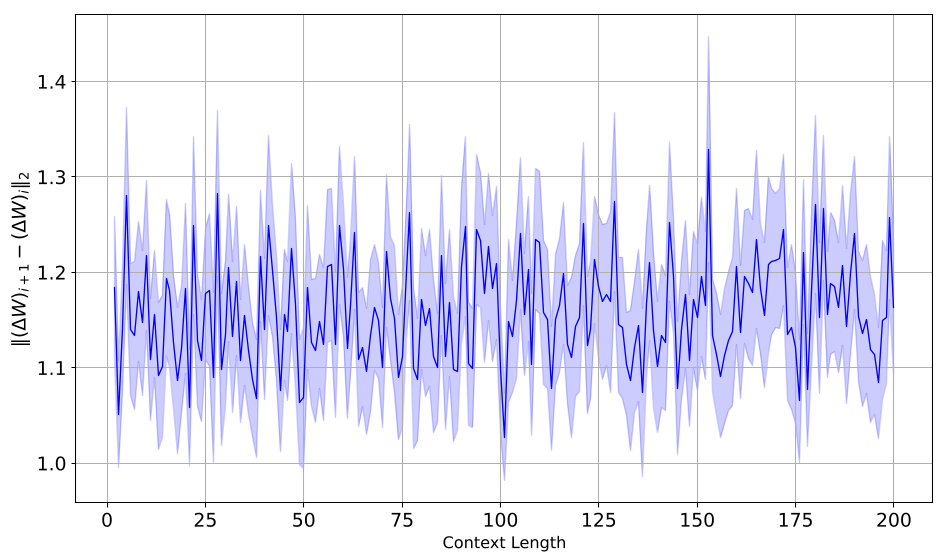 Figure 2: Comparing the stability of implicit weight updates. Note the smooth convergence of Attention (left) vs. the instability of RNNs (right).
From Theory to Practical Use: Static Thought Patches
While the derivation is token-specific (the update depends on the query ), the authors introduce a practical application called "Thought Patches." By using a small calibration set of queries, they can approximate many token-dependent updates into a single, static weight update that represents the entire context.
This "Thought Patch" generalizes well to unseen tokens, potentially enabling Prompt Compression: instead of storing massive KV-caches for a prompt, we could simply update a small subset of the model's weights to "remember" the context.
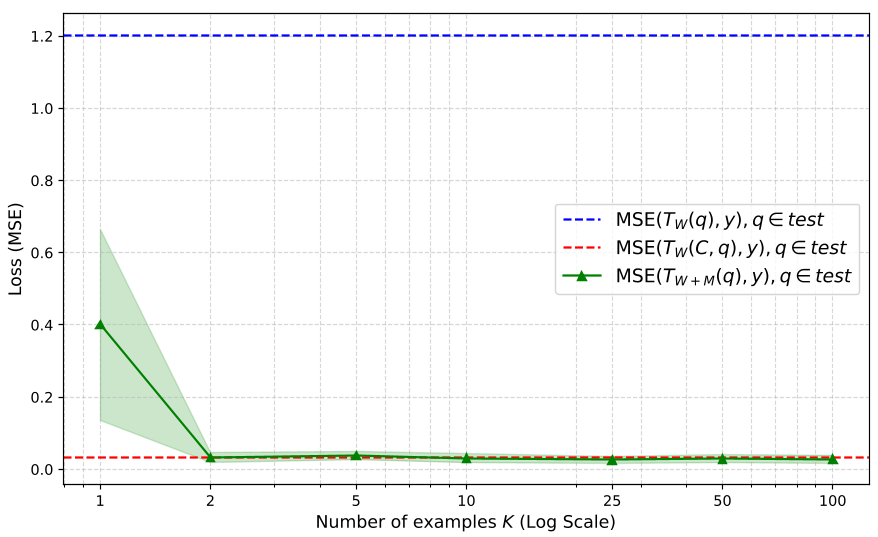 Figure 3: As the calibration set size (K) increases, the static "Thought Patch" converges to the performance of the full context-aware model.
Critical Insight & Conclusion
This paper changes the perspective on LLMs from "static calculators" to "dynamic meta-learners." By showing that steering vectors and rank-1 factual edits (like ROME) are naturally occurring internal mechanisms of the Transformer, it unifies several disparate branches of interpretability research.
Key Takeaways:
- MLPs are Reservoirs: The Feed-Forward Networks in Transformers are not just static knowledge bases; they are the primary targets for context-dependent weight adaptation.
- ICL is Gradient Descent: The sequential processing of tokens inherently generates a dynamic similar to online stochastic gradient descent.
- Mechanistic Alignment: The findings provide a formal mathematical path toward compressing long contexts directly into model parameters, which could revolutionize inference efficiency and model personalization.