
MVCBG: Minimizing Rumor Spread through Community-Aware Blocking
Least Cost Rumor Community Blocking optimization in Social Networks
This paper introduces a novel optimization framework called Least Cost Rumor Community Blocking Optimization (LCRCBO) and a corresponding heuristic named Minimum Vertex Cover Based Greedy (MVCBG) algorithm. The method focuses on containing rumors within a specific source community while ensuring the overall infection count remains below a strict threshold K.
TL;DR
Researchers from Shanghai Jiao Tong University have formulated a new optimization problem, LCRCBO, which aims to contain rumors within their originating community while minimizing the total cost (nodes blocked). Their proposed MVCBG algorithm leverages graph theory (Minimum Vertex Cover) and greedy influence reduction to outperform standard heuristics like MaxDegree and Betweenness Centrality in real-world social network simulations.
Problem & Motivation: The Community Isolation Challenge
In Online Social Networks (OSNs), rumors often start within a specific cluster—a "rumor community." The challenge isn't just stopping the rumor from leaving this cluster, but also ensuring that the infection inside the cluster doesn't explode before the boundaries are secured.
Existing methods often overlook this dual-constraint nature:
- Topological Heuristics (MaxDegree, BC): They focus on influential hubs but don't guarantee that the rumor community is actually isolated.
- Flow-based methods: They treat networks like water pipes, which doesn't align with the probabilistic nature of the Independent Cascade (IC) model used in social sciences.
The authors' insight is simple: Identify and block the "bridge ends"—the gateways through which rumors escape to neighboring communities—while simultaneously pruning internal high-risk nodes.
Methodology: A Two-Step Surgical Strike
The LCRCBO problem is #P-complete, making an exhaustive search impossible. The MVCBG (Minimum Vertex Cover Based Greedy) algorithm breaks the task into two logical phases:
Phase 1: Boundary Isolation (The Graph Theory Approach)
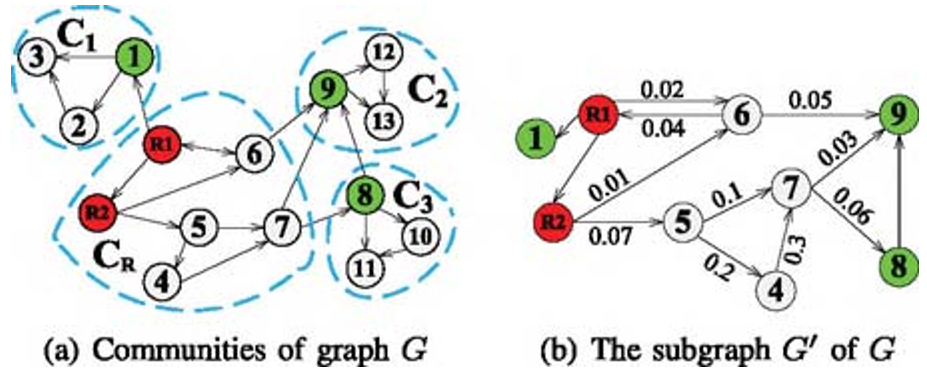
The algorithm first identifies Bridge Ends—nodes in neighboring communities reachable from rumor originators. It constructs a bipartite graph between the parents of these bridge ends and the bridge ends themselves. By applying Kőnig’s theorem, it finds the Minimum Vertex Cover, ensuring all "bridge edges" are cut with the fewest possible node removals.
Phase 2: Internal Suppression (The Greedy Approach)
Once the community is isolated, the algorithm checks if the expected infection count is below the target . If not, it enters a greedy loop, iteratively blocking nodes that provide the maximum reduction in expected spread within the community.
Experimental Validation
The authors tested MVCBG on five diverse networks, ranging from the high-density Wiki-Vote to the sparse Scale-Free (SF) networks.
Performance Comparison
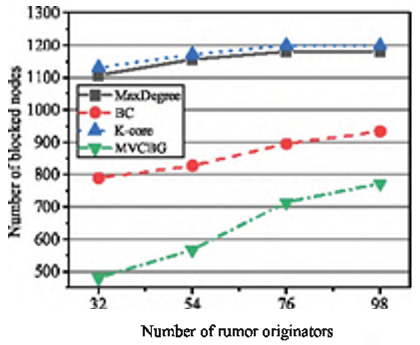
In every scenario, MVCBG achieved the target (protecting 90% of nodes) by blocking fewer nodes than MaxDegree, K-core, or Betweenness Centrality (BC).
- Efficiency: On the Epinions dataset, the gap between MVCBG and other heuristics is substantial, proving that structural knowledge of communities is more "cost-effective" than simple hub-blocking.
- Trade-off: The primary cost is Running Time. Because Step 2 involves influence estimation, MVCBG is computationally heavier than simple degree-based methods, particularly on dense graphs.
Critical Insight & Conclusion
The MVCBG algorithm demonstrates that rumor containment is most effective when it acknowledges the "mesoscopic" structure of social networks—communities. By using the Minimum Vertex Cover to handle boundary constraints and greedy search for internal spread, the authors provide a mathematically grounded yet practical roadmap for digital health and information security practitioners.
Future Work: While effective, the algorithm's reliance on greedy simulations suggests room for optimization using Sketching or Reverse Reachable (RR) Sets to speed up the influence estimation in Step 2.