
Beyond Keywords: Using Associative Ontologies for Legal Document Validation
Legal Tech: Documents’ Validation Method Based on the Associative-Ontological Approach
This paper introduces an associative-ontological method for the automated validation of legal documents, specifically targeting "Consent to Personal Data Processing" in the Russian legal context. By representing document structure as an associative semantic graph, the system achieves high-accuracy validation of mandatory legal elements through rule-based matching and machine learning.
TL;DR
The legal industry is undergoing a digital transformation known as Legal Tech, yet automating the validation of complex documents remains a challenge. This paper presents a specialized framework that moves beyond simple keyword searching. By treating legal texts as associative semantic graphs, the authors provide a method to verify if a document—such as a personal data consent form—contains all legally required components with up to 97% accuracy.
The "Short Text" Problem in Legal Tech
Most current NLP solutions rely on statistical distributions (like LDA) that require vast amounts of text to identify "topics." However, a legal document is not a generic "topic"; it is a collection of precise, mandatory structural elements.
In the Russian legal system, a "Consent to personal data processing" form must contain specific details—name, purpose, actions, and duration. These sections are often too short for traditional statistical models to recognize accurately. Furthermore, lawyers need to be able to see and edit the logic behind the automation—a "black box" AI is often unacceptable in a court of law.
Methodology: The Associative-Ontological Approach
The core innovation lies in representing the Semantic Invariant of a legal topic as a graph.
1. Graph Representation
Instead of viewing a sentence as a string of words, the system transforms it into a graph where:
- Nodes: Lemmatized notions (words in their base form).
- Edges: Associative links representing the measure of cohesion between terms.
2. Rule Creation
Rules are generated through two paths:
- Machine Learning: Training on sets of valid/invalid text fragments.
- Expert Correction: Lawyers can manually adjust the graph patterns to reflect new legislative changes.
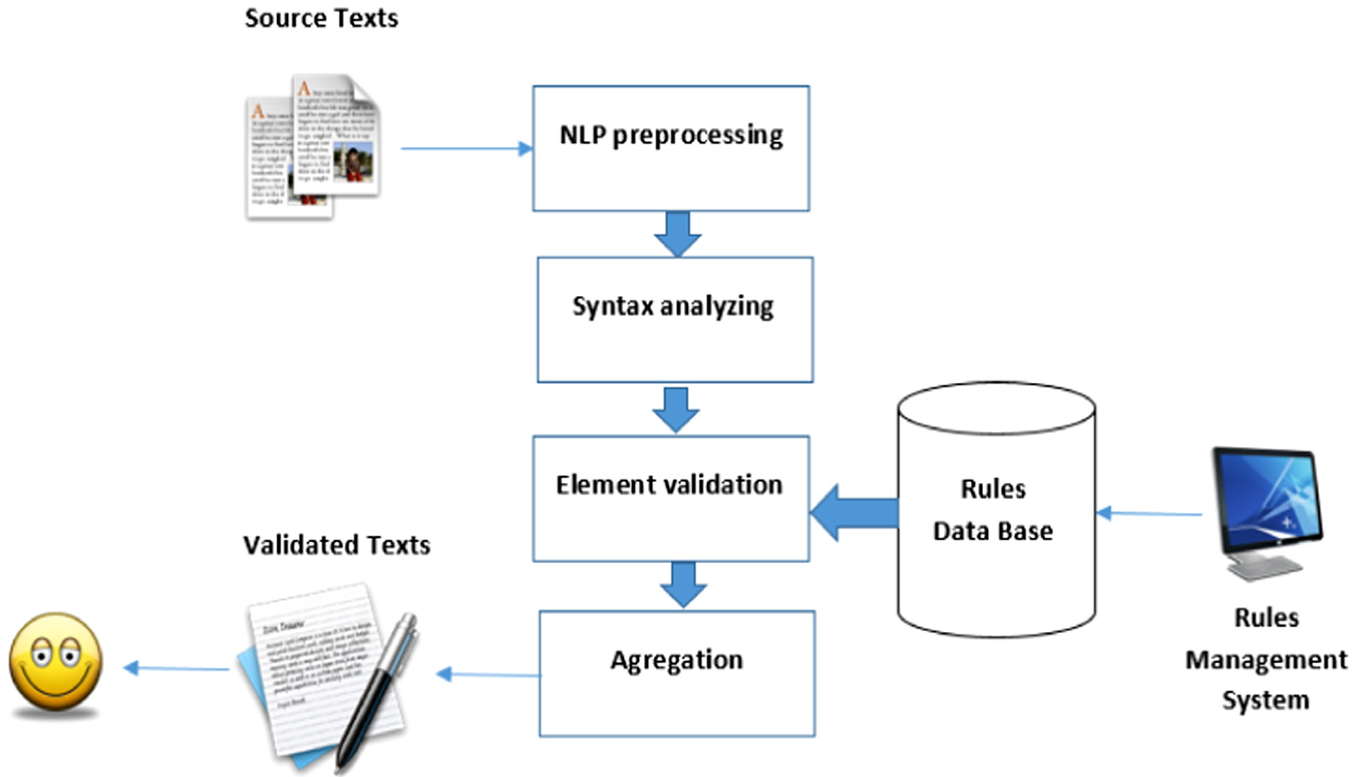 Figure 1: The structural diagram of the document validation system, emphasizing the NLP subsystem and Rule Management toolbox.
3. Comparison Algorithm
The system validates a document by searching for the "Rule Graph" within the "Document Graph." If the structural invariant (the core nodes and their associations) is found, the element is marked as present.
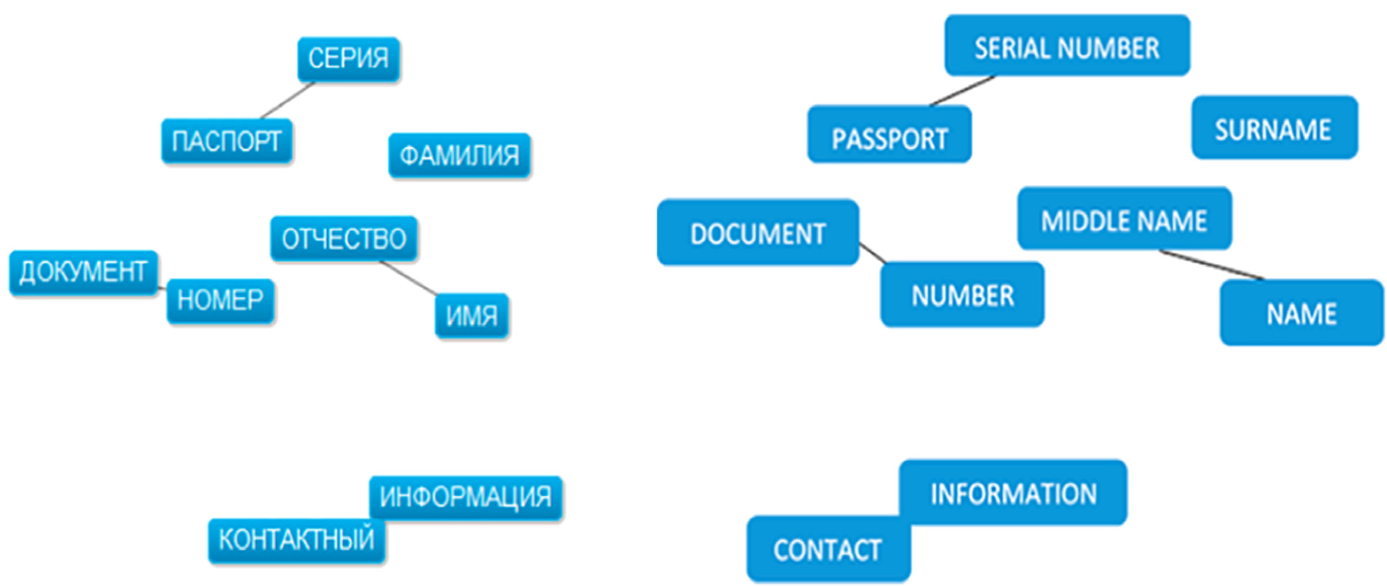 Figure 2: A rule for "Ordinary personal data" showing the associations between terms like 'fio' (name), 'address', and 'passport'.
Experimental Results
The researchers tested their prototype on 500 documents. The results highlight a clear advantage for hybrid systems:
- Overall Accuracy: 0.76
- ML-Generated Rules: 0.82
- Top Performer: Identifying the "Set of actions with personal data" reached a staggering 0.97 accuracy.
| Structural Element | Method | Validation Accuracy |
|---|---|---|
| Ordinary Personal Data | ML | 0.92 |
| Biometric Data | ML + Manual | 0.92 |
| Consent Validity Term | ML | 0.95 |
The study found that sectors with highly specific terminology (like "Biometric Data") performed significantly better than those with high linguistic variability.
Critical Insight: The Human-in-the-Loop
The true value of this work isn't just the 82% accuracy—it's the interpretability. Unlike deep learning models that act as "black boxes," these associative graphs can be visualized and corrected by actual lawyers (as seen in Figure 5).
Limitations & Future Work
The system currently struggles with highly variable text where legal experts haven't yet refined the semantic associations. The authors plan to integrate this into a full-scale web service that can be plugged into existing Legal Tech infrastructures, potentially saving thousands of man-hours in routine document proofreading.
Conclusion
As Legal Tech matures, the industry's focus is shifting from simple document templates to intelligent validation. By combining the rigor of Ontological Graph Theory with the flexibility of Machine Learning, this approach provides a robust framework for ensuring legal compliance in a world of increasingly complex data regulations.