
LENS: Solving the Spam Problem Through Social Trust and Gatekeepers
LENS: Leveraging social networking and trust to prevent spam transmission
LENS is a social network-based spam protection system that leverages "Gatekeepers" (GKs) to authenticate senders beyond a recipient's immediate social circle. By integrating social trust into the SMTP protocol, it achieves highly efficient spam prevention and significantly reduces network bandwidth consumption compared to traditional content-based filtering.
TL;DR
Spam remains a multi-billion dollar nuisance, but the biggest cost isn't just a cluttered inbox—it's the massive bandwidth wasted as spam traverses the globe. LENS (Leveraging Social Networking and Trust) flips the script by using your social circle to vet senders. Instead of scanning an email's text to see if it's "spammy," LENS uses Gatekeepers to vouch for senders before the email is even sent, making it 1,000x faster than traditional filters like SpamAssassin.
The Problem: Filtering is Too Late and Too Heavy
Most current spam solutions (e.g., Bayesian filters) act as "edge filters." They wait until the entire email has arrived to decide if it's junk. This presents two fatal flaws:
- Infrastructure Waste: By the time a filter rejects a 50KB email, the bandwidth has already been consumed.
- Computational Complexity: Content analysis is expensive. As email volumes grow, Mail Servers (MS) struggle to keep up with the processing load.
While previous social-based approaches like RE: Reliable Email successfully used "Friends of Friends" (FoF) lists, they fell short when a legitimate sender was 3 or 4 hops away, forcing the system back onto unreliable content filters.
Methodology: The Gatekeeper Mechanism
LENS introduces a tiered architecture consisting of community formation, trust management, and the core innovation: Gatekeeper (GK) Selection.
How it Works:
- The Social Circle: If you are my friend or a friend of my friend, your email goes straight through.
- The Gatekeepers: For senders further away, LENS selects "Gatekeepers"—trusted users at the boundary of your social circle who have high connectivity.
- Vouchers: These GKs issue RSA-signed vouchers to their own friends. If someone at a social distance of 4 hops wants to email me, they present a voucher from a GK I trust.
- SMTP Integration: LENS appends these vouchers to the
RCPT TOcommand. If the voucher isn't valid, the server terminates the connection immediately—before the email body is transmitted.
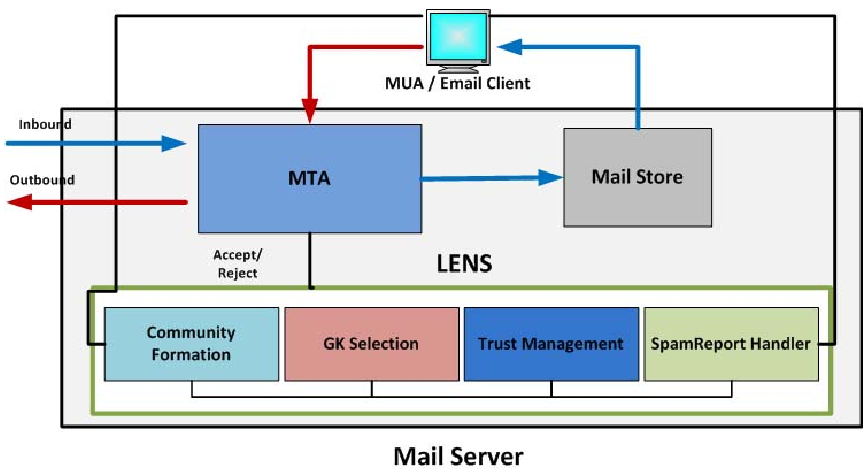 Figure 1: The LENS Architecture, highlighting the interaction between Mail Servers, Gatekeepers, and trust management.
Experimental Results: Speed and Reach
The researchers tested LENS using a sample of 3.1 million Facebook users to simulate real-world social dynamics.
1. Massive Reachability
A common fear with social-based filtering is "isolation"—can people still reach me? The study found that with just ~500 Gatekeepers, a user becomes reachable to over 1.7 million legitimate users (approx. 55% of the entire network) with zero false positives.
2. Performance vs. SpamAssassin
The most striking result is the efficiency. Content filters like SpamAssassin scale poorly as email size increases. LENS, however, relies on simple RSA verification which is independent of message size.
- SpamAssassin: Takes ~0.5 to 8.7 seconds depending on message size.
- LENS: Takes ~2 to 30 milliseconds.
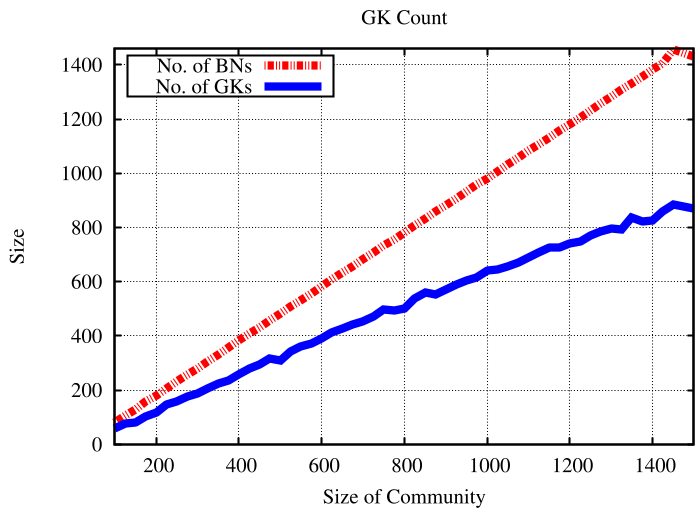 Figure 2: Analysis of the number of Gatekeepers required and the resulting reachability across the network.
Critical Insight: Why This Matters
The genius of LENS lies in its Inductive Bias: it assumes that "legitimate people know other legitimate people." By mathematically encoding this trust through RSA signatures and using the small-world property of social networks, LENS transforms spam prevention from a "pattern recognition" problem into a "structural trust" problem.
Limitations & Future Work
- Initial Verification: For the very first "cold" contact between two strangers with no mutual GKs, a manual legitimacy verification is still required.
- Social Network Access: The system relies on Mail Servers having access to social graphs, which raises privacy considerations that may require decentralized identity solutions in the future.
Conclusion
LENS proves that social networking isn't just for status updates—it can be the backbone of a more secure, efficient internet. By rejecting spam at the "handshake" level, we can save billions in infrastructure costs while ensuring that legitimate voices always get through.