
Let’s Chance: Reimagining Probability as a Creative Material for Kids
Let's Chance: Playful Probabilistic Programming for Children
The paper introduces "Let’s Chance," a computational microworld extension for the Scratch programming language. It enables children to engage in probabilistic programming by creating custom digital "dice" with tinkerable distributions to build generative art, music, and simple Markov-based AI models.
TL;DR
Probability is the heartbeat of modern AI, yet for most children, it remains a dry subject of coin flips and fractions. Let’s Chance is a transformative Scratch extension that turns probability into a "tinkerable" design tool. By allowing kids to build and manipulate digital dice, the tool enables them to create generative music, art, and even simple AI models, moving probability from the textbook to the creative studio.
The Problem: The "Disempowered" Math
As Seymour Papert once noted, school often "disempowers" powerful ideas. Probability is typically taught as an impersonal, abstract set of calculations. The "Pick Random" block found in most coding platforms is a "black box"—you see the result, but you can't easily manipulate the nature of the randomness. This creates a gap in AI literacy: if children don't understand how distributions work, they cannot understand how AI models make predictions or why they might be biased.
Methodology: The Architecture of Chance
The core of Let’s Chance is the "Dice" object. Unlike a standard 1-to-6 die, these digital dice are highly flexible:
- Multi-media Sides: Sides can be sounds, costumes (images), text, or even Scratch code blocks.
- Tinkerable Distributions: A visual interface with sliders allows users to drag probabilities up or down in real-time.
- Dynamic Programming: Blocks like "change chance of [side] by [number]" allow the code to change its own behavior based on user input.
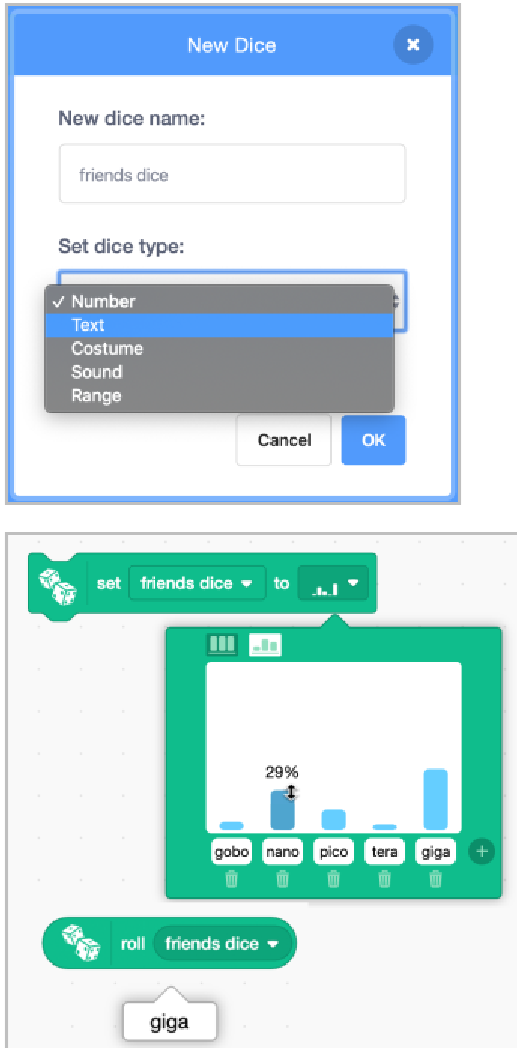 Figure 1: The custom dice interface where children can visually adjust the likelihood of specific outcomes.
For advanced users, the extension introduces Markov Transitions. This allows a die to remember its previous state, enabling "probabilistic learning." For example, if a child draws a "red" stroke, the computer learns to increase the probability of "red" appearing next.
From Music to Mazes: Experimental Results
In pilot workshops, the "Low Floor, High Ceiling" design philosophy was evident.
- Starter Level: Beginners created "Music Machines" where they acted as DJs, sliding probability bars to change the rhythm and beatbox sounds of a sprite in real-time.
- Intermediate Level: Students built "Maze Generators" using an angle-based dice (0° vs 90°) to procedurally generate millions of unique game levels.
- Advanced Level: Some users explored "Script Generators"—code that writes code—demonstrating a sophisticated grasp of meta-programming and randomness.
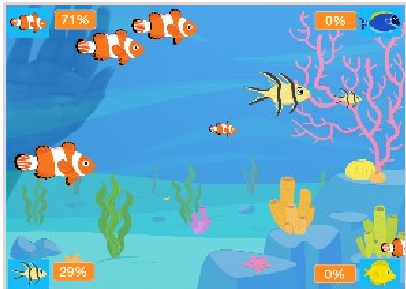 Figure 2: A procedural maze generator (left) and a probabilistic script generator (right) created by students.
The feedback was overwhelmingly positive. One student noted, "It’s an improvement to the ‘pick random’ block because the probabilities can be changed and more can be achieved."
Critical Analysis: Why This Matters for AI Literacy
The brilliance of Let's Chance lies in its transparency. Most AI education tools today use pre-trained models (like "recognize an apple"). While cool, these are "black boxes." Let’s Chance adopts a White-Box approach.
When a child sees that "rolling a red fish" happens more often because they wave their hand (triggering a change chance block), they are witnessing the fundamental logic of a training loop. This provides a natural segue into discussing Algorithmic Bias—if the "input data" (the slider) is skewed, the "model output" (the dice roll) will be biased.
Limitations & Future Work
While powerful, the current version is a research prototype. The authors aim to expand the dice types to include "location dice" and "color dice." The bigger challenge remains: how to bridge these simple Markov models to the massive neural networks that power ChatGPT or DALL-E in a way that remains "playful."
Conclusion
Let's Chance proves that we don't need complex calculus to teach the soul of AI. By treating probability as a "clay-like" computational material, the researchers have given children a powerful lens to decode the probabilistic world around them. As one 15-year-old participant put it: "Probabilistic code is code that itself acts as a dice!"