
Deciphering Social Privacy: Fusing Content Sensitiveness and User Trustworthiness
Leveraging Content Sensitiveness and User Trustworthiness to Recommend Fine-Grained Privacy Settings for Social Image Sharing
The paper proposes a novel framework for fine-grained privacy setting recommendation in social image sharing by integrating image content sensitiveness and user trustworthiness. It introduces a tree classifier that utilizes deep feature extraction and a Deep Multiple Instance Learning (DMIL) algorithm to identify 280 privacy-sensitive object classes and events, achieving superior performance on datasets like PicAlert and Mirflickr.
In the age of ubiquitous smartphone photography, the act of "sharing" has outpaced our ability to manage the personal data captured in every frame. While social platforms offer "Friends" or "Public" toggles, these binary choices are often too blunt to protect our nuanced social lives. A new study by Jun Yu and colleagues targets this gap by asking: Can AI understand not just what is in a photo, but who is trustworthy enough to see it?
TL;DR
This paper introduces a sophisticated recommendation system for social image privacy. By combining deep image analysis (what’s in the photo) with a behavioral model of user trust (who is looking), the authors propose a tree-based classifier that recommends fine-grained actions—ranging from full sharing to selective blurring—significantly reducing the risk of accidental privacy disclosure.
The Core Motivation: The "Inseparable Duo"
Most existing privacy research is lopsided. Visual-based systems look at the pixels but ignore the social context (sharing a beer photo with a best friend vs. a boss). Topic-based systems look at social circles but ignore the content (sharing a landscape vs. a medical document).
The authors argue that privacy is a function of two variables:
- Content Sensitiveness (): Specific objects (acne, identifiable tags) or events (religious ceremonies) that trigger concern.
- User Trustworthiness (): The reliability of the viewer based on their historical social behavior.
Methodology: Beyond Generic Deep Learning
1. Representing Image Sensitiveness
The authors moved away from using generic models like AlexNet (designed for 1,000 general objects) and instead adapted the architecture to focus on privacy-sensitive categories.
- Feature-based: They scaled down the fully-connected layers to 1024-D to prevent overfitting on the smaller "privacy task space."
- Object-based: Using Deep Multiple Instance Learning (DMIL), they trained the system to detect 268 sensitive objects (like facial expressions, skin conditions, or identifiable tags) and 12 events.
 Figure 1: The proposed framework architecture combining feature and object-based visual analysis with user behavior modeling.
2. Characterizing User Trust
To quantify "trust," the system analyzes:
- Interaction intensity.
- Relationship closeness (Family vs. Colleague).
- User reputation and behavioral stability.
Users are clustered via Spectral Clustering into representative social groups (e.g., "altruistic," "cynical," "distrusting"), forming a unique "trustworthiness dictionary" ().
3. The Tree Classifier: The Decision Engine
The brilliance of the approach lies in how it handles cross-modal data. Instead of simple concatenation, a Tree Classifier selects the most discriminative feature (either or ) at each node to branch the decision.
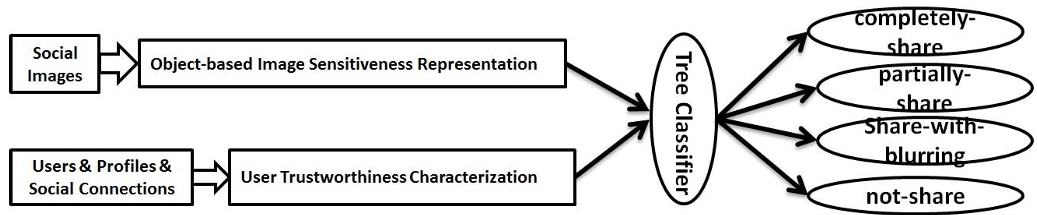 Figure 2: The hierarchical tree classifier training flow, determining the optimal decision sequence for share vs. not-share.
Experimental Results: Precision and Interpretability
The team tested their system on 800,000 social images and public datasets (PicAlert, Mirflickr).
- Lower Disclosure Risk: The object-based detection significantly outperformed traditional methods. By identifying why an image is sensitive (e.g., "heavy makeup" or "facial expression"), the system provides better "share-with-blurring" recommendations.
- Efficiency: The adapted 1024-D features reduced computational costs compared to traditional 4096-D deep features while actually improving accuracy.
 Figure 3: Comparative performance showing the effectiveness of using specific privacy-sensitive object classes versus generic visual features.
Critical Insight: Why This Matters
This work shifts the paradigm of privacy from "automated filtering" to "contextual recommendation." By inserting a "share-with-blurring" option, the model respects the social utility of an image while protecting personal dignity.
Limitations & Future Directions:
- Subjectivity: Privacy is deeply personal; the authors suggest that future versions should allow users to define their own sensitive objects.
- Speculation: Blurring objects can sometimes attract more attention. The authors envision using Generative Adversarial Networks (GANs) to replace sensitive parts with "perceptually similar but privacy-free" patches—essentially AI-driven "deepfake" anonymization.
Conclusion
Jun Yu's team has provided a robust blueprint for the next generation of social media privacy tools. Unlike current black-box filters, this system understands the social relationship behind the post, offering a future where we can share freely without the fear of leaking our private lives to the wrong audience.