
Beyond Friendship: Predicting "Enemies" Through the Science of Shared Dislikes
Leveraging Rating Behavior to Predict Negative Social Ties
This paper introduces a novel framework for predicting negative social ties (enmity/distrust) by leveraging user rating behavior. It proposes a rating-based feature set and an adaptation of status theory to infer negative links in social networks where only positive relationships and item ratings (likes/dislikes) are available, achieving an F-measure of 0.82 on the Epinions dataset without requiring direct user-to-user interaction data.
TL;DR
Most social platforms only show who we follow or like, hiding the "negative" half of the social equation (who we distrust). This paper demonstrates that we can accurately predict these hidden negative ties by looking at how users rate items. Specifically, it proves that "enemies" are often revealed not by what they like, but by the specific items they both hate.
The "Invisible" Negative Network
In the world of social data analysis, Signed Networks (networks with both positive "+" and negative "-" links) are a goldmine. Knowing who a user distrusts can drastically improve recommendations and combat misinformation. However, there is a "scarcity problem":
- Invisibility: Most platforms (Facebook, Twitter) don't have an "Enemy" button.
- User Hesitation: Even when available (like on Epinions), users rarely label others negatively (often <15% of links).
- Data Silos: Previous SOTA methods required direct user-to-user interactions (like voting on someone's comment), which many platforms simply don't have.
The authors ask: Can we find the "bullies" and "frenemies" just by looking at the movies or products they rate?
The Core Insight: The Polarity of Agreements
The researchers' breakthrough stems from a psychological observation: agreement on a "dislike" is more telling than agreement on a "like."
If two people both like The Avengers, it might just be because it's a popular movie (Item Bias). But if two people both dislike a niche, generally well-liked product, it suggests a profound alignment in their specialized taste—or in this paper's case, a potential social signal.
The Methodology
The paper introduces two key technical components:
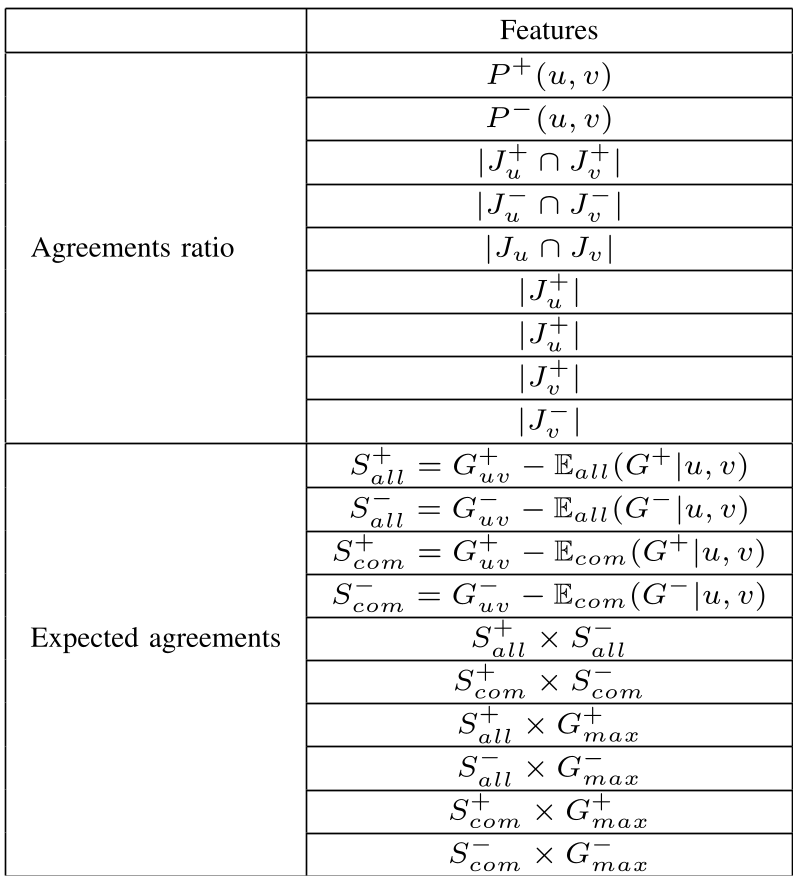
- Expected Agreements: They don't just count shared ratings. They calculate "Expected Gain" (Equations 3 & 4), which adjusts the weight of a shared rating based on how popular an item is. Agreeing on a controversial item provides more "signal" than agreeing on a blockbuster.
- Synthetic Negative Ties: To train a classifier without real "enemy" data, they use RMSD (Root Mean Square Difference). If two users' ratings are wildly different, and their positions in the social graph satisfy Status Theory (the idea that positive links go "up" in status and negative links go "down"), they are labeled as a synthetic negative pair for training.
Experimental Battleground: Epinions
The authors tested their approach against three scenarios:
- Signed: Real-world friend/enemy data.
- Interactions: Using user-to-user comment voting.
- Ratings-only: The "hard mode" where only item ratings are known.
Results & Evidence
The results confirm that while social features (triads like "friend of a friend") are powerful, adding Opinion-based features provides a significant boost.
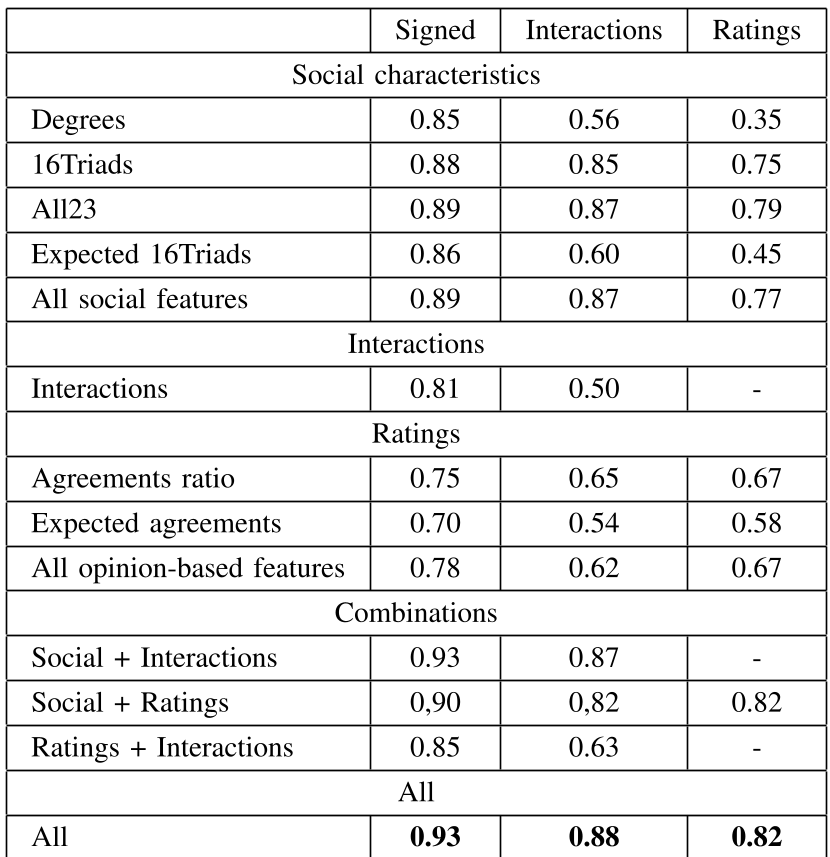
- Social + Ratings (All): In the most restrictive setting, the system achieved an F-measure of 0.82.
- Feature Significance: The logistic regression coefficients (Table V) showed that Sall- (shared negative agreements after correcting for bias) had the strongest negative weight (-285.41), proving that common "hates" are the primary indicators of negative social ties.
Critical Insight: The Future of "Social" Recommenders
This work shifts the focus of social link prediction from structural (who do you know?) to behavioral (how do you judge?).
Limitations: The study is currently limited to the Epinions dataset. The effectiveness of this model in "Like-only" environments (where "Dislike" buttons don't exist, such as Instagram) remains an open question for future research.
Takeaway: If you want to know who is likely to clash in a social network, don't look at their shared hobbies—look at the things they collectively despise. This "negative orientation" is a more robust predictor of social friction than positive alignment.