
FaceTrust: Turning Social Circles into Anonymous Identity Credentials
Leveraging Social Feedback to Verify Online Identity Claims
FaceTrust is a decentralized identity verification system that leverages Online Social Networks (OSNs) to validate user attributes like age or profession. By combining a "game with a purpose" feedback mechanism with a novel, scalable max-flow-based trust inference algorithm (MaxTrust), it achieves high-veracity identity claims while preserving user anonymity.
TL;DR
FaceTrust allows you to prove you are a "CS Professor" or "Over 18" without showing your ID to a website. By asking friends to "tag" your claims on social media and using a Sybil-resistant algorithm called MaxTrust, the system generates a veracity score that is highly correlated with the truth while keeping your identity anonymous.
Background Positioning
In the landscape of digital identity, we usually face a binary choice: total anonymity (which breeds fraud) or total surveillance (Real Name policies). FaceTrust sits in the middle—an "Academic SOTA" (as of its publication) that explores relaxed credentials. It doesn't claim 100% cryptographic certainty but offers a practical, high-confidence signal for social interactions, reviews, and age-restricted access.
Problem & Motivation: The Anonymity Paradox
The fundamental problem is captured by the famous cartoon: "On the Internet, nobody knows you're a dog." While anonymity protects free speech, it allows a "chef" reviewer to actually be a paid bot. Current fixes are heavy-handed:
- Centralized CA: Expensive and requires manual verification.
- Real-Name Badges: Destroys privacy.
- Social Links: Simple "friend" counts are easily gamed by Sybil attacks, where one person creates 1,000 fake accounts to vouch for themselves.
The authors' insight? Ground-truth identity attributes (age, location) are verifiable by real-life acquaintances. If we can harvest that feedback and filter out the noise of fake accounts, we have a lightweight credential system.
Methodology: The Mechanics of MaxTrust
The core of FaceTrust is a two-step process: Social Tagging and Trust Inference.
1. Social Tagging
Users post a claim (e.g., "Am I over 18?") and friends tag it as True or False. To prevent "camouflaging" (where a liar acts honest to gain trust), trust is calculated separately for different attribute types.
2. MaxTrust Algorithm
The challenge is determining which taggers to trust. If a Sybil account vouches for a liar, its "Trust" must be low. FaceTrust models the social network as a flow network:
- Seeds: A few known honest users are the "source" of trust.
- Flow: Trust "flows" along edges based on tagging similarity.
- Bottleneck Property: The total trust that can flow into a cluster of fake (Sybil) accounts is limited by the few edges they have with real humans.
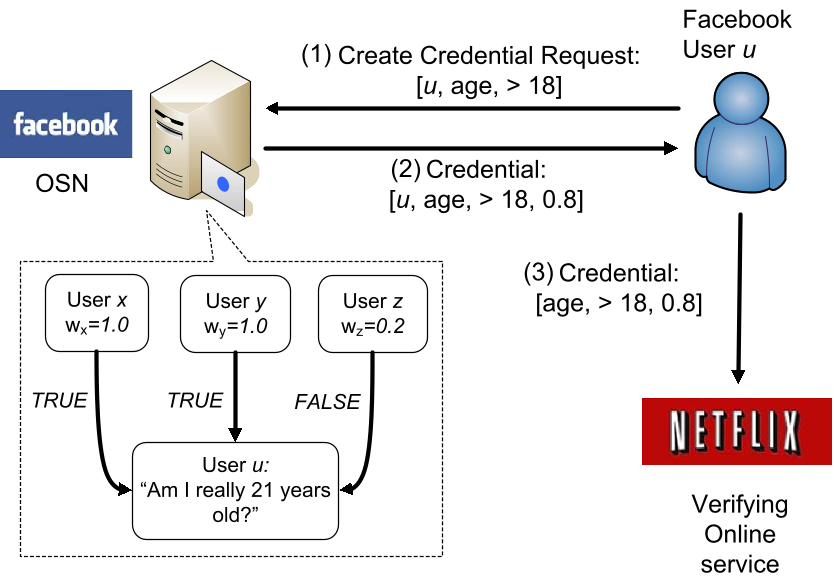 Figure 1: High-level overview of credential issuance through OSN feedback.
Instead of the slow Edmonds-Karp algorithm, the authors developed a Breadth-First Search (BFS) heuristic that approximates max-flow, making it feasible for networks with millions of nodes.
Experiments & Results: Resilience under Fire
The authors tested FaceTrust against a variety of attacks:
- Random Dishonest Users: Even if 40% of users lie, the system maintains a clear gap between the veracity of true and false claims.
- Sybil Attack: Even when one attacker creates 200 fake accounts to tag their own posts, the MaxTrust bottleneck effectively cuts their influence.
- Pearson Correlation: The system achieved a 0.91 correlation with reality—exceptional for a crowd-sourced model.
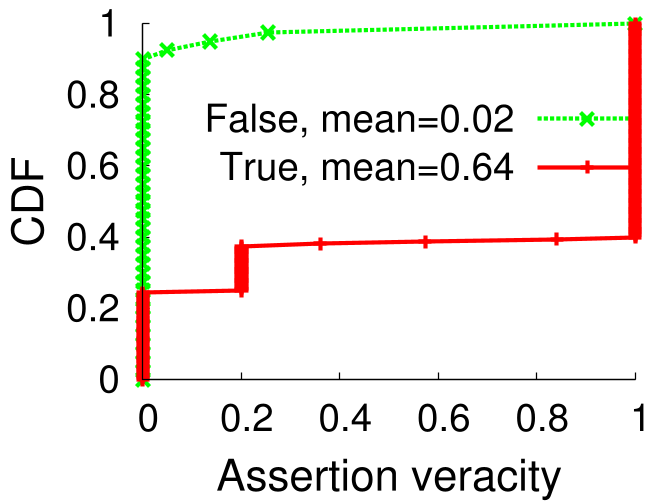 Figure 2: Distribution showing that false assertions (red/dashed) almost always receive a veracity score near 0.
Crucially, the "Am I Really?" (AIR) Facebook deployment proved that real users are indeed willing to tag their friends, providing an average of ~14 tags for age claims.
Critical Analysis & Conclusion
Takeaway
FaceTrust proves that transitive trust is a powerful deterrent against Sybil identities. By weighting human feedback with a sophisticated flow-based trustworthiness score, we can create a "web of trust" that is far more resilient than simple upvotes or likes.
Limitations
- The "Focused Colluder" Problem: If a large, coordinated group of real humans (e.g., a massive click farm or a organized propaganda group) decides to lie, the system's veracity scores will drift toward the lie.
- Bootstrap: The system requires an existing social graph. It cannot verify "loners" or people new to a platform.
Future Outlook
While this paper was published in 2014, its logic is foundational for current Web3 and Decentralized Identity (DID) projects. As AI-generated bots become indistinguishable from humans, the "FaceTrust" model of using verified social links as a "Proof of Personhood" is more relevant today than ever.