
Bridging the Gap: Using Facebook to Unlock Academic Resources via LoA Escalation
Leveraging social networks to gain access to organisational resources
The paper introduces a federated identity management service named Logins4Life. It enables users to access high-security organizational resources using social networking accounts (e.g., Facebook, Google) by leveraging an extended "Level of Assurance" (LoA) framework and account linking mechanisms.
TL;DR
Researchers at the University of Kent developed Logins4Life, a system that allows users to use social media accounts (Facebook, Google, Twitter) to access sensitive university resources. By "linking" these social accounts to a verified university identity, the system safely boosts the social login's Level of Assurance (LoA), providing a seamless Single Sign-On (SSO) experience for students without compromising campus security.
The Friction of Federated Identity
We’ve all experienced the fatigue: your university or employer forces you to remember yet another complex password, even though you’re already logged into Facebook or Gmail all day. Why can't we just "Login with Google"?
The problem is Trust.
- Social Accounts: Low registration rigor. Anyone can be "IronMan123" on Twitter. Most are NIST LoA 0 or 1.
- Organizational Accounts: High registration rigor. The university checks your passport and birth certificate (LoA 4).
Previously, these two worlds were isolated. If you logged in with Facebook, the university treated you as an anonymous guest, blocking access to grades or lecture notes.
The Core Insight: Separating Registration from Login
The authors break down the Level of Assurance (LoA) into two distinct variables:
- Registration LoA: How well did we verify who you are in person?
- Login LoA: How hard is it to hack your current password/session?
The magic happens through Account Linking. Once a student links their LoA 4 University account with their LoA 0 Facebook account in a "Trusted Third Party" (TSP) database, the TSP can perform an Assurance Escalation.
The system calculates the final session assurance using this logic:
Deep Dive into the Architecture
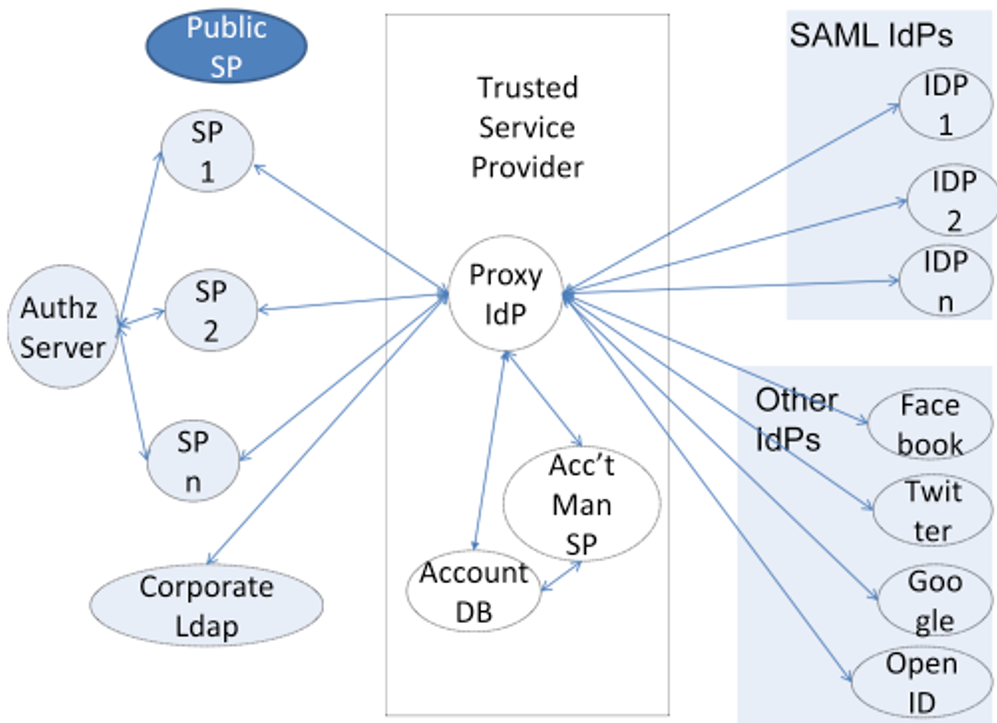
The system functions as a Proxy IdP (Identity Provider).
- The User hits a Service Provider (e.g., the student data system).
- The Service Provider (SP) requests a specific LoA (e.g., "I need LoA 2").
- The Proxy IdP filters the list of social logins. It only shows options that, when combined with the user's linked high-assurance registration, can meet the requirement.
- The Attribute Model ensures that sensitive attributes (like "Student ID") are only released if the current session meets the safety threshold.
Experimental Reality Check: Is Facebook Secure?
Before deploying, the authors stress-tested social providers (circa 2011) for Login LoA:
- Google: Passed for LoA 1. It required 8+ characters and used CAPTCHAs to prevent brute-forcing.
- Facebook/Twitter: Initially failed (LoA 0). Why? Twitter allowed dictionary words like "passwd," and Facebook's "help page" redirects were not as effective as formal rate limiting against automated attacks (JMeter).
- University of Kent: Easily achieved LoA 2 for login and LoA 4 for registration due to strict password entropy (31 bits) and face-to-face passport verification.
User Trials and the "Aha!" Moment
In trials, students were asked to perform tasks ranging from downloading public forms (LoA 0) to accessing private lecture notes (LoA 1).
- The Result: Users who linked their accounts could access restricted files via Facebook. When they tried to access the most sensitive "Student Data System" (requiring LoA 2), the system dynamically warned them or filtered their options, forcing a more secure login method.
- UX Feeback: The biggest takeaway was transparency. Users wanted to see a "Logged in via Facebook" badge to understand which identity was currently active.
Critical Insight & Future Outlook
This paper was ahead of its time in advocating for Identity Escalation. Today, we see this in "Step-up Authentication," where a site lets you browse with a social cookie but asks for FaceID/MFA only when you hit the "Purchase" button.
Limitations: The "Dead Account" problem remains—how does an organization handle it when a student deletes their Facebook but the link persists? Furthermore, the reliance on IdPs to voluntarily publish LoA metadata (SAML Identity Assurance Profiles) remains a hurdle in the fragmented web.
Conclusion: By leveraging the ubiquity of social networks, organizations can radically improve user engagement. The lesson is simple: don't build another silo; wrap the existing ones in a layer of organizational trust.