
ecSSL: Overcoming Error Accumulation in Multimodal Emotion Recognition
Leveraging Unlabeled Data for Emotion Recognition With Enhanced Collaborative Semi-Supervised Learning
This paper introduces Enhanced Collaborative Semi-Supervised Learning (ecSSL) for multimodal emotion recognition, leveraging vast unlabeled data. By combining auditory and visual modalities with a mutual learning strategy between SVM and RNN models, the proposed framework achieves state-of-the-art results on the RECOLA database, significantly improving the Unweighted Average Recall (UAR).
TL;DR
Building robust emotion recognition models is notoriously difficult due to the scarcity of high-quality labeled data. This paper presents Enhanced Collaborative Semi-Supervised Learning (ecSSL), a framework that successfully converts the sea of unlabeled audio-visual data into a training goldmine. By implementing a "re-evaluation" mechanism and a "multi-model collaborative" fusion, the authors managed to break the performance plateau that usually plagues semi-supervised systems.
The "Vicious Circle" of Semi-Supervised Learning
In the world of Semi-Supervised Learning (SSL), we typically use a model trained on a small labeled set to "guess" labels for a larger unlabeled set. These "pseudo-labels" are then fed back into the training loop.
The fatal flaw? Error Accumulation. If the model makes a mistake in iteration 1, that mistake becomes "ground truth" for iteration 2. The noise compounds until the model is essentially learning its own delusions. In affective computing—where human emotion is subtle and subjective—this noise often leads to systems that perform worse than if they hadn't used the extra data at all.
Methodology: The ecSSL Blueprint
The authors tackle this via two structural pillars:
1. The "Enhanced" Re-evaluation Strategy
Unlike traditional self-training that "locks in" pseudo-labeled data, the Enhanced strategy keeps the original unlabeled pool intact. In every iteration, the system re-examines the entirety of the pool. If an updated, more intelligent model realizes a previous label was wrong, it corrects it. This "dynamic correction" prevents the error spiral.
2. Multi-Modality and Multi-Model Collaboration
The system doesn't rely on a single perspective. It uses:
- Multi-View: Splitting features into acoustic (MFCC-related) and visual (Delta features).
- Heterogeneous Models: Combining Support Vector Machines (SVM), which are excellent at global optimization, with Long Short-Term Memory (LSTM-RNN), which excels at capturing temporal context.
The decision to "trust" a sample is governed by Minimum Joint Entropy. Only samples where the Audio-SVM, Audio-RNN, Video-SVM, and Video-RNN reach a high-confidence consensus are added to the training set.

Experimental Proof: Turning Consensus into Performance
The researchers tested ecSSL on the RECOLA database, a benchmark for spontaneous affective interaction.
Key Findings:
- Accuracy Boost: The collaborative approach consistently outperformed simple self-training (Red lines vs. Black/Blue lines in results).
- Diversity of Data: By using "Model-based Collaboration," the system selected more diverse samples (measured by Euclidean distance), covering a wider manifold of human expressions.
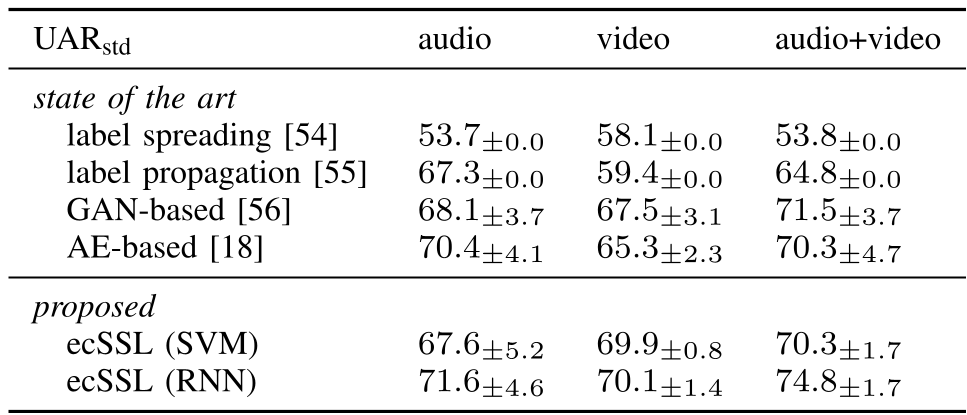
- Superiority over SOTA: As shown in the table below, ecSSL (RNN) achieved 74.8% UAR on audiovisual data, beating Gan-based (71.5%) and Autoencoder-based (70.3%) methods.
Critical Insight: Why Diversity Matters
The paper highlights a fascinating observation: SVMs tend to pick "high-confidence" samples far from the decision boundary, which increases the Diversity of the training set. RNNs, while powerful, can suffer from local minima. By forcing these two architectures to "vote" on unlabeled data, ecSSL harnesses the inductive bias of both, filtering out noise that would trick one but not the other.
Conclusion
The success of ecSSL proves that more data is only better if it is better data. By treating semi-supervised learning as an iterative, collaborative process of re-evaluation rather than a one-way street, we can finally leverage the massive amount of unlabeled human interaction data available in the wild.
Future Outlook: The next frontier involves integrating these collaborative strategies with even larger Transformer-based architectures and self-supervised pre-training (like Wav2Vec 2.0) to see if the "collaborative" benefit scales with model size.