
LFW-Gender: Toughening the Benchmark for Unconstrained Gender Recognition
The LFW-Gender Dataset
The paper introduces LFW-Gender, a standardized, balanced subset of the Labeled Faces in the Wild (LFW) dataset specifically curated for gender recognition. It provides 5,810 manually verified images with a 1:1 male-to-female ratio and establishes a baseline using Deep CNNs and classical ML techniques.
TL;DR
Recognizing gender in the "wild" is harder than it looks. While the famous Labeled Faces in the Wild (LFW) dataset is a staple for face recognition, its inherent class imbalance—skewed heavily toward males—makes it a problematic benchmark for gender classification. This paper introduces LFW-Gender, a balanced, manually verified, and standardized subset designed to provide a "level playing field." By performance testing, the authors prove that when you remove the "easy" bias of class imbalance, the task becomes significantly more difficult, with even Deep CNNs struggling to match previous (inflated) SOTA numbers.
The Hidden Bias in Modern Databases
Most researchers using LFW for gender studies overlook a critical flaw: Imbalance. With over 10,000 male images and fewer than 3,000 female images, a classifier can achieve over 75% accuracy simply by guessing "Male" every time. This creates a "lazy" model that fails to capture the nuanced physiological features of the minority class.
Furthermore, "unconstrained" images often include background clutter (microphones, hats, scenery) that can act as "shortcuts" for neural networks. If most female celebrities in a dataset are photographed on red carpets with specific backgrounds, the model might learn the carpet, not the face.
Methodology: Engineering a Fairer Fight
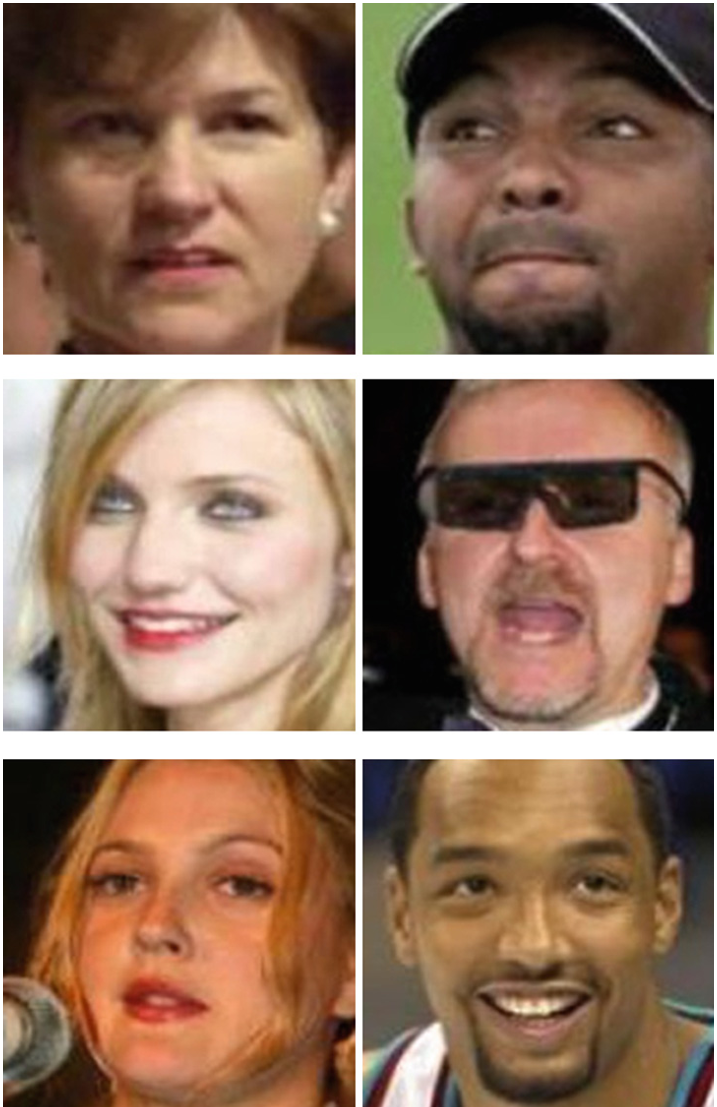
To solve this, the authors transformed the chaotic LFW into the structured LFW-Gender:
- Alignment & Cropping: Using Deep Funneling for alignment and Viola-Jones detectors, they cropped faces to 200x200. This ensures the model focuses on facial morphology rather than environmental context.
- The Balancing Act: They sub-sampled the male class to exactly 2,905 images (matching the female count) and enforced a "one image per person" rule for males to increase intra-class variety.
- Gold-Standard Labeling: Recognizing that names can be unisex (e.g., "Alex" or "Jordan"), they moved beyond simple API-based labeling. Every single image was manually verified by human annotators to ensure the ground truth was 100% accurate.
Technical Deep Dive: Why is it Harder?
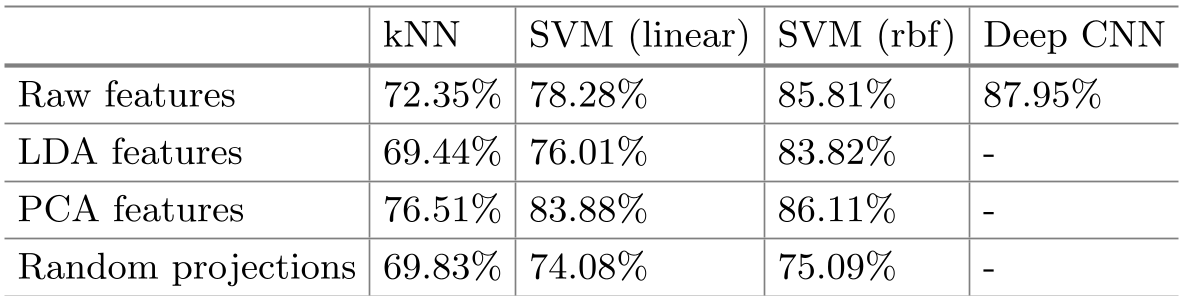
The authors established a baseline using a 6-layer Deep CNN and various classical pipelines (PCA + SVM, LDA, and even Random Projections).
The Performance Gap
Previous studies reported gender recognition rates on LFW as high as 91.27%. However, on the LFW-Gender subset, the same algorithms plummeted:
- Deep CNN: 87.95%
- SVM (RBF) + PCA: 86.11%
- SVM (Linear) + Raw Pixels: 78.28%
This ~4-13% drop in performance suggests that the "success" of previous models was partially a mirage created by the dominant male class. By balancing the dataset, the authors exposed the true difficulty of gender identification in unconstrained poses and lighting.
Critical Insights
- Feature Superiority: Interestingly, if we exclude Deep Learning, PCA (Principal Component Analysis) features outperformed raw pixels and LDA. This suggests that for gender tasks, capturing the global variance of facial structure is more effective than discriminative projections (LDA) which might overfit on small training sets.
- Random Projections: For the first time in gender recognition, the researchers tested Random Projections (based on the Johnson-Lindenstrauss lemma). While it performed worst (~75%), it provided a fast, low-compute baseline that preserved data distances surprisingly well for such a simple method.
Conclusion: A New Baseline for Industry
The LFW-Gender dataset is more than just a subset; it’s a reality check. For developers building HCI (Human-Computer Interaction) or security systems, relying on imbalanced training data is a recipe for failure in real-world deployment.
Future Work: The authors suggest that this dataset is a precursor for context-specific emotion recognition. Since men and women often express emotions differently (e.g., variations in the intensity of positive vs. negative emotions), perfecting gender recognition is the first step toward building truly empathetic AI.
Academic Metadata:
- Dataset URL: https://sites.google.com/site/usmantariq/
- Core Achievement: Successful creation of a 50/50 balanced, manually verified benchmark for unconstrained gender recognition.