
LibrARy: Transforming Cultural Spaces into Collaborative Digital Sandboxes
LibrARy – Enriching the Cultural Physical Spaces with Collaborative AR Content
This paper introduces LibrARy, a Collaborative Augmented Reality (CAR) system built on Unity and Google ARCore, designed to revitalize physical cultural spaces. It enables multiple co-located users to interact with shared 3D virtual objects and digital sticky notes in real-time, achieving seamless synchronization via Cloud Anchors.
TL;DR
LibrARy is an innovative AR platform designed to turn physical libraries into collaborative, augmented environments. By leveraging Cloud Anchors, it allows multiple users to simultaneously view, place, and manipulate 3D objects in a shared physical space. Beyond mere visualization, it introduces "spatial sticky notes" for threaded discussions, effectively bridging the gap between social interaction and digital information.
Background: Beyond the Single-User AR Bubble
While traditional Augmented Reality (AR) has matured in gaming and standalone tools, its potential for Collaborative AR (CAR) remains under-explored in the public sector. The authors identify a "cultural stagnation" in physical libraries and museums. The core insight is that for AR to truly revitalize these spaces, it must move from a solitary experience to a shared social one where users remain grounded in reality but share a "digital layer."
The Problem & Motivation
The challenge in CAR isn't just rendering 3D models; it's spatial consistency. If User A places a 3D bust of Aristotle on a library table, User B must see it in the exact same spot from their own perspective. Prior systems often suffered from drifted alignment or high latency. LibrARy aims to solve the synchronization of the "Reality-Virtuality continuum" (as per Milgram’s taxonomy) for educational settings.
Methodology: The Architectural Core
The system is built on Unity and uses a modular architecture to manage high-level interactions.
1. Spatial Synchronization (Google ARCore)
The backbone of LibrARy is the Cloud Anchor API. When a user hosts an anchor, the system maps the environment's visual features and uploads them to the cloud. Other users then "resolve" this ID to align their local coordinate system with the host's, achieving a "shared world."
2. The Content Pipeline
The system originally interfaced with Google Poly (now transitioning to Sketchfab) for runtime asset loading. This allows the environment to remain lightweight while providing access to thousands of 3D models.
3. Collaborative Metadata
A centralized MySQL database stores:
- Cloud IDs: For spatial alignment.
- Access Rights: Managing who can view or edit specific objects.
- Sticky Note Threads: Enabling asynchronous communication (leaving a digital note for a future visitor).
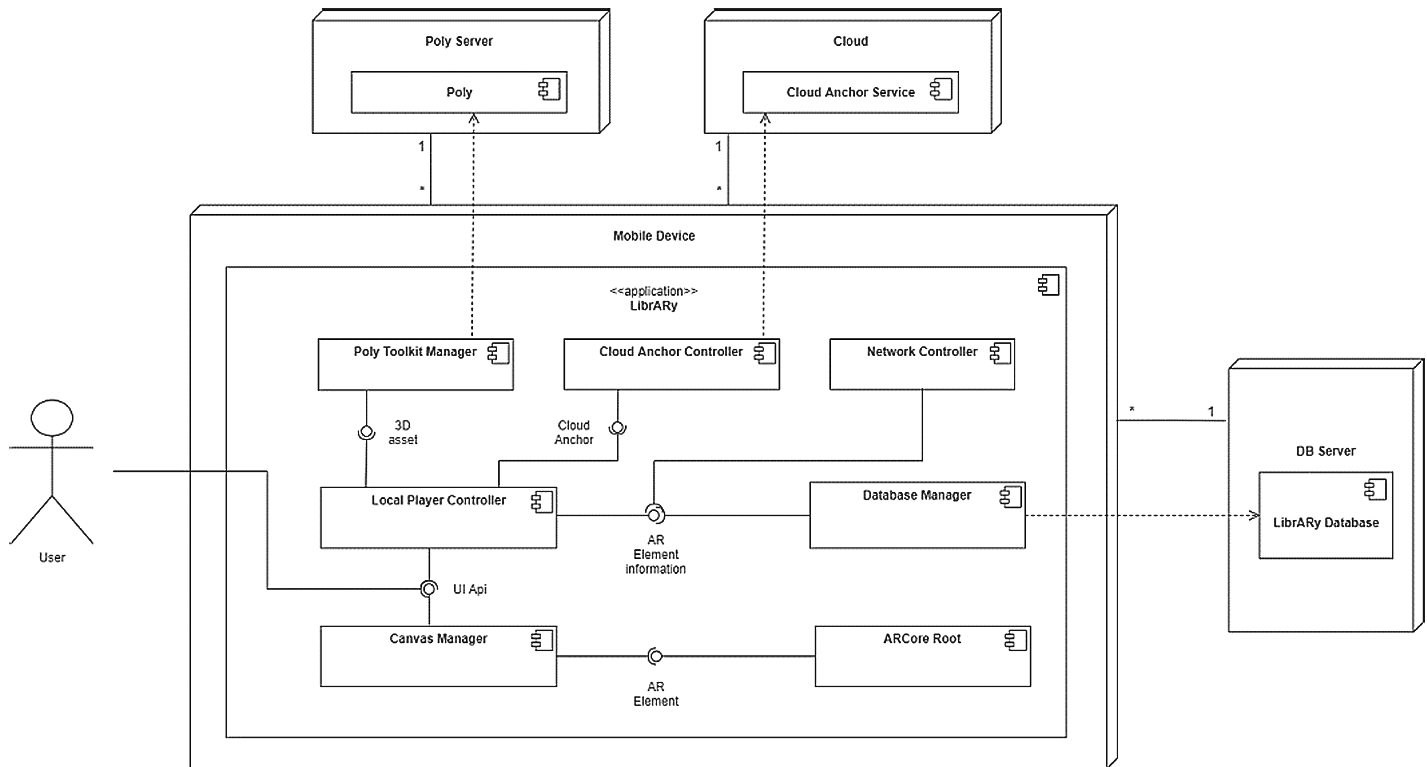 Figure: The component diagram shows the interplay between the ARCore Root, Database Manager, and the Network Manager for real-time state synchronization.
Experiments & Use Cases
The authors propose two primary deployment scenarios:
- The Interactive Library: Visitors leave digital annotations on physical books or exhibits—creating a living history of thoughts.
- The STEM Classroom: Students at the Faculty of Automatic Control and Computers use CAR to visualize abstract complex systems (like 3D molecular structures or architectural models) collectively.
Performance metrics:
The system adheres to Google’s request quotas, supporting:
- 30 Anchor hosts/min: Allowing rapid environmental setup.
- 300 Anchor resolves/min: Ensuring smooth entry for large groups of students/visitors.
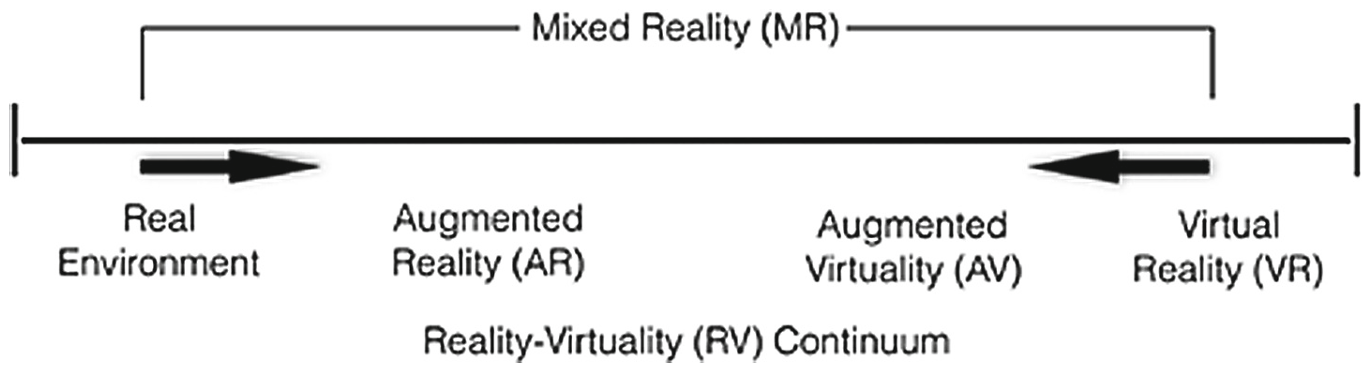 Figure: Contextualizing LibrARy on the Milgram's Continuum—closer to reality than traditional VR, emphasizing grounded social interaction.
Critical Analysis & Conclusion
The Takeaway: LibrARy successfully frameworks how cultural heritage can be "digitized" without losing its physical essence. The inclusion of access rights and threaded notes transforms AR from a visual gimmick into a productivity tool.
Limitations:
- The reliance on the now-deprecated Google Poly highlights the fragility of relying on external 3D libraries.
- The system is currently limited to handheld devices (tablets/smartphones), which can cause "gorilla arm" fatigue during long sessions.
Future Outlook: The next logical step is porting LibrARy to Head-Mounted Displays (HMDs) like HoloLens or Magic Leap to allow for hands-free interaction, which would further merge the digital and physical workflows in academic research.