
The Lies We Tell: Decoding the Psychology of Facebook Interaction Profiles
The lies we tell and what they say about us: Using behavioural characteristics to explain Facebook activity
This study investigates user interaction styles on Facebook, identifying three distinct psychological profiles—Broadcasters, Communicators, and High Interactors. By applying regression and cluster analyses to behavioral data from 113 students, the researchers mapped how personality traits like extraversion and risk-taking correlate with different patterns of online deception and impression management.
TL;DR
Not all social media users are looking for the same thing. This study reveals that Facebook users split into three distinct psychological camps: Broadcasters, who use the platform for high-risk self-promotion; Communicators, who focus on maintaining existing friendships; and High Interactors, who do both. Crucially, your "group" determines how you lie—whether it's to boost your ego or to act as "social oil" for your friends.
Background: The Digital Mirror
In the early days of social media research, a debate raged: does the internet make us more "ourselves," or does it encourage us to build a hyper-polished, deceptive version of our lives? This study moves past the "what" and asks "who." By looking at 113 active users, the researchers aimed to see if interaction styles (Broadcasting vs. Communicating) could explain the messy reality of online behavior.
The Three Archetypes of Social Networking
The most striking finding was the emergence of three clear profiles through cluster analysis.
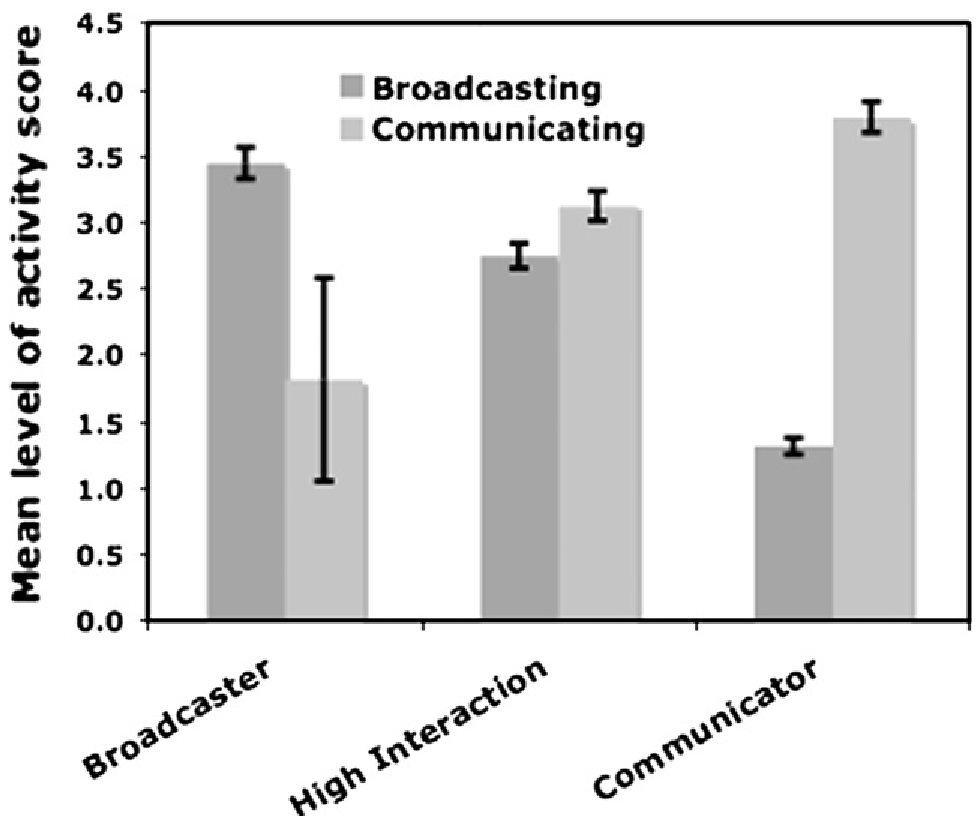
1. The Broadcaster: The Self-Promoter
Broadcasters operate on a "one-to-many" frequency. Their goal is visibility.
- Traits: High risk-taking, extraversion, and a higher propensity for Mild Social Deviance (MSD).
- Interaction Quality: Surprisingly low. They talk to a wide net of people they don't necessarily like or know well.
- Deception Style: They tell self-oriented lies. These are "aggrandizing" lies meant to make the individual look more successful, attractive, or interesting than they are.
2. The Communicator: The Relationship Maintainer
Communicators use Facebook as a digital extension of their living room.
- Traits: Lower risk-taking and more cautious.
- Interaction Quality: High. They engage with a small, "anchored" circle of close friends.
- Deception Style: They tell other-oriented lies. Think of these as "white lies" or "social oil"—stating they liked a photo or a post just to keep the social gears turning and avoid conflict.
3. The High Interactor: The Power User
This group bridges the gap. They have high levels of both broadcasting and communicating. While they are keen to self-project, they remain more uncomfortable with the risks of lying than the pure Broadcasters.
Methodology: Beyond Self-Reports
The researchers didn't just ask users if they lied. They used a sophisticated battery of tests:
- Eysenck Personality Profiler (EPP-S): To measure the "Big Three" traits plus risk-taking.
- DePaulo’s Taxonomy of Lies: To categorize the intent behind deceptions.
- Regression Analysis: This revealed that Interaction Quality was actually a better predictor of broadcasting behavior than sex or pure extraversion.
Deep Insight: Why Does This Matter?
The study validates both the Hyperpersonal Model (which explains the Broadcaster) and the Anchored Relationship Theory (which explains the Communicator).
The "Broadcaster" behavior mirrors what we see in anonymous environments—a desire to edit the self into something better. However, because Facebook is "non-anonymous" (your real friends see it), the risk of being caught in a lie is high. Broadcasters are simply people who are psychologically more comfortable with that risk.
Conclusion & Future Outlook
This work provides a foundational "behavioral coordinate system" for social media. It suggests that platforms should not be viewed as monolithic; a single feature (like a "Status Update") is used as a megaphone by some and a private letter by others.
Limitations: The study focused on UK students in 2011. In today's era of "Influencer Culture," the Broadcaster profile has likely become even more specialized, and the "white lies" of Communicators have moved into encrypted spaces like WhatsApp.
Takeaway: The next time you see a post that feels "too good to be true," you're likely looking at a Broadcaster in their natural habitat, using deception not to hurt, but to build a digital "me" that their risk-averse counterparts wouldn't dare to dream of.