
Beyond Individual Use: How Life Satisfaction Catalyzes the "We-Intention" on Facebook
Does Life Satisfaction influence the intention (We-Intention) to use Facebook?
This study investigates the psychological and sociological drivers of Facebook usage among Brazilian youth by extending the Social Influence and Uses & Gratifications models. It introduces "Life Satisfaction" as a key independent variable to explain "We-Intention" (the collective intention to use a social platform), achieving a predictive explanatory power of R² = 0.36.
TL;DR
Why do we keep coming back to Facebook? This study shifts the focus from individual utility to "We-Intention"—our collective commitment to engage in a social environment. By analyzing 1,111 Brazilian users, the research reveals that Life Satisfaction serves as a vital psychological fuel that strengthens our social bonds (Social Identity and Group Norms), which ultimately drives our intention to stay active in digital communities.
Contextual Positioning
This work serves as a critical cultural bridge in SNS literature. While previous models were validated in Hong Kong and the US, this study adapts these theories for the Brazilian context, characterized by high collectivism. It sits at the intersection of psychology (Life Satisfaction) and sociology (Social Influence), refining our understanding of why social networks transition from mere tools to essential "virtual communities."
The "Why": Motivation and Cultural Nuance
Most SNS research treats usage as a solitary decision based on utility or fun. However, the authors argue that for Brazilians, Facebook is a space for establishing relationships where the "feeling of belonging" is paramount.
The central insight is the Life Satisfaction Paradox: being satisfied with life doesn't necessarily make you use Facebook directly, but it makes you more susceptible to social influences. If you feel good about your life, you are more likely to internalize the norms of your group and identify with your digital peers, thereby increasing your "We-Intention."
Methodology: The Integrated Model
The authors extended the Cheung et al. (2011) model by integrating four theoretical pillars:
- Life Satisfaction (LS): The subjective judgment of one's quality of life.
- Social Influence (SI): Comprising Subjective Norms, Group Norms, and Social Identity.
- Uses and Gratifications (U&G): Focuses on Entertainment and Interconnectivity.
- Social Presence (SP): The feeling of being "there" with others.
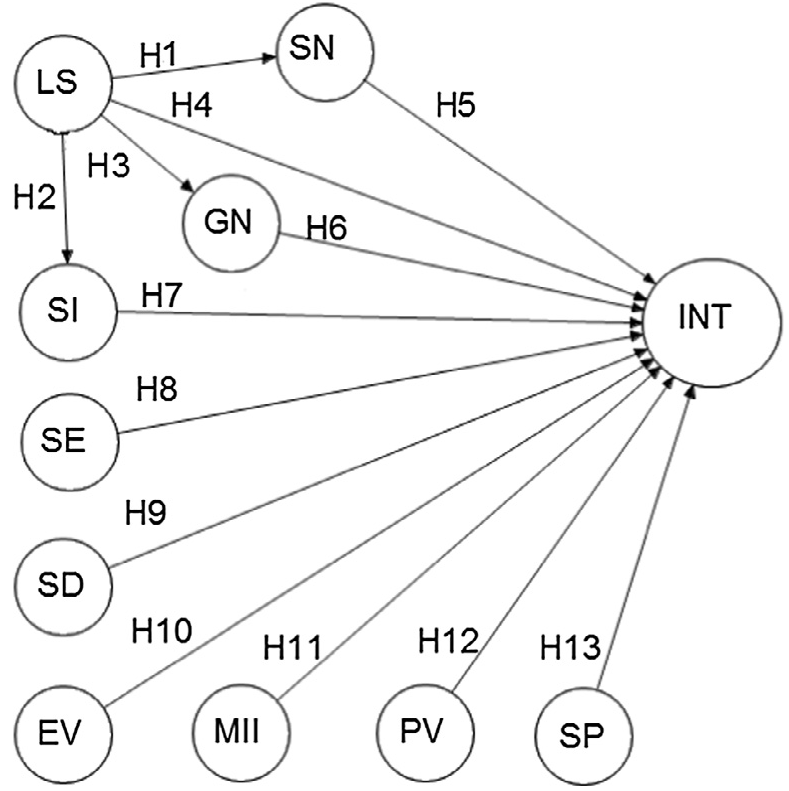 Figure 1: The conceptual framework showing the pathways from Life Satisfaction to We-Intention.
Key Findings and Battle Records
Using PLS-SEM (Partial Least Squares Structural Equation Modeling), the researchers found that:
- Social Identity is the strongest predictor: The knowledge of belonging to a group is the primary driver of Facebook use in Brazil (β=0.252).
- Life Satisfaction as a Mediator: LS significantly influences Subjective Norms (t=4.68) and Social Identity (t=9.09).
- The Rejection of Social Presence: Unlike in Asian studies, the "Social Presence" hypothesis was rejected for Brazilians, who prioritize actual interconnectivity and fun over the abstract feeling of "presence."
 Table 1: Path coefficients and hypothesis testing results showing supported vs. non-significant (NS) paths.
Critical Analysis & Conclusion
Takeaway
The study proves that social networks in Brazil are governed by informal rules and social ties. To engage this audience, one must tap into their desire for status, interconnectivity, and collective identity.
Limitations
- Platform Specificity: The results are concentrated on Facebook and may not translate to TikTok or ephemeral platforms like Snapchat.
- Social Desirability Bias: Variables like "Social Enhancement" might have been underreported as users may not want to admit they use Facebook to "look better" than others.
Future Outlook
As digital interactions become increasingly public, understanding the "engine" of social influence is critical. Future research should leverage Social Data Mining to see if these self-reported intentions match actual behavioral patterns (Big Data) across different age groups and economic tiers.