
Lighting Up Copper: The Strategic Evolution of DSL from Kilobits to Gigabits
15242_Lighting up copper [History of Communications].
This paper provides a 30-year retrospective on the evolution of High-Speed Digital Subscriber Line (DSL) technology, specifically detailing the transition from voiceband modems to multi-gigabit copper connections. Authored by John M. Cioffi, the "father of DSL," it highlights the introduction of Discrete Multi-Tone (DMT) modulation and Dynamic Spectrum Management (DSM) as the key breakthroughs that enabled DSL to achieve SOTA status in residential broadband.
TL;DR
This retrospective by John M. Cioffi chronicles the "miracle" of DSL—a technology that was repeatedly pronounced dead but survived through three decades of technical breakthroughs. By replacing simple single-carrier modulation with Discrete Multi-Tone (DMT) and introducing Dynamic Spectrum Management (DSM), engineers squeezed gigabit performance out of century-old copper wires, transforming the global telecommunications landscape.
Contextual Positioning
This is a seminal "History of Communications" paper. It serves as the definitive record of the "Line Code Wars" between single-carrier (CAP/QAM) and multi-carrier (DMT) philosophies, written by the academic and industrial leader who successfully championed the latter.
The Core Friction: Why Copper is "Difficult"
The telephone infrastructure consists of billions of twisted-pair copper wires originally designed for 4 kHz analog voice. When engineers tried to push high-speed data through them, they encountered two massive walls:
- Frequency-Selective Fading: Different loops have wildly different attenuation patterns.
- Crosstalk (NEXT/FEXT): Signals from one wire "leak" into another, creating a chaotic noise environment.
Earlier digital attempts, such as T1 and ISDN, were either too range-limited or too slow because they used inefficient line codes (like AMI) that ignored the underlying physics of the channel.
Methodology: The DMT Revolution
The breakthrough came when the industry moved away from treating the copper wire as a single pipe. Instead, Discrete Multi-Tone (DMT) modulation treats the wire as hundreds of narrow, independent sub-channels.
1. Water-Filling and Bit-Swapping
DMT allows for "water-filling," a Shannon-theoretic approach where more data is sent through frequencies with high SNR, and little to no data is sent through "noisy" frequencies. This is visualized in the "multi-bowl" theory described in the paper.
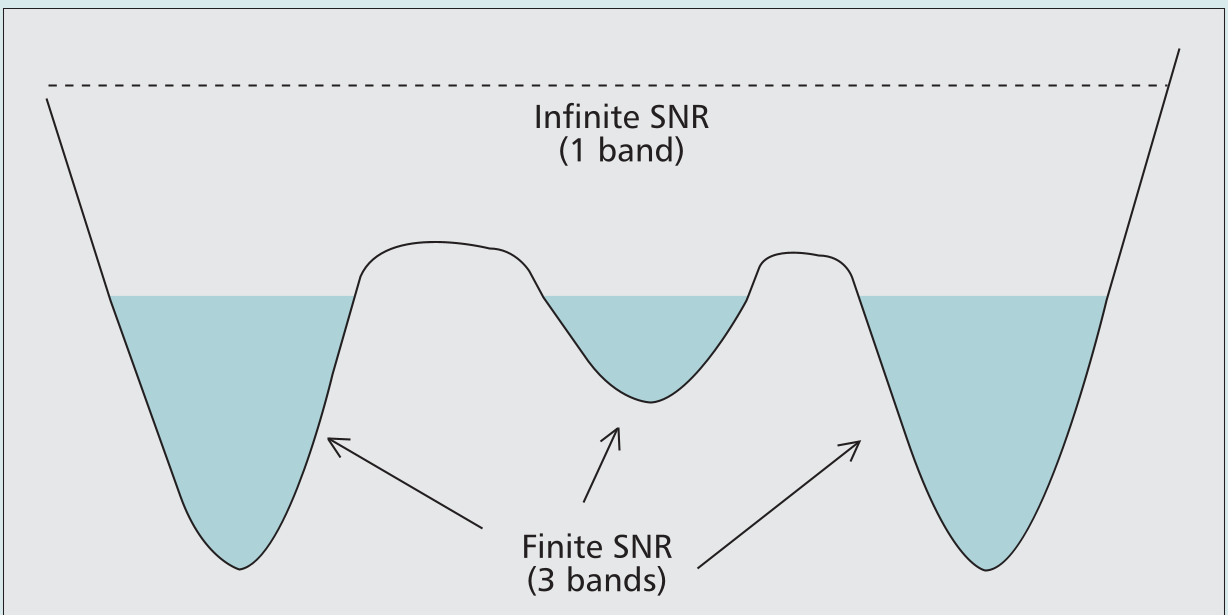 Note: Single-carrier systems essentially assume a "single bowl" of noise, whereas DMT correctly identifies and exploits the multiple frequency gaps.
2. Dynamic Spectrum Management (DSM)
DSM Level 3, or Vectoring, essentially treats a bundle of copper wires as a single MIMO (Multiple-Input Multiple-Output) system. By coordinating the signals across different pairs, the system can "cancel out" the crosstalk interference (FEXT), effectively making the wire "quiet" again.
The "ADSL Olympics": Data over Politics
One of the most dramatic segments of the paper describes the 1993 "ADSL Olympics" hosted by Bellcore. Despite heavy political pressure from industry giants like AT&T (supporting CAP), the DMT prototype from Amati (Cioffi’s startup) demonstrated overwhelming superiority.
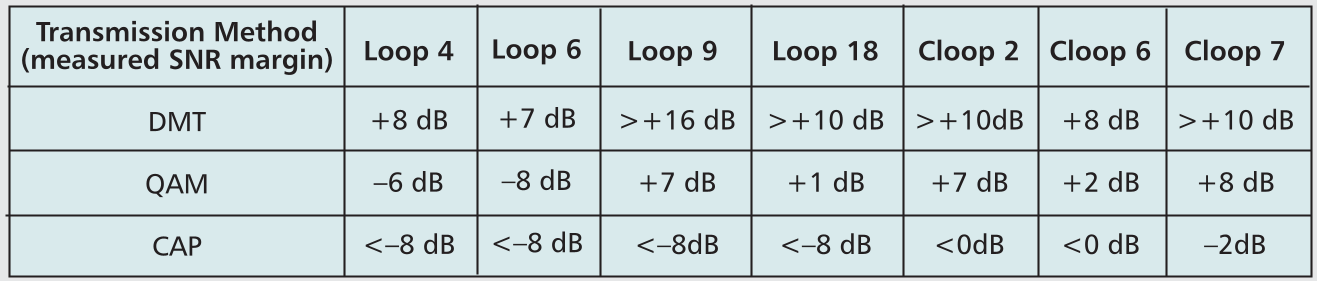 The Olympic results: DMT consistently maintained positive SNR margins on loops where CAP and QAM failed completely (negative margins).
Deep Insight: Why Multi-Carrier Won
As Cioffi notes, single-carrier proponents relied on an infinite SNR approximation (). In the reality of DSL, SNR can often drop to zero at certain frequencies. In these "unused" bands, the simple single-carrier models break down. Multi-carrier (DMT) is the only architecture that respects the Paley-Wiener criteria for realizable filters in discontiguous bands.
Conclusion and Future Outlook
DSL saved the fixed-line industry. Today, it provides the "backhaul" for the very wireless networks (Wi-Fi/5G) that were supposed to replace it. The paper concludes with a powerful reminder of economic practicality: it is often better to ask "What can we do with what we have?" than to spend billions on new infrastructure that might not be necessary.
Takeaways
- Inductive Bias: Incorporating the physics of frequency-selective fading into the modulation design (DMT) was more effective than trying to "brute-force" a single carrier.
- Managed Networks: Transitioning from autonomous modems to managed DSM networks was the key to scaling from 1.5 Mbps to 1 Gbps.