
Lightweight Blockchain for VSNs: Bridging Local Consensus and Global Trust
15909_Lightweight Blockchain Consensus Protocols for Vehicular Social Networks.
This paper introduces lightweight blockchain consensus protocols tailored for Vehicular Social Networks (VSNs), eliminating the need for Proof-of-Work puzzles or pre-existing cryptocurrencies. The system utilizes a hybrid "private-public" chain architecture to achieve consensus within local vehicle groups and synchronize results with infrastructure-based servers.
TL;DR
This research presents a novel, resource-efficient blockchain framework for Vehicular Social Networks (VSNs). By discarding the energy-intensive Proof-of-Work (PoW) in favor of a hybrid Private-Public chain architecture, the protocol allows vehicles to reach consensus on local events (like accidents or congestion) in seconds, even with unreliable wireless links, and securely upload these "proofs" to a global ledger.
Back to Basics: Why Standard Blockchain Fails in Traffic
Standard blockchains are built for the internet—where nodes are static and power is plentiful. In a vehicular environment, we face three deal-breakers:
- Computational Constraints: Vehicles cannot afford to "mine" PoW puzzles while performing safety-critical tasks.
- Network Volatility: V2V (Vehicle-to-Vehicle) communication is notoriously unreliable ().
- Latency: A traffic accident consensus cannot wait 10 minutes (Bitcoin's block time); it needs to be settled in milliseconds.
The Hybrid Strategy: Private & Public Chains
The authors solve this by splitting the problem into two distinct layers:
1. The Private Chain (Local Group Agreement)
When an event occurs, vehicles in the vicinity form a local group. They use a probabilistic voting mechanism (Algorithm 1 & 2 in the paper) to reach consensus. Instead of complex math, they rely on digital signatures and repeated broadcast rounds to overcome message loss.
2. The Public Chain (Global Persistence)
Once the local group agrees, the results must be stored permanently. To save bandwidth, all nodes don't upload the data. Instead, Universal Hash Functions are used to randomly elect "proposers" to send the consensus to a Roadside Unit (RSU).
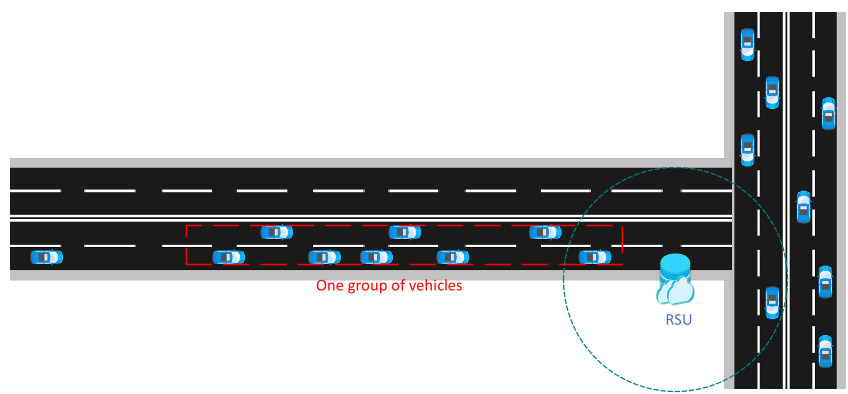 Fig 1: The hierarchical structure where local events are bundled into blocks on the RSU-managed public chain.
Mathematical Rigor: The Power of Probability
The core "magic" lies in Theorem 1 and Lemma 3. The authors don't just hope the messages get through; they use the Chernoff Bound to calculate exactly how many rounds () are needed to guarantee that all non-malicious nodes see the same result with a failure probability () lower than .
This formula ensures that even if 49% of the vehicles are "bad" (malfunctioning or malicious), the "good" majority will still prevail.
Performance: 2 Seconds to Truth
Simulations using real-world traffic data from Cologne, Germany, demonstrate that the protocol is highly responsive:
- Speed: In a group of 100 vehicles, consensus is reached in approximately 20 rounds (roughly 2 seconds).
- Reliability: Even if the probability of a message being received () is as low as 0.7, the protocol remains robust.
- RSU Density: The study found that if 36% of intersections have RSUs, 90% of vehicles can upload their data within 0.6 hours—perfect for insurance and police records.
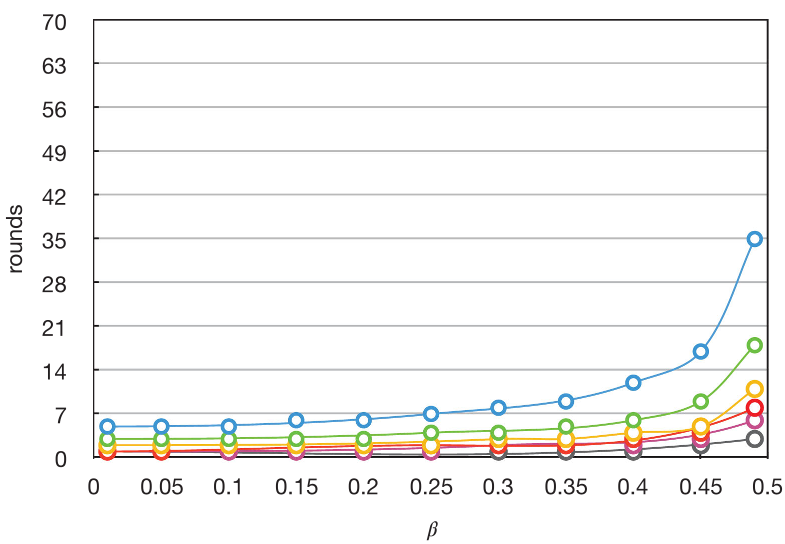 Fig 2: Comparison between theoretical "worst-case" rounds and average simulation performance.
Critical Insight & Future Outlook
The brilliance of this work is its realism. It acknowledges that sensors fail and signals drop. By treating consensus as a probabilistic game rather than a deterministic certainty, it creates a system that is actually deployable on current DSRC/V2X hardware.
However, the current model assumes a binary decision tree. Future iterations will need to handle complex, multi-variable metadata (e.g., varying degrees of accident severity). As we move toward fully autonomous "social" networks of cars, protocols like this will be the "legal framework" that allows machines to trust one another on the open road.