
AssIuT-IoT: Bridging the Gap in IoT Education with Remote Federated Testbeds
18929_Design and Operation of a Lightweight Educational Testbed for Internet-of-Things Applications.
The paper introduces AssIuT-IoT, a lightweight, remotely accessible educational testbed for Internet-of-Things (IoT) applications. Utilizing the Experiment as a Service (EaaS) model, it allows students to interact with real hardware nodes (Arduino, ESP8266, Xbee) and is federated within the CRC II consortium to share resources across universities.
TL;DR
AssIuT-IoT is a specialized educational testbed that provides remote access to physical IoT hardware. Unlike massive research-grade testbeds, it uses accessible components like Arduino and ESP8266, offering an "Experiment as a Service" (EaaS) model. It enables students to design, code, and deploy IoT topologies (WiFi/ZigBee) remotely while providing real-time data visualization and debugging tools.
The Motivation: Why Current Testbeds Fail Students
The IoT explosion has led to the creation of impressive testbeds like FIT-IoT, which houses over 1,500 nodes. However, for a student or junior researcher, these platforms present a "barrier of complexity." They often require knowledge of complex Real-Time Operating Systems (RTOS) and use hardware that isn't easily found in a local electronics store.
The authors of AssIuT-IoT identified a critical "missing middle": a platform that is sophisticated enough to mirror real-world challenges (like network latency and security overhead) but simple enough to be replicated in a student's dorm room.
Methodology: The "Relay" Architecture
The testbed is built on a 5-layer IoT model (Things, Sensors, Nodes, Communication, and Cloud). What makes it technically interesting is the federation strategy.
1. Hardware Selection
- Processing: Arduino Mega 2560 (Easy to program, widely available).
- Communication: Dual-stack capability with ESP8266 (WiFi) and Xbee (ZigBee).
- Sensors: DHT-11 for temperature and humidity.
2. The Control Portal
The backbone of the system is a Django-based server that manages Authentication, Authorization, and Accounting (AAA). To solve the problem of physical port limitations on a single server, the authors utilized Raspberry Pis as intermediate relays.
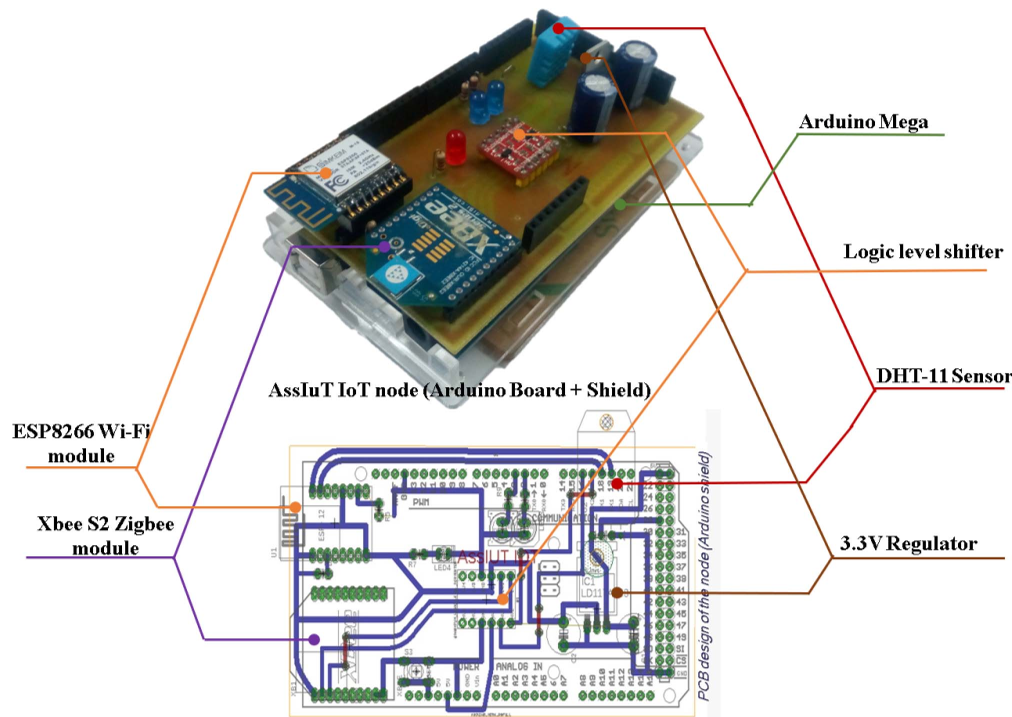 Figure: The control portal architecture showing the interaction between users, the middle manager, and the hardware nodes.
By using RPis, the testbed can scale across geographic locations. The RPi handles the local AVRDude programming commands and relays serial debugging messages back to the user via the web interface.
Critical Analysis: WiFi vs. ZigBee in IoT
One of the core educational values of this testbed is the ability to compare communication protocols. In the paper's experiments, the authors demonstrate a fundamental IoT trade-off:
- WiFi (ESP8266): Efficient for high data rates but suffers from high energy consumption and limited connection slots (max 5 simultaneous TCP connections in station mode).
- ZigBee (Xbee): Slower, but supports mesh networking and has significantly lower energy requirements, making it ideal for battery-powered sensor nodes.
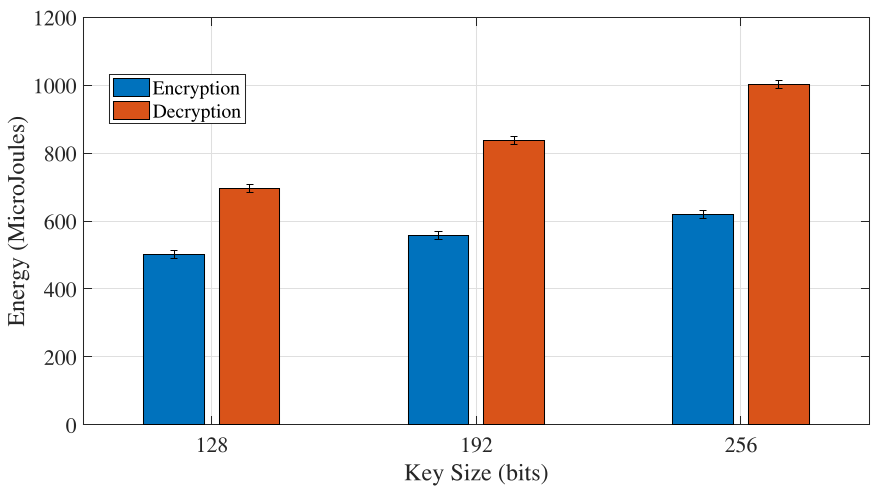 Figure: Energy consumption comparison—ZigBee shows a clear advantage in energy efficiency despite lower raw speeds.
The researchers also explored the "Security Tax"—the processing overhead of encryption. They found that implementing AES-128 encryption on an 8-bit MCU is feasible, tasks that take only a fraction of the time compared to the actual wireless transmission of data. This teaches students that "communication is the bottleneck, not computation."
Results & Impact
The testbed was stress-tested during a student competition involving nine teams from various universities. Students completed missions ranging from basic WiFi data logging to advanced encrypted mesh networks.
Key metrics from the evaluation include:
- Server Load: Even with multiple users, the i7-based control server remained under 5% CPU utilization.
- Latency: The system provides near real-time serial monitoring, essential for remote debugging.
- Reproducibility: Because the hardware is "off-the-shelf," students could take their validated code from the testbed and build physical prototypes immediately.
Conclusion and Future Work
AssIuT-IoT settles a unique niche in the academic landscape. It doesn't try to be the biggest testbed; it tries to be the most usable. By leveraging Slice-based Federation Architecture (SFA), it joins a larger ecosystem (CRC II), allowing students to jump between IoT, FPGA, and SDR (Software Defined Radio) resources with a single login.
Limitations: Currently, the hardware is static (no mobility). Future iterations could benefit from integrating mobile nodes (robots or drones) to test dynamic routing protocols in real-time.
For educators, the takeaway is clear: the future of engineering education lies in Federated Labs—where specialized hardware is shared, but the learning is global.