
Efficient Privacy in the Smart Grid: A Lightweight Lattice-Based Approach
10780_A Lightweight Lattice-Based Homomorphic Privacy-Preserving Data Aggregation Scheme for Smart Grid.
This paper proposes a lightweight, lattice-based homomorphic privacy-preserving data aggregation scheme for Smart Grids. By enabling smart household appliances to aggregate readings internally without initial Smart Meter (SM) involvement, it achieves a secure, low-latency architecture that maintains consumer privacy and data integrity against honest-but-curious entities.
TL;DR
As the Smart Grid evolves, the fine-grained electricity consumption data of our homes has become a double-edged sword: essential for grid efficiency but a goldmine for privacy-intruding eavesdroppers. This paper introduces a lightweight lattice-based homomorphic encryption scheme that allows smart appliances to aggregate data among themselves. The workflow bypasses the heavy computational costs of traditional encryption, making it ideal for low-power IoT devices while keeping human habits invisible to even the Utility Company.
Problem & Motivation: The "Heavy" Cost of Privacy
In a typical Home Area Network (HAN), the Smart Meter (SM) acts as the bridge to the Utility's Control Center (CC). Current SOTA privacy solutions usually fall into two categories:
- Noise Addition (Differential Privacy): Reduces accuracy and makes demand forecasting difficult.
- Public-Key Cryptography (Paillier/ABE): Secure, but computationally expensive. The "exponentiation" operations in these schemes can cause delays of hundreds of milliseconds, which adds up quickly as the number of devices grows.
The authors' insight is to shift the paradigm: Why rely on the Smart Meter for everything? By utilizing a lattice-based approach—which relies on simple vector additions—the encryption becomes efficient enough to run on a cheap Raspberry Pi embedded in a toaster or an AC unit.
Methodology: Vector Space Homomodphism
The core of this work is the transition from number-theoretic problems (like factoring) to the Hidden Lattice Problem (HLP).
1. Collaborative Aggregation
Instead of every appliance talking to the SM, the system defines a rotating "Aggregator" appliance. In each round, appliance sends its cipher to the aggregator . Because the encryption is additively homomorphic, the aggregator can sum these values without ever knowing what the individual readings are.
2. The Lattice Cryptosystem
The encryption uses a structure where the message is obscured by "hard noise" () and several "soft noise" matrices ().
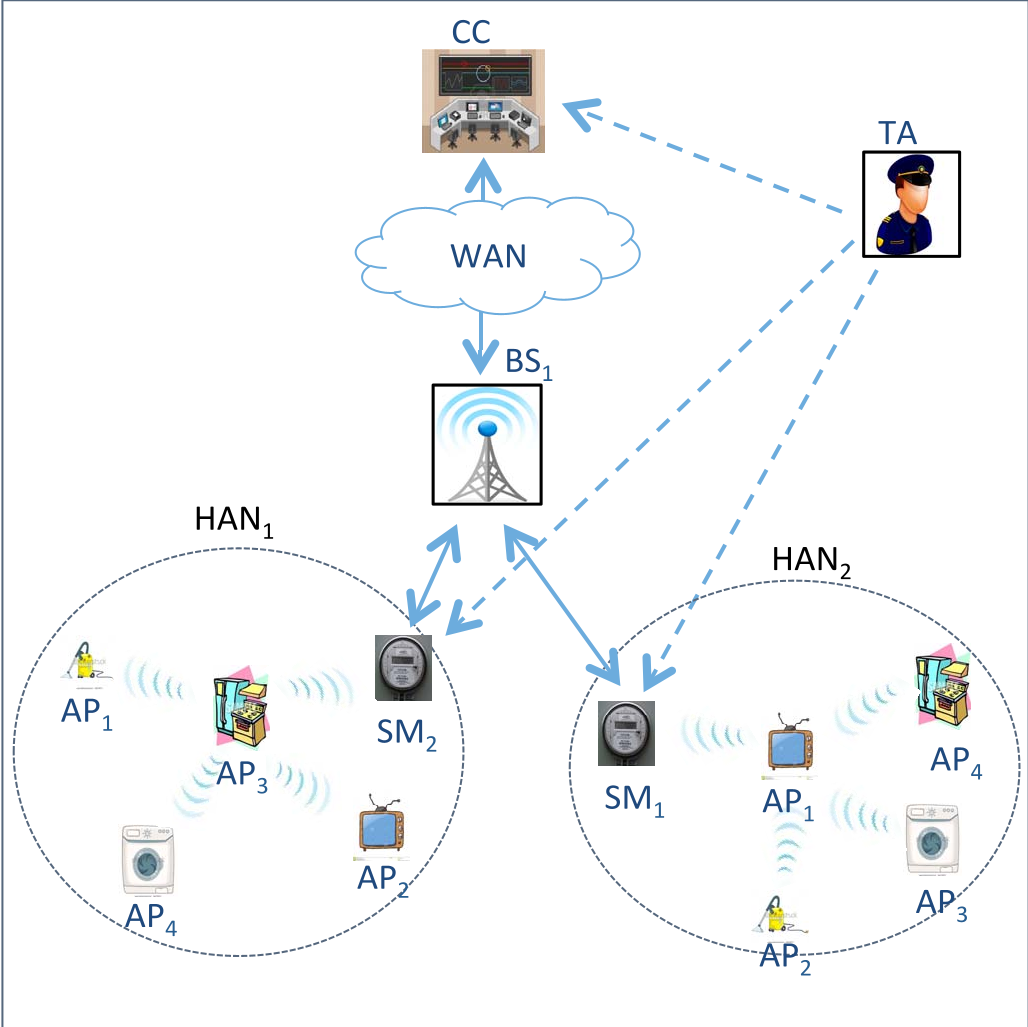 Figure 1: The proposed network hierarchy from Appliances to the Control Center.
The encryption formula requires only matrix multiplications and additions. This "lightweight" nature is the secret sauce that enables high performance on restricted-resource hardware.
Experiments & Results: Slashing Latency
The authors validated their scheme against the traditional Paillier-based homomorphic encryption (a common benchmark in Smart Grid privacy).
Scaling with Appliances
As the number of appliances in a home increases from 2 to 20, the Paillier scheme's delay skyrockets. In contrast, the proposed lattice scheme remains relatively flat.
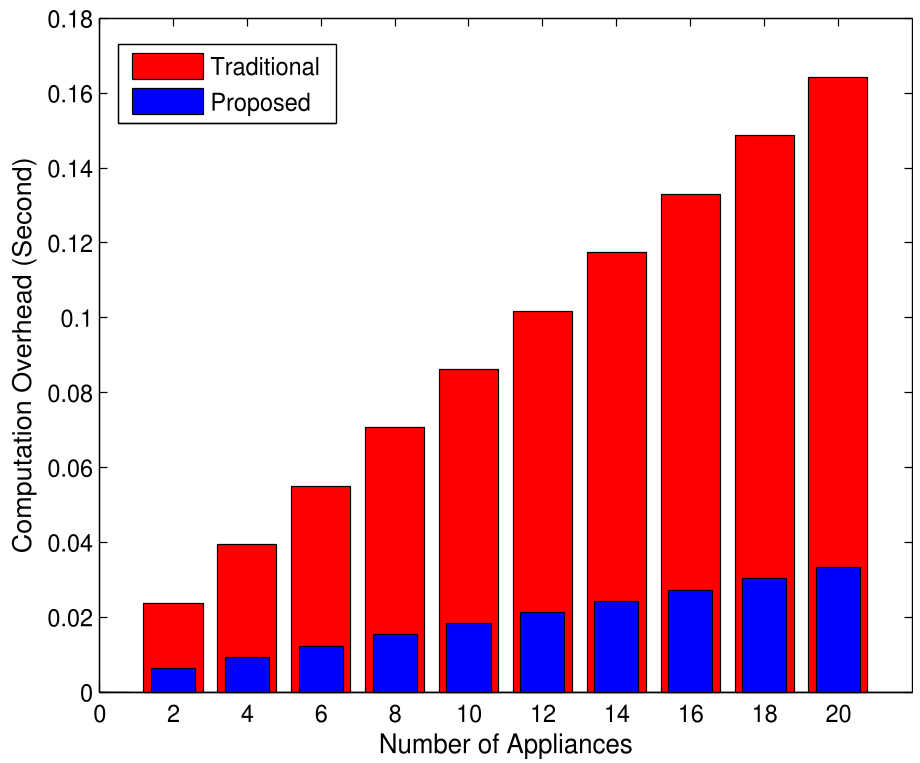 Figure 2: Computation delay vs. number of appliances. Note the significant gap between the proposed scheme (lower) and traditional methods.
Cluster-Level Performance
When scaling to 100 homes (HANs) over a 24-hour period, the total computational duty for the area reaches only 90 seconds, whereas traditional methods would keep the processors busy for over 7.5 minutes (450 seconds). This 80% reduction is critical for real-time demand response in smart cities.
Critical Analysis & Conclusion
Takeaway
This paper effectively demonstrates that lattice-based cryptography is not just a theoretical "post-quantum" luxury; it is a practical tool for the IoT era. By moving aggregation into the HAN and simplifying the math to vector spaces, it achieves "Privacy by Design" without the "Hardware Tax."
Limitations & Future Work
While the computation is lightweight, the Public Key size in lattice-based schemes can be larger than RSA or Elliptic Curve keys. The authors note that the public parameter size depends on the lattice dimension (). Future iterations might explore Ring-LWE variants to further compress these keys. The authors also plan to investigate how Electric Vehicles (EVs), acting as both loads and storage units, can be integrated into this privacy framework.